Households that regularly use a jar
For regular breakfasts and snacks, the jar size should match the amount your household actually gets through. 750 g options feature in the ranges listed by Auchan, E.Leclerc and Aldi, among others.


For the new school year, choose a pack size your household will genuinely use: a large jar suits regular consumption, while an individual portion is better for an on-the-go snack. Before settling on a recipe, compare the sugars per 100 g and check the ingredients and any ‘may contain’ warnings if someone needs to avoid certain allergens.
For regular breakfasts and snacks, the jar size should match the amount your household actually gets through. 750 g options feature in the ranges listed by Auchan, E.Leclerc and Aldi, among others.
To compare a standard recipe with a reduced-sugar or no-added-sugar option, check the ‘of which sugars’ line per 100 g. These claims do not mean the same thing.
The presence of hazelnuts, milk or soya varies between the recipes listed by retailers. Check the ingredients list and any ‘may contain’ warnings on your chosen jar before considering its size.
First rule out any recipes containing ingredients you need to avoid. Then compare the sugar content and choose an amount that suits how often you use it.
| What to consider | What to check | Who this matters to |
|---|---|---|
| Jar size | The net weight and how much your household will actually use. | If we have breakfast and snacks regularly, I want a pack size that suits our consumption. Around 33% of consumers would prioritise this. |
| Sugars | The ‘of which sugars’ line per 100 g and the precise meaning of any claims on the jar. | When comparing two recipes, I want to know their declared sugar content rather than relying on a single claim. Around 27% of consumers would make this their priority. |
| Ingredients and traces | The ingredients list and any ‘may contain’ warnings for the product you choose. | If someone in my household needs to avoid an ingredient, I need to be able to rule out any unsuitable recipe. Around 20% of consumers would put this check first. |
| Storage | The storage and after-opening instructions for the specific product. | If we use only a little spread, I prefer an amount we can finish while following the instructions on the jar. This would matter most to around 20% of consumers. |
A 750 g jar may not be right for a household that rarely uses chocolate spread.
Estimate how much you use across breakfasts and snacks, then read the storage instructions for the product you choose.
These claims are not interchangeable. Auchan’s product listing for Lucien Georgelin ‘no added sugar’ chocolate spread still shows 8.5 g of sugars per 100 g.
Compare the ‘of which sugars’ line per 100 g for the recipes you’re interested in, and check the exact claim on each pack.
According to Santé publique France, displaying Nutri-Score is voluntary. If it appears, it does not replace checking the nutritional information and ingredients; if it is absent, that alone is not enough to judge a recipe.
If the jars you’re comparing display it, use it as an additional point of information when comparing products in the same category.
A claim about sugars or palm oil does not, by itself, tell you whether a product contains hazelnuts, milk, soya or traces of these. E.Leclerc’s listing for ECO+ 750 g chocolate spread mentions all three of these ingredients.
If this affects someone in your household, check the ingredients and any trace warnings on the pack you actually buy.
Hazelnut and cocoa spread available in several pack sizes.
Retailer offering, among other products, a 400 g jar of Carrefour Classic’ chocolate spread.
Retailer listing ECO+ hazelnut-flavoured spread in a 750 g jar.
Retailer offering spreads in different sizes and recipes, including Pouce 750 g.
Retailer offering, among other products, Tartichoc hazelnut spread in a 750 g pack.
This 25 g portion of chocolate spread is handy for an on-the-go snack. If you’ll be having breakfast and snacks at home regularly, also compare this size with the amount your household usually uses.
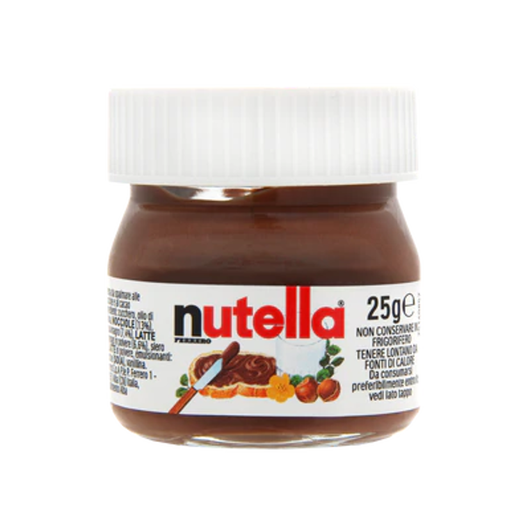 Image unavailable
The 25 g individual portion is a handy option for an on-the-go snack, unlike a large family-sized jar.
Before choosing it, check the sugars per 100 g, the full ingredients list and any ‘may contain’ warnings on the packaging.
No. Santé publique France says displaying it is voluntary. If it appears, you can use it to compare products in the same category, while also checking their nutritional information and ingredients.
No. Auchan’s product listing for Lucien Georgelin ‘no added sugar’ chocolate spread shows 8.5 g of sugars per 100 g. Check the ‘of which sugars’ line for the product you’re thinking of buying.
Check the ingredients and any trace warnings on the specific jar you choose. Products listed by Auchan and E.Leclerc show that the presence of hazelnuts, milk and soya needs to be checked product by product; a claim about sugars will not answer this question.
Follow the instructions on its own label. Auchan’s listings for Pouce and Jardin Bio étic say not to refrigerate these products; the Jardin Bio étic listing also recommends consuming it within a month of opening, preferably. Don’t assume these instructions apply to another product without checking its packaging.
No. The scale published in the Bulletin officiel des finances publiques-Impôts on 24 December 2025 applies to non-alcoholic drinks, not spreads. To compare products in this aisle, check their declared sugars per 100 g instead.