Organisers handing out cakes one at a time
You’re looking for a suitable amount of spread for each cake and a way to serve them that keeps handling to a minimum.


For a school cake sale, choose the format to suit how you’ll prepare and hand out the portions. A pre-packed portion can make one-at-a-time distribution easier, if the school allows it, while a jar is suitable for filling cakes. Before choosing a product, check its allergens on the packaging, storage instructions and the school’s guidance. A large jar still needs to be portioned out.
You’re looking for a suitable amount of spread for each cake and a way to serve them that keeps handling to a minimum.
You’re filling the cakes yourselves and need to choose a jar that suits the quantity you’re making, then note down the ingredients of the product used.
You need to be able to share the allergens in the finished cake without assuming that every chocolate spread has the same recipe.
Consider this: for handing out portions individually, if the school allows this method and the packaging suits the way you plan to serve them.
Bear in mind: each portion has its own packaging. Check the ingredients and information on the exact product.
Consider this: for filling a small batch of cakes before the sale. Auchan, for example, offers chocolate spreads in 200 g, 340 g and 400 g jars.
Bear in mind: these jars aren’t individual portions, so you’ll need to plan how to portion and serve the spread.
Consider this: for making a larger batch of cakes, once you’ve worked out how much you need and how you’ll portion it.
Bear in mind: a large container doesn’t determine how much spread goes on each cake. You’ll also need clean utensils and suitable storage.
| Criteria | What to check | Who it matters to |
|---|---|---|
| Format and portions | Check whether it’s an individual portion or a jar to portion out. Where stated, check the quantity in each unit. | If I’m handing out each cake separately, I want to control the amount of filling without having to guess when serving. Around 36% of consumers would prioritise this need to portion out the spread. |
| Allergens | Read the ingredients and any may-contain information on the exact product, then take the cake’s other ingredients into account. | Before offering the cakes to families, I need to know which allergens they contain and follow the school’s guidance. This would be the top priority for around 29% of consumers. |
| Recipe and nutritional information | Compare the ingredients and sugars per 100 g in chocolate spreads of the same category. Check the Nutri-Score if one is shown. | When choosing between different recipes, I’d rather compare the ingredients and nutritional information than rely on a single logo. Around 21% of consumers would put this comparison first. |
| Amount to prepare | Compare the jar’s weight with the number of cakes you’re making and the amount of filling you want for each cake. | If I’m making a large batch, I want to buy enough for the number of cakes without overlooking the time needed to portion it out. Around 14% of consumers would put this need first. |
Recipes vary from product to product. The chocolate and hazelnut spreads mentioned by Nutella France and Auchan list ingredients including hazelnuts and milk, and some also contain soya. This doesn’t tell you about other products or the finished cake.
Check the ingredients and any may-contain information on every pack you use. Don’t describe the cake as “gluten-free” based solely on the name of the chocolate spread.
In France, displaying the Nutri-Score is voluntary, according to Santé publique France. Its absence isn’t enough to judge the recipe of a chocolate spread.
If the logo is shown, consider it alongside the ingredients list and nutritional information, comparing products in the same category.
The contribution described by the French Ministry of the Economy applies to sugary drinks, not chocolate spread. The sugar content is still useful nutritional information to check on the packaging.
To compare two recipes, look at the sugars per 100 g rather than treating chocolate spread like a drink.
A jar that needs to be portioned after opening isn’t a substitute for individual packaging. The amount served depends on how the cakes are prepared and handed out.
Decide how you’ll portion the spread before choosing a format. If it needs to be handed out separately, check that the school allows the portion you have in mind.
Portioning can also take time and require clean utensils and individual packaging.
Nutella France offers its hazelnut and cocoa spread in several jar sizes, from 220 g to 1 kg, as well as separate snack products.
Auchan offers a 340 g jar of Nestlé Dessert chocolate and hazelnut spread, described as palm-oil-free.
Auchan describes its 400 g cocoa and hazelnut spread as organic, Fairtrade-certified and palm-oil-free.
Auchan offers a 200 g jar of Lindt milk chocolate and hazelnut spread. Its product listing states that it contains 25% hazelnuts.
ALDI France offers this hazelnut spread in a large 750 g jar.
This selection includes a 25 g portion to consider for individual distribution, as well as jars from 750 g to 3 kg to portion out during preparation. Check the packaging and label of your chosen product, and follow the school’s guidance before using it.
 Image unavailable
Worth considering for larger-scale preparation if you can portion the filling for each cake. The 3 kg jar doesn’t provide individual portions, so check the allergens and any may-contain information on the packaging you receive.
 Image unavailable
Worth considering for filling a batch of cakes. This 1 kg jar needs to be portioned after opening. Check the allergen information on the packaging you use before sharing details about the cakes’ ingredients.
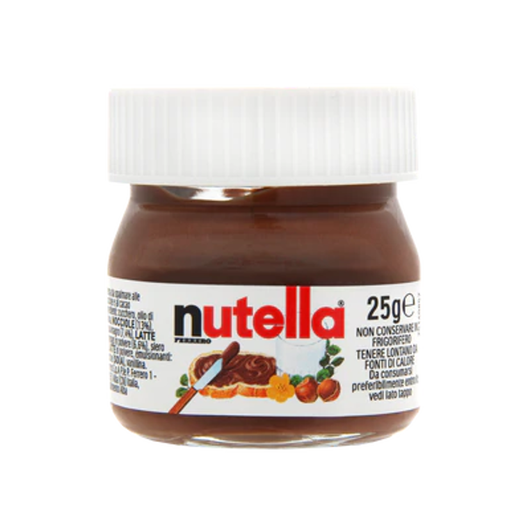 Image unavailable
Worth considering if you want to hand out the spread in individual portions and the school allows this method. Before using it, check the ingredients, allergens and any may-contain information on the 25 g pack.
 Image unavailable
Worth considering for preparing and filling cakes once you’ve worked out how much you need. The 750 g jar isn’t made up of individual portions, so plan how to portion it and check the label on the product you receive for allergen information.
No. According to Santé publique France, displaying the Nutri-Score is voluntary in France. If it appears on the packaging, you can consider it alongside the ingredients list and nutritional information when comparing chocolate spreads in the same category.
No. The contribution described by the French Ministry of the Economy applies to sugary drinks, not chocolate spreads. To compare them, check the amount of sugars per 100 g shown on their labels.
Check the allergens in the exact chocolate spread you’re using and in all the cake’s other ingredients. The European Commission says allergens used as ingredients must be highlighted. Also read any may-contain information and confirm the school’s guidance on what to tell families.
No. Although it means you won’t need to portion the spread out of a jar while serving, check that the school allows it to be handed out and read the information on the packaging. The French Ministry of Education recommends minimising food-related risks at school events.