For ganache, mousse or crémeux, choose a praline that the manufacturer explicitly recommends for baking. For filling a cake, chocolate spread may work if the recipe calls for it. Work out how much you need before choosing a large pack: it doesn’t necessarily come in a sharing bag or have the same properties as praline intended for baking. In France, the DGCCRF explains that Nutri-Score is voluntary. Also check the ingredients, allergens and nutritional values per 100 g.
Who will find these criteria useful?
Anyone making cakes in larger quantities
When you’re making a cake, yule log or entremets for several people, the stated use of the spread in a ganache or filling matters just as much as how much you buy. Valrhona lists these uses for its Amande Noisette Fruité 50% praline, but that doesn’t mean they apply to all praline pastes.
Anyone planning a get-together
If you’re expecting several portions, use the amount in grams required by your recipe to decide how many jars you need or what pack size to choose. The words “sharing bag” don’t replace this check.
Anyone keeping an eye on ingredients
If the cake is for sharing, compare the ingredients and allergens for each product, as well as the sugars and fat listed per 100 g. Nutri-Score can provide an extra point of reference if it appears on the packaging, but the DGCCRF reminds consumers that displaying it is voluntary.
What should you look for in a cake to share?
First decide what the spread needs to do in your recipe, then work out how much you need before choosing a pack size. If you’re making a cake for several people, check the allergens in the product you buy.
| Criterion |
What to check |
Who it matters to |
| Use in the recipe |
For ganache, mousse or crémeux, look for a product explicitly recommended for baking. Check that its formulation suits the recipe you’re following. |
When making ganache for a cake to share, I want to know whether the manufacturer recommends the product for that use, rather than relying on how easy it is to spread. Around 42% of consumers would put suitability for baking at the top of their list. |
| Quantity and packaging |
Compare the number of grams required with the net weight, and check whether it comes in a jar or another type of packaging. |
When I’m making several portions, I want enough for the recipe without choosing an unnecessarily large pack. Pack size would be the top criterion for around 33% of consumers. |
| Ingredients and labelling |
Read the ingredients and allergen information; compare sugars, fat and salt in the nutritional values per 100 g. |
If the cake is for sharing, I want to know what’s in it so I can take account of the people who’ll be eating it. Around 25% of consumers would prioritise ingredients, allergens and nutritional information. |
Common mix-ups to avoid
-
Assuming Nutri-Score is compulsory
The DGCCRF describes Nutri-Score as a voluntary label in France. Its absence doesn’t, by itself, mean that the label is non-compliant; and a score on the pack is no substitute for the ingredients list.
To compare similar prepacked foods, check the nutritional values per 100 g and the ingredients. Nutritional declarations are generally mandatory for the products concerned, subject to applicable exemptions.
-
Assuming chocolate spread and praline for baking are interchangeable
A product described as easy to spread isn’t necessarily intended for making crémeux or ganache. Valrhona lists these uses for its Amande Noisette Fruité 50% praline, but this doesn’t describe other formulations.
If you’re adding praline to a technical preparation, check the recommended uses for the product you’ve chosen and follow the recipe quantities.
-
Choosing a large pack just because the cake is for sharing
A 225 g jar and a 1 kg professional pack are suited to different quantities, but the weight alone won’t tell you how much you need for your cake. A large-format hazelnut spread isn’t automatically a sharing bag.
Add up the grams required by the recipe, then check the net weight, packaging and storage instructions on the label.
If the pack contains more than you’ll use, you’ll have some left over to store according to the instructions on the label.
-
Guessing the allergens from the word “praline”
Recipes vary. Carrefour’s product listing for Sainte Lucie praline paste, for example, mentions hazelnuts and soya lecithin. This composition doesn’t apply to every product.
Before serving a cake to several people, check whether anyone has relevant allergies and read the full ingredients and allergen list on the product you’ve bought.
Brands to know when comparing recipes
Valrhona
Valrhona describes its Amande Noisette Fruité 50% praline as suitable for spreading or baking.
- The brand lists mousse, crémeux and ganache among the preparations you can make with this product.
- These recommended uses apply to this specific praline. Check the packaging and product information for the one you’re considering.
Sainte Lucie
Carrefour lists Sainte Lucie praline paste in a 225 g jar.
- Carrefour’s product listing states that it contains 49% hazelnuts and mentions soya lecithin. Both are worth bearing in mind when comparing ingredients.
- For a baked or technical preparation, don’t assume this paste behaves like a praline explicitly intended for baking.
Artisans Noisetiers
Carrefour describes “La pralinée” by Artisans Noisetiers as a chocolate spread containing 54% hazelnuts, in a 300 g jar.
- The stated net weight and hazelnut content help you assess whether this product suits the quantity and flavour you’re looking for in your recipe.
- Hazelnut content alone won’t tell you how it will behave in a preparation that goes in the oven.
Funkie
Funkie offers a praline-style chocolate spread. Carrefour’s product listing describes a 200 g jar with a different formulation.
- The listed ingredients include red bean purée, 21% hazelnuts and cocoa. The name “praline” can cover a range of recipes.
- If your cake needs a large quantity or a product specifically intended for baking, compare the amount required with the information provided for this product.
A large-format hazelnut spread
This 5 kg hazelnut spread could be an option for filling a cake made in larger quantities, if the recipe and amount required call for it. Check the type of packaging: a large pack doesn’t mean it’s a sharing bag or praline intended for baking.
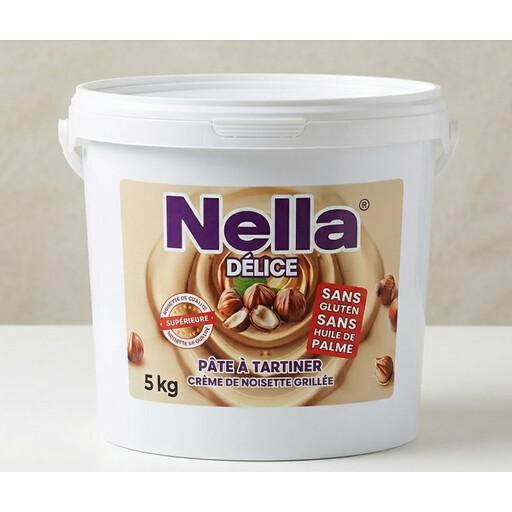 Image unavailable
NELLA PRO Roasted Hazelnut Spread 5 kg
For filling a cake made in larger quantities, the product description recommends it for baking. Check that your recipe calls for chocolate spread rather than praline intended for baking.
The stated pack size is 5 kg. Before serving the cake, check the type of packaging, how much you need and the allergens listed on the label.
View on Joybuy
Frequently asked questions
Is Nutri-Score compulsory on praline chocolate spread in France?
No. The DGCCRF says Nutri-Score is voluntary in France. For the prepacked foods concerned, a nutritional declaration is generally mandatory, subject to applicable exemptions. Values per 100 g make it easier to compare products.
What should I check before adding praline paste to a cake?
First check what the recipe uses it for: a filling, ganache or another preparation. If it calls for praline intended for baking, look for this use in the manufacturer’s information, then check the net quantity, ingredients and allergens for the product you’ve chosen.
Should I check whether it contains hazelnuts and soya?
Yes, if someone eating the cake needs to avoid these ingredients. Carrefour’s product listing for Sainte Lucie praline paste mentions hazelnuts and soya lecithin. Always check the label on the product you actually buy, as ingredients vary between products.
Is a 1 kg pack always a better choice for a celebration cake?
No. Start with the amount required by the recipe and think about how you’ll use any leftovers. Valrhona Selection lists a 1 kg Pariani hazelnut spread intended for professionals, but the pack size doesn’t determine the type of packaging you want or whether it’s suitable for a particular recipe.


