Households that like to see the portion before serving
For the occasional snack or crêpes, individually portioned units with a stated net weight let you plan what to open, rather than serving straight from a large jar.


Choose mini pots if you only serve individual portions occasionally: you know how much you’re opening before you open each one. If you use chocolate spread regularly, a regular jar may suit your routine better. Either way, compare the sugars per 100 g, ingredients and allergens for the specific product.
For the occasional snack or crêpes, individually portioned units with a stated net weight let you plan what to open, rather than serving straight from a large jar.
You might want to start by comparing sugars, fats, ingredients and allergens per 100 g. Then consider the format; if a Nutri-Score is displayed, use it as an additional guide.
The total weight and number of containers matter just as much as the size of each portion. A pack designed for a buffet may not suit the needs of a household cupboard.
Start with how often you’ll use it: mini pots give you separate portions, while a regular jar lets you serve as much or as little as you like. Then check the recipe and the total quantity in the pack you’re considering.
| What to consider | What to check | Who this matters to |
|---|---|---|
| Portion size and frequency | Weight per unit, number of units and how often you expect to use them. | For occasional snacks, I want to decide how much to open before serving; around 36% of consumers make visible portions their priority. |
| Nutrition information | Sugars and fats per 100 g, then the amount actually served; Nutri-Score if displayed. | Before choosing a format, I prefer to compare recipes on the same basis: around 29% of consumers prioritise this. |
| Quantity and containers | Total weight, number of jars and storage instructions after opening. | If the product is going to stay in the cupboard for a while, I look for a pack my household can use without accumulating lots of small containers; around 21% of consumers put this first. |
| Ingredients and allergens | Ingredients list, declared allergens and any possible traces for the specific product. | If I need to avoid certain ingredients, I check the recipe before considering the jar size; this is the top criterion for around 14% of consumers. |
The format sets the amount in each unit, but it doesn’t change the spread’s ingredients.
Compare the sugars per 100 g in the nutrition information, then consider how much you plan to serve.
The Nutella pack of 64 x 25 g portions listed by METRO Marketplace is intended for buffets or catering, rather than occasional household use.
Count how many portions you’ll actually use before choosing a pack size.
A large number of units also means you’ll need cupboard space and have more containers to manage.
This claim describes the choice of fat, not the sugar content. Auchan’s product listings state that Auchan Bio contains 55 g of sugars per 100 g, while the Nocciolata product checked contains 51 g.
Check the ingredients, sugars per 100 g and format separately.
The chocolate and hazelnut recipes checked list hazelnuts and milk, among other ingredients; some also mention soya or traces of other nuts.
Read the label for the specific product and format you’re buying, even if you already know the brand.
The brand offers a hazelnut and cocoa spread gift pack containing five 25 g pots, or 125 g in total.
The Auchan listing checked includes a regular 220 g jar. METRO Marketplace also offers a pack of 64 x 25 g portions, intended in particular for buffets.
Auchan describes its organic cocoa and hazelnut spread as a regular-jar option for comparing recipes rather than individual portions.
The 400 g cocoa and hazelnut spread is another regular jar to compare.
Auchan’s 300 g hazelnut and chocolate spread is for people comparing the ingredients in regular jars.
This product may suit you if you’re looking for a small amount of chocolate and hazelnut spread for occasional use. Check the type of container if you specifically want a mini pot.
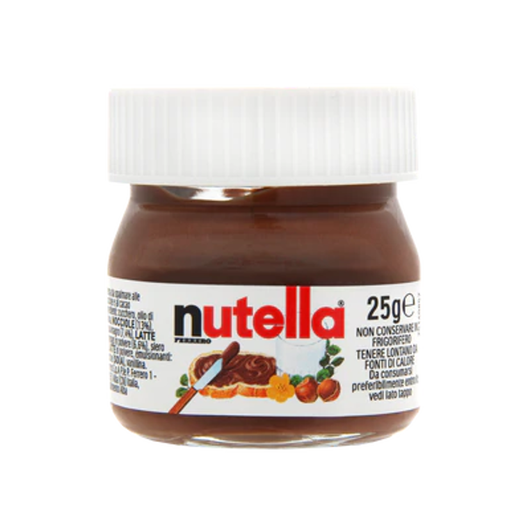 Image unavailable
The 25 g size lets you plan for one portion for an occasional snack. If you’re looking for an individual pot, check the type of container. Also read the label for ingredients, allergens and sugars per 100 g.
No. According to the French Ministry of the Economy, the French contribution known as the “soda tax” applies to sugary drinks, not chocolate spreads. To compare chocolate spreads, check their nutrition information instead.
No. Santé publique France says that producers display Nutri-Score voluntarily. If it appears on two comparable products, you can use it alongside their nutrition information and ingredients lists. Its absence alone doesn’t tell you anything about the recipe.
First, compare the “of which sugars” figure per 100 g on both labels: the size of the container doesn’t change this basis for comparison. Then consider how much you plan to serve, whether it’s pre-portioned or spooned from a jar.
Yes, if the number of portions suits how you’ll actually use them. A small gift pack of five 25 g pots, such as the one from Bonne Maman, meets a different need from the Nutella pack of 64 x 25 g portions offered by METRO Marketplace for buffets and catering.
Check the allergens listed for the specific product: the product listings consulted mention hazelnuts and milk, as well as soya or traces of other nuts, depending on the recipe. Don’t assume a mini format has the same ingredients as another jar from the same brand.