Who are these formats for?

Students who prefer a ready-portioned snack

If you’d rather not serve yourself straight from a jar, an individually wrapped bite gives you a clear portion per piece. Nutella France states that one B-ready wafer weighs 22 g and contains 10.4 g of sugars. It’s ready to eat as it is, not a portion of spread for you to put on toast.

Students making toast in their accommodation

If you’re using chocolate spread for breakfast, a compact jar is a good fit without starting with a large container. Auchan’s range includes Dukanella in a 220 g jar and Nestlé Dessert in a 340 g jar; you can decide how much to serve.

People who check the ingredients first

If sugars, ingredients or allergens influence your choice, check the specific product rather than relying on the word ‘mini’. Nutritional information lets you compare values per 100 g. Santé publique France says the Nutri-Score can also be a useful guide when it’s displayed voluntarily.

What should you look for before choosing?

Individually wrapped filled wafer

Choose this if: you want a ready-to-eat snack to take with you, with no spoon needed.

Bear in mind: a wafer with a filling is a different product from a jar of spread for toast.

Small-format chocolate spread

Choose this if: you want to spread it on toast and use the container more than once.

Bear in mind: the container alone doesn’t determine how much you’ll serve; check the type of packaging too.

What to consider What to check Who is it for?
Defined portion The weight and sugars per piece, as well as the number of pieces in the pack. Nutella France states that each B-ready contains 22 g and 10.4 g of sugars. I prefer to know exactly what one piece amounts to, rather than serving myself from a jar. Around 31% of consumers prioritise a defined portion.
Taking it with you and storing it The difference between a ready-to-eat product and a spread, then the storage instructions on the packaging. When I’m going from my accommodation to lectures, I mainly want something that’s easy to carry and store. This convenience comes first for around 25% of consumers.
Ingredients Sugars and other nutritional values per 100 g, then per portion; the ingredients list, allergens and Nutri-Score, if shown on the product. I want to know exactly what’s in the recipe before choosing, especially if certain ingredients or allergens matter to me. Ingredients are the main consideration for around 25% of consumers.
Repeated use The container’s weight and what you plan to use it for: making several pieces of toast or having the occasional snack. Check the packaging before assuming a 25 g portion is a mini jar. If I make toast regularly, I want a format that’ll last for several breakfasts. Around 19% of consumers prioritise this kind of repeated use.

Common mix-ups to avoid

  • Mistaking a filled wafer for a mini jar

    Nutella B-ready combines a wafer with a chocolate and hazelnut filling. Its individual wrapper makes it easy to identify one piece, but it isn’t for spreading on toast like chocolate spread from a jar.

    First decide whether you want a ready-to-eat snack or a spread, then read the nutritional values for the type you’ve chosen.

  • Assuming a mini format is low in sugars

    The size of a piece doesn’t tell you everything about its ingredients. Nutella France states that one 22 g B-ready contains 10.4 g of sugars.

    To compare recipes, check the sugars per 100 g, then compare the value per portion with how much you plan to serve or eat.

  • Ruling out a product because it has no Nutri-Score

    Santé publique France says that displaying the Nutri-Score is voluntary. Its absence alone doesn’t tell you whether a chocolate spread is nutritious.

    If it’s shown, use it to compare similar products, and check the nutritional information and ingredients list too.

  • Relying on the word ‘chocolate’ to check for allergens

    Ingredients vary from one product to another. The Nutella B-ready product information lists hazelnuts, milk, soya, wheat and barley, among other ingredients. The Nestlé Dessert spread information lists hazelnuts and milk, and says it may contain peanuts and other nuts.

    Check the allergens on the exact product’s packaging before buying, even if you already know another product from the same brand.

Brands to know when comparing

Nutella

With B-ready, Nutella offers an individually wrapped filled wafer rather than a mini jar of spread.

  • Nutella France states that each piece weighs 22 g, with packs available containing 2, 6, 10 or 15 pieces.
  • The brand states that each piece contains 10.4 g of sugars. The wafer contains wheat, milk, hazelnut and soya, among other ingredients, and isn’t a substitute for a spread.

Dukan

Dukanella is a 220 g jar of spread: it’s made for spreading, not for an individually wrapped bite.

  • Auchan’s product information states that it contains 4.2 g of sugars per 100 g and displays a Nutri-Score A for this product.
  • The recipe includes maltitol, hazelnut, milk and soya; check the ingredients and allergens on the packaging you choose.

Nestlé Dessert

The 340 g chocolate and hazelnut product is a jar of spread to serve on toast.

  • Auchan’s product information gives a 15 g portion, containing 7.8 g of sugars per portion and 52 g per 100 g.
  • This product contains hazelnuts and milk, and may contain peanuts and other nuts. Its storage instructions say to keep it somewhere dry, away from heat and light.

Auchan

The retailer’s Pasta Cao jars give you formats to compare if you’re looking for a spread rather than a wafer.

  • Auchan offers Pasta Cao jars in 400 g and 750 g sizes, among others.
  • Choose a weight that suits how you plan to use it, and check the exact product, its ingredients and its storage instructions.

Formats to find on Joybuy

These two Nutella products suit different needs when you’re moving into student accommodation: B-ready is a filled wafer that’s ready to eat, while the 25 g format is a chocolate and hazelnut spread. If you specifically want a mini jar, check what type of container the latter comes in.
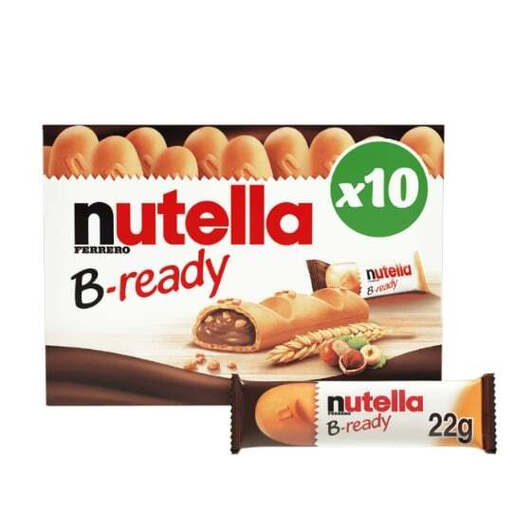
Nutella B-ready, pack of 10 filled wafers, 220 g

Nutella B-ready, 10 wafers, 220 g

A ready-to-eat snack for when you’re out and about, with no utensils needed. The pack contains 10 individually wrapped 22 g pieces. Nutella France states that each piece contains 10.4 g of sugars. It’s a filled wafer, not a jar of spread; check the allergens on the packaging.

View on Joybuy
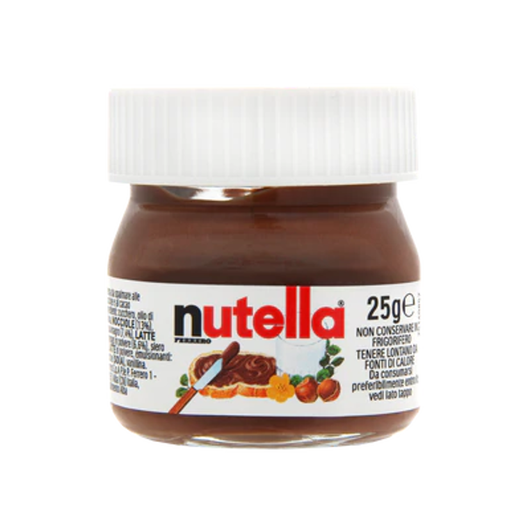
Nutella chocolate and hazelnut spread, 25 g

Nutella chocolate and hazelnut spread, 25 g

A small amount of spread for when you’d prefer it to a ready-to-eat wafer. Check the type of container if you’re looking for a mini jar, and refer to the packaging for nutritional values and the full list of allergens.

View on Joybuy

Frequently asked questions

Is the Nutri-Score compulsory on chocolate spread?

No. Santé publique France says that businesses display the Nutri-Score voluntarily. The European Commission says that most prepacked foods must, however, carry a nutrition declaration. Use the values per 100 g in particular to compare chocolate spreads.

Does the ‘sugar tax’ help you choose a chocolate spread?

No, it isn’t a way to compare chocolate spread recipes. The French Ministry of the Economy describes this levy as applying to sugary drinks. To assess a chocolate spread, check the sugars listed in its nutritional information instead.

Which allergens should you check in a chocolate and hazelnut bite?

Check the packaging for the exact product you’re buying. Nutella France lists hazelnuts, milk, soya, wheat and barley, among other ingredients, for B-ready. Don’t assume the same list applies to another bite-sized snack or a jar of spread.

Where should you store a jar of spread in your room?

Follow the instructions on the jar you’ve bought and store it somewhere that meets them. The instructions for the 340 g Nestlé Dessert spread sold by Auchan say to keep it somewhere dry, away from heat and light, at between 17 and 23 °C.