People who compare labels
When choosing a snack, you want to check the sugar, fat and ingredients, including when a jar doesn’t display a Nutri-Score.


No: when choosing chocolate spread for a snack, check the ingredients and allergens first, then compare the nutrition information and choose a size that suits how much you use. The glass jar may matter if you want to reuse or recycle it, but it tells you nothing about the recipe. In France, the DGCCRF explains that Nutri-Score is voluntary, so its absence is no reason to skip the nutrition declaration.
When choosing a snack, you want to check the sugar, fat and ingredients, including when a jar doesn’t display a Nutri-Score.
You want to identify the container material so you can consider reusing it or follow recycling instructions, without making assumptions about the recipe.
You need to check the ingredients and allergens listed on the exact product before choosing a chocolate and hazelnut spread.
When choosing chocolate spread for a snack, your priority might be the nutrition label, the ingredients, the container or the quantity you buy. A glass jar and a displayed Nutri-Score answer different questions.
| Criterion | What to check | Who is it for? |
|---|---|---|
| Nutrition information | Look for the Nutri-Score if it appears on the jar; also compare sugar, fat, saturates and salt per 100 g. | To compare several spreads for a snack, I need to check their values on the same basis, whether or not they carry a logo. Around 27% of consumers put this nutritional comparison first. |
| Ingredients and allergens | Read the ingredients list and check which allergens are highlighted; look out for any sweeteners. | If certain ingredients aren’t suitable for me, I need to check the recipe on the specific jar before thinking about the container. This would be the priority for around 33% of consumers. |
| Glass jar | Confirm the material of the exact product and check the recycling instructions for its different components. | I want to keep or recycle a glass jar, but the word ‘jar’ alone doesn’t tell me what it’s made of. For around 20% of consumers, the container would come before other criteria. |
| Quantity | Compare the net weight of each size and choose according to how often your household eats chocolate spread. | If snacks are an occasional treat, I’d rather avoid keeping a large jar open for a long time; a household that eats it regularly may prefer a different size. The pack size would be the main consideration for around 20% of consumers. |
According to the DGCCRF, Nutri-Score is voluntary in France, while a nutrition declaration is compulsory for most prepacked foods. So the absence of the logo alone tells you nothing conclusive about the recipe.
Compare the values per 100 g and the ingredients list, whether or not a Nutri-Score is shown.
A product listing that simply mentions a ‘jar’ doesn’t necessarily specify its material. Nutella France describes its jars as glass, but that information doesn’t apply to other products.
Check the container in the listing or on the packaging of the exact product before making it a deciding factor.
A claim such as ‘organic’ or ‘palm oil free’ doesn’t tell you everything about the ingredients. Products listed by Carrefour France may contain hazelnuts, milk, soya or a sweetener, depending on the product.
Read the full ingredients list and check the allergens stated on the jar you choose.
An option if you’re looking for a branded glass jar in a size that suits how much you use.
The 600 g chocolate and hazelnut spread may appeal if you want to compare its recipe with other spreads.
The 220 g product listed by Carrefour France displays a Nutri-Score A.
Consider the 350 g organic chocolate and hazelnut spread if its ingredients and packaging meet your criteria.
A range to explore if the quantity in the jar is your main consideration when choosing a size.
These two chocolate spreads offer sizes and recipes worth considering for a snack. As for glass, Nutella France describes its jars as glass; check the container for the product you order.
 Image unavailable
This 750 g size is worth considering if your household eats chocolate spread regularly; a smaller jar may be more practical for the occasional snack. Nutella France describes its jars as glass. Check the ingredients on the packaging for this product and follow local recycling instructions for the jar.
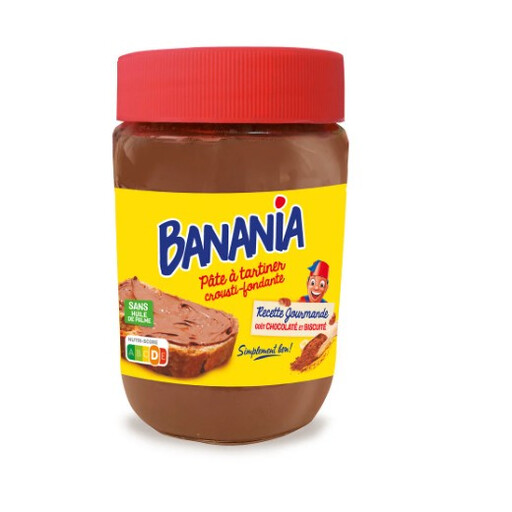 Image unavailable
This 400 g jar lets you explore a recipe described as palm oil free. If you’re specifically looking for a glass jar, confirm the container material before buying; also check the ingredients and allergens on the label.
No. The DGCCRF describes Nutri-Score as a voluntary label, while a nutrition declaration is compulsory for most prepacked foods. So you can compare the values per 100 g even when no logo is shown.
Read the nutrition information per 100 g, including sugar, fat, saturates and salt, then compare the ingredients lists. The absence of a logo doesn’t tell you whether one recipe is better suited to your criteria.
Check the allergens highlighted on the label of the exact jar. Products listed by Carrefour France include hazelnuts, milk or soya, depending on the recipe; don’t assume they all have the same ingredients.
Nutella France describes its glass jar as reusable and recyclable. If you plan to reuse it, check that it’s suitable for the intended use; when disposing of it, follow local instructions for the jar, lid and other packaging components.