Which criteria should you compare?
When serving several people at a local market, first work out how much you’ll need, then compare the recipes on an equal-weight basis. A larger jar is no substitute for checking allergens or nutritional information.
| Criterion |
What to check |
Who it’s for |
| Size and quantity |
Net weight, the portions you’re planning to serve and storage instructions after opening. |
If I’m serving a group, I want to have enough spread without using lots of containers or ending up with too much left over. Around 30% of consumers would prioritise the amount to be served. |
| Sugars and nutritional values |
Sugars and fat per 100 g, then the portion you’re planning to serve; check the Nutri-Score if it appears on the jar. |
When choosing between two recipes for a buffet, I want to be able to compare their sugar content on the same basis. Nutritional comparison would be the main criterion for around 30% of consumers. |
| Recipe and allergens |
The ingredients list and allergen information, particularly for hazelnuts and milk, as well as any stated traces. |
When several people are helping themselves, I need to know whether the recipe is suitable for anyone with ingredient or allergen-related restrictions. This would be the top priority for around 20% of consumers. |
| Organic, sourcing and origin |
The characteristics actually stated, such as organic certification, fair trade, hazelnut origin or place of manufacture. |
I want to choose based on sourcing details or a stated origin without confusing these with the nutritional profile. Around 20% of consumers would put this criterion first. |
The different sizes offer distinct trade-offs. Nutella France and E.Leclerc list 1 kg jars of Nutella and Nustikao respectively, while Auchan describes Nestlé Dessert in a 590 g jar and Jardin Bio étic in a 750 g jar. A 400 g jar may also suit your preferred recipe, but you’ll need to work out how many jars you need for the number of portions you plan to serve.
Brands to compare
These products let you compare specific sizes and recipes. A product’s characteristics don’t necessarily apply to every jar from the same brand.
Nutella
Nutella France offers a hazelnut and cocoa spread in several sizes, including 1 kg.
- The brand states that it contains 13% hazelnuts and gives a reference portion of 15 g.
- The recipe lists palm oil, milk and soya lecithin. Nutella France gives the sugar content as 56.3 g per 100 g.
Nustikao
The E.Leclerc listing features Nustikao spread in a 1 kg jar.
- This product contains 13% hazelnuts and comes in a size worth considering for serving a group.
- The listing shows a Nutri-Score of E and 58 g of sugars per 100 g. The recipe also lists milk, palm oil and rapeseed oil.
Nos Régions ont du Talent
The product listed by E.Leclerc highlights hazelnuts from Lot-et-Garonne and comes in a 400 g jar.
- The listing states that this recipe contains 35% hazelnuts and is made in France.
- You may need several 400 g jars; the listing shows a Nutri-Score of E and mentions milk.
Nestlé Dessert
Auchan offers a 590 g jar of Nestlé Dessert chocolate and hazelnut spread.
- The product listing describes this recipe as palm-oil-free.
- It contains hazelnuts and milk, may contain peanuts and other tree nuts, and has 52 g of sugars per 100 g.
Jardin Bio étic
The 750 g chocolate and hazelnut spread listed by Auchan combines several stated recipe and sourcing characteristics.
- The listing describes it as organic and palm-oil-free, and states that 56% of its ingredients come from agricultural sources meeting the stated fair-trade standards.
- The recipe contains hazelnuts and milk, may contain other tree nuts, and has 51 g of sugars per 100 g.
Chocolate spread jars available on Joybuy
This selection includes several sizes for sharing, as well as recipes to consider if the hazelnut percentage or a particular range characteristic matters more to you than the volume. Check the ingredients and allergen information on the pack before serving it to a group.
 Image unavailable
Nutella hazelnut and cocoa spread, 1 kg jar
The 1 kg jar is a good option if you need a large quantity. Nutella France states that this spread contains 13% hazelnuts and 56.3 g of sugars per 100 g. Check the allergens on the jar you buy.
View on Joybuy
 Image unavailable
Nutella chocolate and hazelnut spread, 3 kg
The 3 kg size is worth considering for a large event, once you’ve worked out how much you’ll actually need. Check the recipe, allergens and storage instructions for this pack.
View on Joybuy
 Image unavailable
Nutella spread, 750 g jar
A 750 g jar lets you adjust the amount if 1 kg is more than you need. Compare its per-100 g nutrition information and allergen details with those of the other jars you’re considering.
View on Joybuy
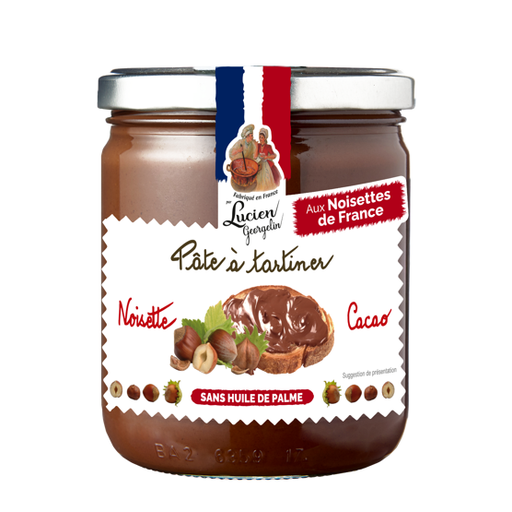 Image unavailable
Lucien Georgelin Lot & Garonne hazelnut and cocoa spread, 400 g
The 400 g jar is suited to a smaller gathering or if you’ve chosen this particular recipe. If you’re planning to serve lots of portions, work out how many jars you’ll need and check the product’s allergen information.
View on Joybuy
 Image unavailable
Lucien Georgelin Organic hazelnut and cocoa spread, 400 g
This 400 g jar lets you consider another Lucien Georgelin recipe for sharing. Check the organic details on the pack, along with the ingredients, allergens and quantity you’ll need for your group.
View on Joybuy
Frequently asked questions
Does France’s ‘soda tax’ apply to chocolate spread?
No. The contribution described by BOFiP-Impôts applies to non-alcoholic drinks containing added sugars, not this type of spread. To compare two jars, look at their ingredients and nutritional information.
Is the Nutri-Score mandatory on a jar sold in France?
No. According to the Ministry of the Economy, the Nutri-Score is voluntary in France. The DGCCRF states that most prepacked foods must carry a nutrition declaration, so check it even if no Nutri-Score is shown.
How can I compare two jars if only one displays a Nutri-Score?
Compare their nutritional values per 100 g, particularly sugars, fat, saturated fatty acids, salt and energy, then check their ingredients lists. The Nutri-Score on one jar doesn’t replace comparing both products on the same basis.
Which allergens should I check before sharing chocolate spread?
Check the label on the jar you’re going to serve. The products featured here include hazelnuts and milk, and some recipes also contain soya or may contain traces of other tree nuts or peanuts. The DGCCRF states that allergenic ingredients must be highlighted in the ingredients list on prepacked foods.
How should I store a large jar once it’s open?
Follow the instructions on the jar you buy, as they vary by product. For its 750 g product, the Jardin Bio étic listing featured by Auchan advises against keeping it in the fridge and recommends eating it within a month of opening. These instructions don’t apply to all chocolate spreads.


