Families stocking up
You use chocolate spread regularly and want a jar you can finish within the recommended time after opening.


When stocking your cupboard, start by choosing a chocolate spread with a recipe and pack size that suit the way you’ll use it. Compare the ingredients, allergens, sugar per 100 g and storage instructions for the specific jar. A larger jar is best if you’ll use it regularly. Claims such as ‘organic’, ‘palm oil-free’ and ‘plant-based’ refer to different qualities and don’t replace checking the label. A boxed selection of chocolates for gifting isn’t a substitute for a jar of chocolate spread.
You use chocolate spread regularly and want a jar you can finish within the recommended time after opening.
You want to compare the ingredients, stated hazelnut content and nutritional values per 100 g, rather than relying on the recipe name.
You need to check the ingredients and any ‘may contain’ warnings on the specific product. Claims such as ‘organic’, ‘plant-based’ or ‘palm oil-free’ don’t answer all these questions on their own.
Start with the ingredients and any dietary requirements that matter to you, then choose a jar size that suits how often you’ll use it.
| Criteria | What to check | Who it matters to |
|---|---|---|
| Recipe and nutritional values | Ingredients list and stated hazelnut content; sugar per 100 g. | If I’m looking for a particular chocolate and hazelnut recipe, I want to be able to distinguish the hazelnut content from the sugar content. Around 40% of consumers would put this comparison at the top of their list of concerns. |
| Allergens and dietary requirements | Allergens in the ingredients and ‘may contain’ warnings, including for plant-based recipes. | If I want to avoid an ingredient I’m allergic to or stick to my diet, the claim on the front of the pack isn’t enough: the jar’s label is what matters. This check would be a priority for around 20% of consumers. |
| Pack size and storage | Jar size and storage instructions, particularly after opening. | When I’m stocking up, I want a jar that I can use in line with the storage instructions. Pack size would be the main criterion for around 40% of consumers. |
These claims describe features of the recipe, not its sugar content. For example, Auchan Bio cocoa and hazelnut spread lists 55 g of sugar per 100 g.
Compare nutritional information per 100 g and read the ingredients list. If the jar displays a Nutri-Score, use it as an additional guide.
Nutella states that its Plant-Based version may contain milk and isn’t suitable for people with a milk protein allergy.
If you have an allergy, check the ingredients and any ‘may contain’ warnings on the jar in question. Don’t rely on the word ‘vegan’ alone.
A large jar is only practical if you can use its contents in line with the instructions after opening, which vary between recipes.
Think about how much you usually use and check the product’s storage instructions before choosing a size.
A box of chocolates for gifting and a jar of chocolate spread serve different purposes. The former doesn’t let you compare the jar sizes and recipes intended for stocking your cupboard.
For this purchase, look at jars of chocolate spread and their labels, rather than assorted chocolates.
These examples showcase recipes and pack sizes that are worth comparing product by product. A retailer’s name alone doesn’t tell you everything about its jars.
Chocolate and hazelnut spread available in several sizes, as well as a Plant-Based version.
A retailer offering national brands and its own-label chocolate spreads, including Carrefour Classic’ and Carrefour Bio.
A retailer offering products including Bio Village and Nos Régions ont du Talent, each with different recipes.
A retailer offering Auchan Bio cocoa and hazelnut spread, among other palm oil-free products.
A retailer offering TARTICHOC, a hazelnut spread in a 750 g jar.
This selection includes larger Nutella jars, an organic Lucien Georgelin recipe and a BANANIA chocolate spread advertised as palm oil-free. Start by choosing the recipe you’re looking for, then check that the size suits you.
 Image unavailable
Consider this 1 kg jar if you use chocolate and hazelnut spread regularly. Check the allergens and storage instructions before stocking up.
 Image unavailable
This 400 g jar is worth considering if you’re looking for an organic recipe with hazelnuts and cocoa. Compare its sugar per 100 g and check the allergens and instructions for after opening.
 Image unavailable
The 750 g jar offers another size for regular use. Check the jar’s label for allergens and storage instructions after opening.
 Image unavailable
The 3 kg jar is designed for very frequent use or catering, rather than the occasional serving. Before choosing this size, read the storage instructions and check it suits how quickly you’ll use it.
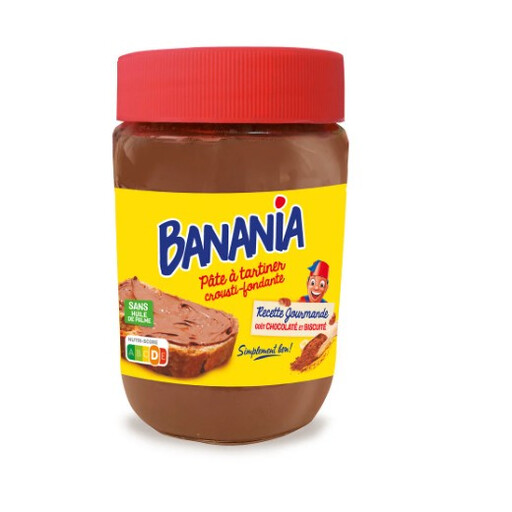 Image unavailable
This 750 g jar may suit you if you’re looking for a spread advertised as palm oil-free. If you specifically want a chocolate and hazelnut recipe, check the ingredients before choosing it. Remember to check the allergens too.
No. The charge described by the French Ministry of the Economy applies to sugary drinks, not jars of chocolate spread. To compare spreads, look at the sugar content per 100 g instead.
No. The French Ministry of Health describes Nutri-Score as a recommended labelling system, not a logo that must appear on every jar of chocolate spread. General food information requirements are set out in part by the European regulation on food information for consumers. When shown, Nutri-Score is an additional guide to the nutritional values.
Read the ingredients and any ‘may contain’ warnings on the specific jar. Some recipes contain hazelnuts, milk and soya, while other labels may also warn of peanuts, other nuts or gluten. Allergens vary by product, so a general claim on the front of the jar is no substitute for checking the label.
Not necessarily. Nutella states that its Plant-Based version may contain milk and isn’t suitable for people with a milk protein allergy. Check the allergen warnings for each plant-based product.
Follow the instructions on the jar you’ve chosen, as they vary between recipes. For example, the product information for Jardin Bio Étic featured by Auchan advises against storing its product in the fridge and recommends consuming it within a month of opening.