Households sharing a jar
If several people enjoy it at breakfast or teatime, choose a jar size based on how much your household will eat during the week, rather than going by the format alone.


For your weekly shop, choose an amount your household will actually use. A large jar works well for sharing at home, but won’t replace individual portions for lunchboxes. If you’re considering a multipack, check how many units it contains and the total weight. For each recipe, check the sugar content per 100 g and the allergens on the label.
If several people enjoy it at breakfast or teatime, choose a jar size based on how much your household will eat during the week, rather than going by the format alone.
If you need a portion to take with you, check whether the product comes in individual packs or is a jar you’ll need to portion yourself. Carrefour’s Nutella product listing gives a 15 g serving for the product shown; this doesn’t mean the jar contains separate portions.
Compare the sugar content and ingredients for each product. If anyone in your household needs to avoid certain allergens, check the information on the jar you buy too: hazelnut and cocoa spreads don’t all have the same recipe.
Start with how much your household actually eats, then decide whether lunchboxes need ready-portioned packs or whether you can prepare portions from a jar.
| What to consider | What to check | Who is it for? |
|---|---|---|
| How much you’ll need for the week | Net weight and how much your household expects to use. | I want a jar we can share without buying far more than we’ll use at our usual rate; around 36% of consumers put the amount they’ll use first. |
| Portions to take with you | Number of units in the multipack, total weight and type of packaging. | For a lunchbox, I need a portion I can take with me, whether it’s already packed or prepared at home. Around 29% of consumers put this convenience first. |
| Nutrition information | Sugars and fat per 100 g; Nutri-Score only if it’s displayed. | When comparing recipes, I want to check their nutritional values on the same basis before choosing; around 21% of consumers prioritise this comparison. |
| Ingredients and allergens | Ingredients list, declared allergens and any ‘may contain’ warnings for the exact product. | If anyone in my household needs to avoid certain ingredients, the contents of the jar I buy are my top priority; around 14% of consumers put this check first. |
A jar for sharing won’t necessarily come with individual packs to pop into a lunchbox.
Before choosing a multipack, check the number of units and their weight. If you portion out a jar yourself, use a suitable food container for taking it with you.
According to Santé publique France, producers choose whether to display the Nutri-Score. If it’s not shown, you can’t infer a score for the spread.
If the logo is shown, compare products in the same category. In every case, check the nutrition information per 100 g and the ingredients list.
The 200 g Gerblé product listed by Auchan is labelled ‘no added sugars’, but still contains 8.2 g of sugars and 36 g of polyols per 100 g.
Check the nutrition information, ingredients and allergens for the exact product rather than relying on the wording on the front of the pack alone.
Carrefour’s product listings show Nutella hazelnut and cocoa spread in several jar sizes, from 220 g to 825 g.
Carrefour’s range of chocolate spreads includes jars weighing 750 g and 1 kg.
Auchan’s 200 g hazelnut and cocoa spread is labelled ‘no added sugars’ and contains a sweetener.
ALDI offers CUCINA milk and hazelnut spread in a 400 g jar.
These are hazelnut and cocoa spread products in jars of different sizes. If you’re buying them for lunchboxes, bear in mind that a jar on its own doesn’t provide individual portions.
 Image unavailable
Worth considering for sharing at home if your household will use this amount. For a lunchbox, portion it into a suitable container and check the allergens on the jar you buy.
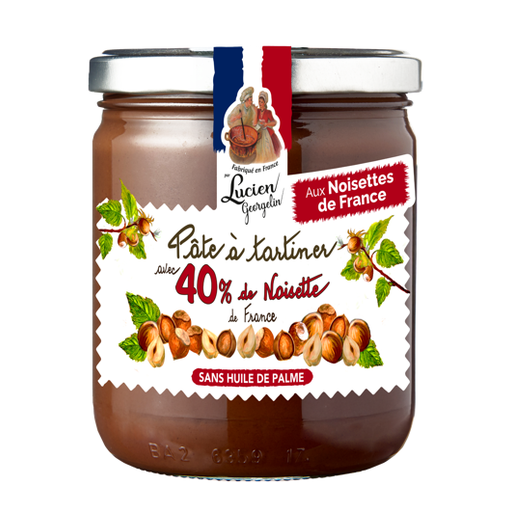 Image unavailable
This 400 g jar lets you choose a more moderate amount than a large family-size jar. The product name states that it contains 40% hazelnuts; check the packaging if you’re looking for ready-portioned servings.
 Image unavailable
Compare this 400 g size with how much you’ll use during the week. The organic label sets this product apart; if you’re choosing based on the recipe, check its ingredients and nutrition information.
 Image unavailable
This jar is worth considering if you’ll be enjoying it at home several times during the week. It isn’t a multipack of individual portions; check the full label if anyone needs to avoid allergens.
 Image unavailable
Only consider this if you’ll use 3 kg: it may be more than you need for a week. You’ll need to prepare separate portions for lunchboxes; check the allergens on the packaging.
Yes, if you can portion it into a suitable food container for taking with you. The jar itself doesn’t provide individual portions, though. If you want ready-packed units, check the number of units and the total weight of the multipack you’re considering.
No. Santé publique France says producers choose whether to display it. Other labelling rules apply to nutrition declarations on prepacked foods, so if there’s no Nutri-Score, you should still check the product’s nutrition information.
Compare their values per 100 g, particularly sugars and fat, then consider the portion you’ll eat. If both products display a Nutri-Score, use it as additional information when comparing products in this category. Don’t rely on it alone to decide whether a recipe suits your needs.
It doesn’t mean ‘sugar-free’. Auchan’s listing for the 200 g Gerblé product gives 8.2 g of sugars and 36 g of polyols per 100 g; check the nutrition information and ingredients for the product you choose.
Check the ingredients list and allergen information on the jar you’re actually using, even if you already know the brand. The Nutella product listing we checked at Carrefour declares hazelnuts, milk and soya; another recipe may contain different ingredients or have different ‘may contain’ warnings.