Organisers of regular coffee breaks
If you’re catering for several meetings, a large jar can mean fewer restocks, provided you’ll use the quantity and can store and serve it properly.


For regular coffee breaks with predictable consumption, a 3 kg jar can reduce the number of jars you need to open. For a one-off meeting or uncertain attendance, 1 kg jars or smaller sizes let you tailor the quantity. Before choosing, check the storage instructions, ingredients and allergens for the product you plan to serve.
If you’re catering for several meetings, a large jar can mean fewer restocks, provided you’ll use the quantity and can store and serve it properly.
If you’re serving chocolate spread to a group, check the allergens and nutritional information on the jar you actually buy. The products reviewed show why you shouldn’t assume the ingredients are the same just because the pack size is different.
Start by working out how much you’re likely to use, then check whether you can store and serve the jar as planned for the meeting.
Consider this: for frequent breaks and predictable group consumption.
Bear in mind: you’ll need to store and serve a large quantity from a single container.
Consider this: if attendance is uncertain and you can keep a second jar sealed until you need it.
Bear in mind: you’ll need to manage several containers if the breaks are regular.
Consider this: for a one-off break or modest consumption.
Bear in mind: you may need to restock if more people help themselves.
| Criteria | What to check | What matters to consumers |
|---|---|---|
| Quantity | Estimate the number of breaks and attendees, then compare 3 kg, 1 kg and under-1 kg sizes. | For several meetings, I want enough chocolate spread without keeping a large opened jar for too long; around 42 % of consumers prioritise getting the quantity right. |
| Ingredients | Check the ingredients, allergens and nutritional values per 100 g for the product you choose. | If I’m serving a group, I need to be able to tell people what’s in the jar, particularly which allergens it contains; for around 33 % of consumers, this comes before other criteria. |
| Serving on site | Confirm it will be available for the meeting, check the storage instructions and make sure you can use a clean utensil dedicated to serving. | Before arranging a shared jar, I want to be able to store it and organise how it’ll be served on site; around 25 % of consumers prioritise these practical considerations. |
The levy described by Légifrance applies to drinks and liquid preparations for drinks, not solid chocolate spread. So it can’t help you decide between these jars.
To compare their nutritional content, check the sugars listed per 100 g in the nutritional information instead.
According to Santé publique France, displaying it is voluntary. Its absence isn’t enough to conclude that a chocolate spread fails to meet the rules.
If it appears on the packaging, read it alongside the ingredients list and nutritional values for the product in question, rather than using it as your only criterion.
The Nutella products reviewed list hazelnuts, milk and soya among their ingredients. Ingredients and precautionary ‘may contain’ statements can vary from one product to another.
Check the label on the jar you buy, let attendees know which allergens are listed and provide a clean utensil for serving.
The sizes reviewed include 1 kg and 3 kg jars.
E.Leclerc offers this Marque Repère product in a 1 kg jar.
The Carrefour range reviewed includes a 1 kg hazelnut spread.
Aldi offers a 750 g jar of Tartichoc hazelnut spread.
These jars offer different quantities for a coffee break: 3 kg for regular use, 1 kg to control how many jars you open, and 750 g or 400 g for more modest consumption. Your choice also depends on the ingredients and serving requirements for each product.
 Image unavailable
This 3 kg jar is worth considering for regular breaks where consumption is predictable.
The Joybuy listing says to store it in a dry place, away from heat, and not to refrigerate it. Hazelnuts, milk and soya are among the allergens to highlight before serving.
 Image unavailable
If attendance is uncertain, having several 1 kg jars means you only need to open the next one if necessary.
The 1 kg Nutella product reviewed lists hazelnuts, milk and soya; check the label on the jar you serve.
 Image unavailable
This 750 g jar is an option when you expect to use less than would justify a 1 kg or 3 kg jar.
Check the label for allergens and storage instructions specific to this product.
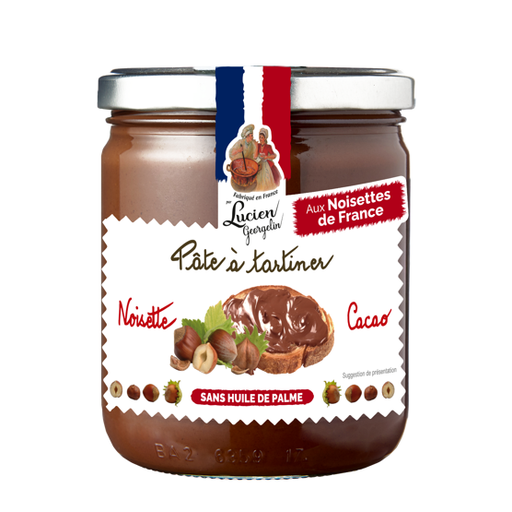 Image unavailable
The 400 g jar lets you plan a smaller quantity for a one-off break or a small group.
If you’re planning several breaks, work out how many jars you’ll need. Check the ingredients and allergens for this product before serving.
Solid chocolate spread does not fall within the scope of the levy on drinks and liquid preparations for drinks described by Légifrance. However, you can check its sugar content in the nutritional information per 100 g.
No. Santé publique France says that displaying it is voluntary. For a prepacked food covered by the labelling rules, also check the ingredients list and nutrition declaration; a Nutri-Score on the pack doesn’t replace this information.
Check the label on the jar you’re actually serving: the 1 kg and 3 kg Nutella products reviewed list hazelnuts, milk and soya. The E.Leclerc listing for Nustikao 1 kg also mentions possible traces of other nuts and soya.
Consider a 3 kg jar for frequent breaks with predictable consumption. If attendance is uncertain, 1 kg jars let you keep one sealed until you need it. Estimate how many servings you’ll need and check the storage instructions before deciding.
The Joybuy listing for the 3 kg Nutella jar says to store it in a dry place, away from heat, and not to refrigerate it. Follow the instructions on the packaging for this jar, including those for after opening.