Parents preparing a snack to take out
A portion that’s already wrapped saves you from making a sandwich before you leave. Still, check whether it contains just chocolate spread or also a wafer or breadsticks.


A single portion works well when you need a snack that’s ready to take with you; a jar lets you choose how much to serve and what to have with it. Bear in mind, though, that a filled wafer or a portion with breadsticks isn’t simply a serving of chocolate spread. In either case, check the exact ingredients, allergens and nutritional information, as well as any school guidance that applies to your child.
A portion that’s already wrapped saves you from making a sandwich before you leave. Still, check whether it contains just chocolate spread or also a wafer or breadsticks.
With a jar, you can choose the amount and what to serve with the snack. Comparing sugar per 100 g doesn’t replace keeping an eye on the portion you actually serve.
The recipe and anything served with it matter just as much as the format. Check the allergens and any possible traces on the specific product you buy. For a school snack, also follow your child’s individual care plan (PAI), if they have one, in line with guidance from the French Ministry of Education.
For children’s snacks, first decide whether you want a ready-made snack or a chocolate spread you can serve yourself. Whichever format you choose, you’ll still need to check the ingredients and compare quantities.
Consider this when: the snack needs to be carried and eaten without any preparation.
Bear in mind: the accompaniment is part of the product. Nutella B-ready contains wheat and barley, while NUSTIKAO breadsticks contain wheat and barley, according to their respective product listings.
Consider this when: you want to decide how much spread to serve and what to have with the snack.
Bear in mind: you’ll need to prepare the portion. Choosing a jar doesn’t mean you can skip checking the allergens in the recipe.
| Criterion | What to check | Who is it for? |
|---|---|---|
| Allergens and school | Check the allergens and possible traces on the exact product, then follow the child’s PAI guidance, if they have one. | If my child has an allergy, I need to be able to check the full recipe before planning their school snack. Around 33% of consumers would put this compatibility first. |
| Snack to take out | Check what’s in each portion and its weight, including any cereal-based accompaniment. | If the snack is going in a bag, I’m looking for something ready to take with me, without mistaking it for a serving of spread on its own. This convenience would be the top priority for around 27% of consumers. |
| Nutritional comparison | Compare sugar and energy per 100 g, then take the portion size into account. | When comparing two recipes, I want to use the same nutritional values as a starting point rather than relying on the word ‘mini’ alone. Around 27% of consumers would make this their main criterion. |
| Family-size format | Check the weight of the jar and how much you plan to serve at each snack time. | If I regularly prepare snacks at home, I prefer to choose the portions myself from a jar. A family-size format would come first for around 13% of consumers. |
A portion that’s easy to hand out may combine spread with a wafer. Its size alone doesn’t tell you how much sugar or energy the snack provides.
Compare the weight and nutritional information for each portion, where available, and consider what will actually be served.
Whether a product contains gluten depends on the specific product and its ingredients, including any accompaniment. NUSTIKAO breadsticks contain wheat and barley, while another product, Jardin Bio Étic, is listed as gluten-free on its Auchan product page.
Check the ingredients, allergens and traces for the exact product you’re buying. Don’t assume the information for one product applies to another.
According to Santé publique France, displaying the Nutri-Score is voluntary and it supplements the mandatory nutrition declaration on pre-packed foods. So the absence of a logo isn’t enough to judge a product’s nutritional make-up.
If comparable products display the Nutri-Score, use it as an extra guide, and check the nutrition declaration and ingredients too.
The brand sells chocolate spread in jars, as well as B-ready: a filled wafer sold in individual portions.
E.Leclerc’s ‘chocolate spread + breadsticks’ product combines both in three 60 g portions.
The BIO VILLAGE hazelnut spread listed by E.Leclerc comes in a 350 g jar that you portion yourself.
Auchan Bio cocoa and hazelnut spread comes in a 400 g jar.
ALDI sells TARTICHOC hazelnut spread in a 750 g jar, rather than in individual portions.
This selection is for an individual snack that’s ready to take out: a filled wafer, not a portion of chocolate spread on its own. Check that its ingredients and format suit the snack you have in mind.
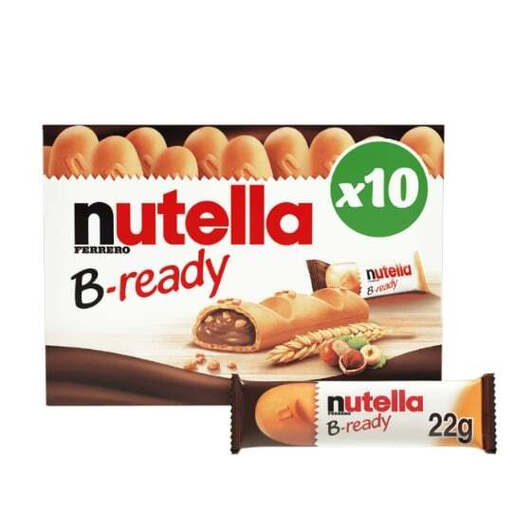 Image unavailable
For a snack you can take out with no preparation, this box contains ten filled wafers, each weighing 22 g. It’s not chocolate spread on its own.
The listed ingredients include hazelnuts, milk, soya, wheat and barley. Check the packaging and, if needed, follow the school’s guidance or your child’s PAI.
No: what’s in the portion matters more than its size. Nutella B-ready contains wheat and barley, while the breadsticks in the NUSTIKAO product contain wheat and barley. Always check the ingredients and possible traces for the exact product.
Check the label on every product and follow the guidance in place for your child. The French Ministry of Education says that an individual care plan can set out adjustments for a pupil with a food allergy. Choosing individually wrapped snacks alone doesn’t replace these measures.
No. According to Santé publique France, producers can choose whether to display the Nutri-Score; it supplements the mandatory nutrition declaration. Check the declaration and ingredients even when a Nutri-Score is shown.
Check what the comparison is based on, then look at the nutritional values for the products you’re interested in. The Auchan listing for Jardin Bio Étic claims 37% less sugar than the average chocolate spread on the market. This comparison alone doesn’t tell you how much sugar is in the portion you’ll serve.
No. The charge described in the French General Tax Code applies to drinks and liquid drink preparations, not chocolate spread. To compare sugar content, check the product’s nutritional information.