People doing a quick top-up shop
You’re looking for a useful quantity without building up a large stock, and want to compare the available sizes quickly.


For a quick top-up shop, choose a quantity that suits your needs, then check that the specific product and size you’ve chosen come in a glass jar. Also read the ingredients, allergen information and nutritional values: the packaging material tells you nothing about the product’s ingredients, and the Nutri-Score may not appear on the packaging.
You’re looking for a useful quantity without building up a large stock, and want to compare the available sizes quickly.
You want to check the packaging material before you buy, especially if you’re planning to recycle or reuse the jar once it’s empty.
You want to check the ingredients, allergens and nutritional information for the specific product you’re buying.
| What to consider | What to check | Who is it for? |
|---|---|---|
| Size | The net weight and how much you expect to use. | For a top-up shop, I’d rather choose an amount that suits my needs than buy a large jar to keep. This would be a priority for around 36% of consumers. |
| Packaging | Look for the word “glass” for the exact product and size; check local guidance if you plan to recycle the jar. | I want to know that the packaging is actually made of glass before choosing it, rather than relying on the word “jar” alone. Around 28% of consumers would make this a priority. |
| Ingredients | The ingredients, allergens and “may contain” information; sugars and fat per 100 g. | Before buying, I need to read the ingredients and check for allergens in this recipe. Around 36% of consumers would put checking the label first. |
According to the DGCCRF, displaying the Nutri-Score is voluntary. So its absence does not, on its own, mean that the jar is incorrectly labelled.
If the logo appears on the product, you can use it as a guide. In all cases, read the ingredients and nutritional values.
You need to check the material for the exact product and size you’ve chosen: the appearance of the packaging or the word “jar” isn’t enough.
Look for an explicit mention of glass on the packaging or on the product page for the specific item.
Carrefour France product pages for Jardin BiO étic and ETHIQUABLE products mention hazelnuts and milk, as well as possible traces of other ingredients depending on the recipe.
If you need to avoid an ingredient, check the allergen list and “may contain” information on the jar you’re buying.
Carrefour France lists several sizes of Nutella hazelnut and cocoa spread, including 220 g, 400 g, 630 g and 825 g.
Carrefour France describes a 300 g jar of organic Jardin BiO étic chocolate spread, with a glass jar and metal lid.
ETHIQUABLE describes its hazelnut spread as organic and Fairtrade.
This 350 g Nutella size could be a good option for a quick top-up shop. If you specifically want a glass jar, check the packaging material for this variant before choosing it.
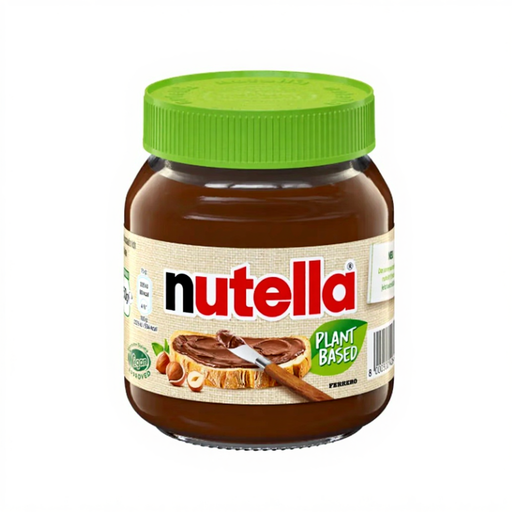 Image unavailable
The 350 g size could be suitable for an occasional purchase. Check the packaging for the material, ingredients, allergens and nutritional values for this variant.
No. The DGCCRF says that Nutri-Score is voluntary. Its absence does not replace or, on its own, call into question the nutritional declaration required for prepacked foods. Compare the ingredients and nutritional values shown on the products.
In particular, check the product name, net quantity, ingredients list, highlighted allergens and nutritional values. The DGCCRF identifies these as elements of the labelling for prepacked foods. Check the exact product, as recipes can differ.
Nutella says its glass jar can be reused, and that recycling depends on local facilities. Check your local authority’s recycling guidance, as well as the material of the lid on the product you’ve bought.
The contribution known as the “soda tax”, as described by the French Ministry of the Economy, applies to sugary drinks, not chocolate spreads. So don’t use it as a criterion when comparing these jars.