What should you look for before buying?
For a garden party, start with how you plan to use the jar, then compare labels and net weights. A larger size isn’t necessarily the right choice if you’re serving several spreads or desserts.
| Criteria |
What to check |
Consumers concerned |
| Glass jar and reuse |
Look for the explicit wording “glass jar” for the size you’ve chosen; check the manufacturer’s guidance before reusing it. |
If I want to keep the container for the table or after the party, I need to confirm what it’s made of rather than judge by its appearance. Around 36% of consumers would make this a priority. |
| Sugars and allergens |
Compare the “of which sugars” figure per 100 g and check the ingredients and any “may contain” warnings. |
When I’m serving several guests, I want to choose a recipe with their labels and allergens in mind. This would be a priority for around 29% of consumers. |
| How much to share |
Compare net weights and plan how many jars you’ll need, based on portions and the other food being served. |
For my buffet, I’d rather plan an appropriate quantity than open lots of jars or end up with too many leftovers. Around 21% of consumers would prioritise size. |
| Recipe and sourcing |
Check the details for the product you’ve chosen for claims about organic ingredients, palm oil or fair trade, depending on what matters to you. |
If ingredient origin or recipe formulation guides my choice, I want to read the claims for each recipe without assuming anything about the jar material. Around 14% of consumers would make this a priority. |
Spreads available on Joybuy
These chocolate and hazelnut, cocoa and hazelnut, and hazelnut and cocoa spreads let you compare quantities and recipes for a buffet. If a glass jar is essential for your garden party, check the material of the specific size before choosing it: a brand’s general description isn’t enough.
 Image unavailable
Nutella chocolate and hazelnut spread, 3 kg
The 3 kg size could suit a buffet where you’re expecting to serve a large quantity. Adjust your plans to the number of guests and the other food being served.
- Net weight: 3 kg.
- Check the sugars per 100 g and look for hazelnuts, milk and soya on the label.
- If glass is essential, confirm the material of this specific size.
View on Joybuy
 Image unavailable
Rigoni di Asiago Nocciolata Organic Cocoa & Hazelnut, 250 g
This 250 g size is ideal if you’d like to offer an organic cocoa and hazelnut spread alongside several other buffet options.
- Net weight: 250 g; described as an organic recipe.
- Check the information on hazelnuts, milk and soya before serving.
- Confirm the container material if you’re looking for a glass jar.
View on Joybuy
 Image unavailable
Nutella hazelnut and cocoa spread, 1 kg jar
The 1 kg jar gives you another size to compare with the 3 kg option, helping you plan for serving without assuming how much your guests will eat.
- Net weight: 1 kg.
- Check the nutrition information per 100 g and look for hazelnuts, milk and soya.
- If you plan to reuse it, check that this size comes in a glass jar.
View on Joybuy
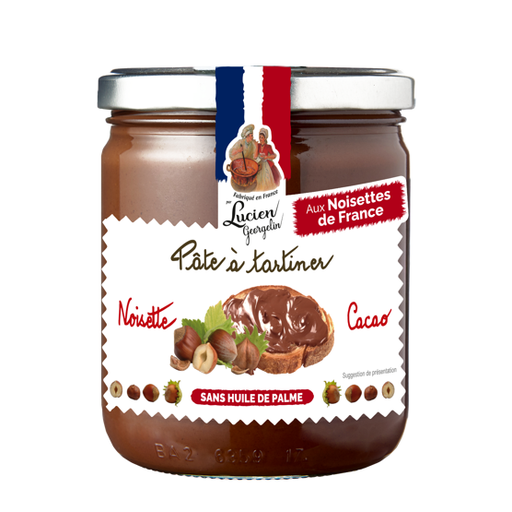 Image unavailable
Lucien Georgelin Lot & Garonne, hazelnut and cocoa spread, 400 g
This 400 g hazelnut and cocoa spread offers another size for your buffet, while letting you compare its ingredients with those in the other jars.
- Net weight: 400 g.
- The product details list hazelnuts and warn that it may contain other nuts, milk and gluten.
- Check the container material if reusing it is part of your decision.
View on Joybuy
 Image unavailable
Lucien Georgelin organic hazelnut and cocoa spread, 400 g
This 400 g product is a good option for comparing organic hazelnut and cocoa recipes for your buffet. The right quantity depends on what else you’re serving.
- Net weight: 400 g; described as an organic recipe.
- Check the information on hazelnuts and milk, as well as any warning that it may contain other nuts.
- Confirm the material of this container before relying on it being a glass jar.
View on Joybuy
Frequently asked questions
Is Nutri-Score compulsory on chocolate spread sold in France?
No. According to the Ministry of the Economy, nutrition declarations have been compulsory on prepacked foods since December 2016, but displaying Nutri-Score is optional. You can compare sugars per 100 g and ingredients even when there’s no logo.
Does the “soda tax” apply to chocolate spread?
No. The French levy set out in Article 1613 ter of the General Tax Code applies to drinks and liquid preparations for making drinks that contain added sugars, not to spreads. Sugar content is still useful nutrition information to compare across recipes.
How can you tell whether your chosen size comes in a glass jar?
Look for clear confirmation on the product page or packaging, rather than relying on the word “jar” or the material used for a different size. Carrefour confirms that its 300 g Jardin Bio étic product comes in a glass jar; check any other jar you’re considering separately.
Can you reuse a jar after the garden party?
It depends on the jar and how you plan to use it. Nutella France highlights ways to reuse its glass jars and, in a decorating tutorial, recommends washing them by hand. Follow the guidance for your particular container and don’t reuse a chipped jar.
What should you check about allergens before serving?
Read the ingredients and any “may contain” warnings for every product you’re serving. Carrefour’s product details for the Jardin Bio étic, Éthiquable and Lucien Georgelin recipes mentioned here list hazelnuts and milk, among other ingredients; some also warn that they may contain soya or other nuts.


