Gamers who want to avoid added sugars
For a break during a gaming session, you’re looking for a chocolate and hazelnut spread with no added sugars, while still checking the sugar content per 100 g.


For a gaming break, a spread labelled ‘no added sugars’ may suit you if you want to avoid added sugars, but it does not necessarily mean the spread is ‘sugar-free’: compare the ‘of which sugars’ figure per 100 g. If you’re considering a recipe made with maltitol, check the polyols too. A classic recipe is a separate option if reducing sugars isn’t your priority.
For a break during a gaming session, you’re looking for a chocolate and hazelnut spread with no added sugars, while still checking the sugar content per 100 g.
You check the ingredients as well as the ‘of which sugars’ figure, particularly when a recipe contains maltitol.
You’re not necessarily looking to avoid added sugars, but want to know what’s in the jar and how big it is before choosing it for a snack.
Start by deciding whether your priority is avoiding added sugars, steering clear of polyols or choosing a classic recipe. Then compare the labels on the same per-100 g basis.
| Criteria | What to check | Who it suits |
|---|---|---|
| Declared sugars | Distinguish ‘no added sugars’ from ‘sugar-free’, then check the ‘of which sugars’ figure per 100 g. | I want to avoid added sugars without assuming the spread contains none. Around 42% of consumers prioritise this distinction and the declared sugar content. |
| Sweeteners and polyols | Look for maltitol in the ingredients and check the amount of polyols if it is listed. | If I want to avoid polyols, a low sugar figure alone isn’t enough to compare the jars; around 33% of consumers put this first. |
| Classic recipe and jar size | Compare the ‘of which sugars’ figure, declared allergens and jar size with how you plan to use it. | I prefer to stick with a classic recipe and choose a size I’ll actually use. This is the priority for around 25% of consumers. |
A recipe with no added sugars may still contain sugars. Auchan’s product listings for the Lucien Georgelin 280 g jar and Gerblé hazelnut and cocoa spread show 8.5 g and 8.2 g of sugars per 100 g respectively.
After checking the claim on the front of the pack, look at the ‘of which sugars’ figure for the specific jar.
Auchan’s listing for the Gerblé hazelnut and cocoa spread states that it contains maltitol and 36 g of polyols per 100 g. The European Commission notes that the laxative effects of polyols should be taken into account.
Check the ingredients too, along with the amount of polyols if it appears on the label.
The DGCCRF describes Nutri-Score as a voluntary label. Article 1613 ter of the French General Tax Code, published by Légifrance, applies to drinks and liquid preparations for drinks, not to a jar of chocolate spread as such.
To compare these jars, look instead at their ingredients, nutritional information, allergens and size.
Joybuy’s Nutella 3 kg listing states that it contains hazelnuts, milk and soya. The Gerblé product listing reviewed states that it is made in a factory that also handles peanuts, tree nuts, soya and gluten, among other allergens.
Check the information for the exact product and choose a jar size that suits how much you plan to use.
The 280 g chocolate and hazelnut spread listed by Auchan is labelled ‘no added sugars’.
The no-added-sugars hazelnut and cocoa spread listed by Auchan contains maltitol.
The hazelnut spread listed by Carrefour as having ‘no added sugars’ contains, among other ingredients, hazelnut purée, date powder and cocoa.
The 3 kg product listed by Joybuy is included here as a classic recipe, not as a no-added-sugars option.
These three products are ranked here by their ‘of which sugars’ figure per 100 g, from lowest to highest. The figures come from Auchan listings for Gerblé and Lucien Georgelin, and Joybuy’s listing for Nutella 3 kg. This ranking is based on just one measure, so it doesn’t compare polyols, all the ingredients or jar sizes.
| Rank | Product | Details | Reason | Retailer |
|---|---|---|---|---|
| 1 | Gerblé hazelnut and cocoa spread with no added sugars, 200 g | 8.2 g of sugars and 36 g of polyols per 100 g; contains maltitol. | According to Auchan, this product has the lowest ‘of which sugars’ figure of the three jars ranked here. The presence of polyols is a separate factor to consider. | Auchan |
| 2 | Lucien Georgelin French hazelnut and cocoa spread with no added sugars, 280 g | 8.5 g of sugars and 433 kcal per 100 g. | According to Auchan, its ‘of which sugars’ figure is close to that of the Gerblé product ranked here; ‘no added sugars’ does not mean ‘sugar-free’. | Auchan |
| 3 | Nutella chocolate spread, 3 kg | 56.3 g of sugars per 100 g; contains hazelnuts, milk and soya. | Joybuy’s listing provides a figure for this classic recipe. It isn’t suitable if you’re looking for a spread with no added sugars. | Joybuy |
This spread suits you if you’re choosing a classic recipe for a gaming break. If your priority is avoiding added sugars, compare the ingredients and nutritional information of jars carrying that claim instead.
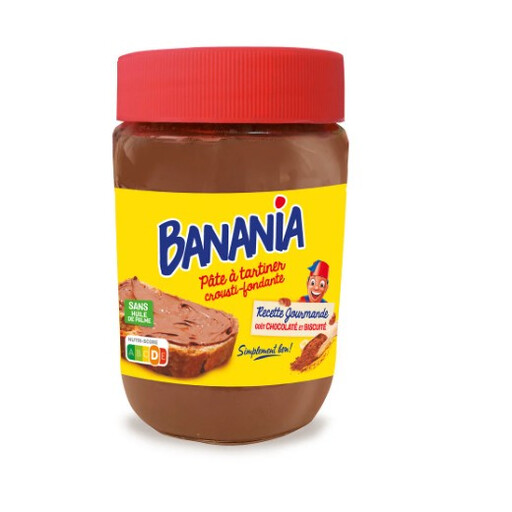 Image unavailable
This classic recipe is for consumers who don’t put avoiding added sugars first. It comes in a 400 g jar and is labelled ‘no palm oil’; check the ingredients and allergens on the jar before buying.
No. A chocolate spread with no added sugars may still contain sugars. Under the European regulation on nutrition claims, ‘sugar-free’ can only be used for products containing no more than 0.5 g of sugars per 100 g or 100 ml. For a jar, check the ‘of which sugars’ figure per 100 g.
Check both the ingredients and the amount of polyols, if it is listed. Auchan’s listing for the Gerblé hazelnut and cocoa spread mentions maltitol and 36 g of polyols per 100 g; the European Commission notes that the laxative effects of polyols should be taken into account.
No. The DGCCRF describes Nutri-Score as a voluntary label. Whether it is shown or not, it doesn’t replace checking the nutritional information and ingredients list for the product you choose.
No, not to a jar of chocolate spread as such. Under Article 1613 ter of the French General Tax Code, published by Légifrance, the levy applies to drinks and liquid preparations for drinks, so it doesn’t help you compare the chocolate spreads featured here.