Hosts keeping an eye on their budget
You’re serving several guests and want to choose a suitable quantity, without assuming that the biggest jar will necessarily meet your needs.


For a birthday party, choose a jar size based on how much you plan to serve and your budget, then compare the ingredients and nutritional information. If any guests have allergies, first check that the recipe and any ‘may contain’ warnings are suitable for them: a larger pack or a ‘plant-based’ label won’t answer that question.
You’re serving several guests and want to choose a suitable quantity, without assuming that the biggest jar will necessarily meet your needs.
You need to check the ingredients and any ‘may contain’ warnings on the jar you choose, particularly for milk, soya and hazelnuts. A recipe labelled as plant-based isn’t automatically suitable for someone with a milk allergy.
The hazelnut percentage shown on the label helps you compare recipes. Also check the sugars per 100 g and, if it appears on the product, the Nutri-Score.
For a birthday party, start by working out how much you’ll serve, check whether any guests have dietary requirements, then compare recipes using the labels.
| Criteria | What to check | Who it matters to |
|---|---|---|
| Quantity and budget | The net weight of the jar and how much you plan to serve. | If I’m hosting several people, I want to make sure there’s enough chocolate spread without choosing an unnecessarily large pack. Around 42% of consumers put quantity and budget at the top of their list. |
| Allergens | The ingredients in the specific jar and any ‘may contain’ warnings. | If a guest has an allergy, I need to know whether the recipe and any declared traces are suitable before serving it. This is the top priority for around 33% of consumers. |
| Recipe and sugars | The declared hazelnut percentage and the sugars per 100 g in the nutritional information. | If I’m looking for a particular chocolate and hazelnut recipe, I want to compare the ingredients rather than relying on the product name alone. Around 25% of consumers prioritise their choice of recipe. |
Santé publique France explains that displaying the Nutri-Score is voluntary. If it appears on the jars you’re comparing, it can provide an additional point of reference, but it doesn’t replace the ingredients list or nutritional information.
A large pack is only useful if the quantity matches what you plan to serve at the party or use afterwards.
First, work out how many guests you’ll have and how you’ll serve the chocolate spread, then check the net weight.
Nutella France states that Nutella Plant-Based may contain milk and isn’t suitable for people with an allergy to milk proteins.
If a guest has an allergy, read the ingredients and any ‘may contain’ warnings on the exact product packaging. Don’t assume it’s suitable based on the recipe name.
According to Santé publique France, displaying the Nutri-Score is voluntary and it complements the nutritional information. So even if it isn’t shown, you should still read the label.
To compare two similar chocolate spreads, check the sugars per 100 g, ingredients and allergens in particular, then look at the Nutri-Score if it’s displayed.
The provisions of the French General Tax Code set out by Légifrance apply to drinks and liquid preparations for drinks; chocolate spread isn’t a drink.
Check the sugar content to compare recipes, but don’t confuse it with the scope of this levy.
The range includes several sizes of cocoa and hazelnut spread, as well as a separate Plant-Based recipe.
The 750 g hazelnut-flavoured spread listed by E.Leclerc is an example of a larger pack to consider when serving a group.
The 400 g spread listed by E.Leclerc lets you consider a recipe with a declared hazelnut percentage.
ALDI France sells a 400 g jar of milk and hazelnut spread under this brand.
These Nutella jars come in different sizes, so you can choose a quantity to suit your party. Before serving, check the ingredients and allergens on the packaging of the jar you choose.
 Image unavailable
Consider the 3 kg jar if you’re planning to serve a large quantity. Check the allergens on the label before offering it to your guests.
 Image unavailable
The 1 kg net weight makes it easy to compare this jar with the quantity you’re planning for your guests. Read the ingredients and allergen warnings before serving.
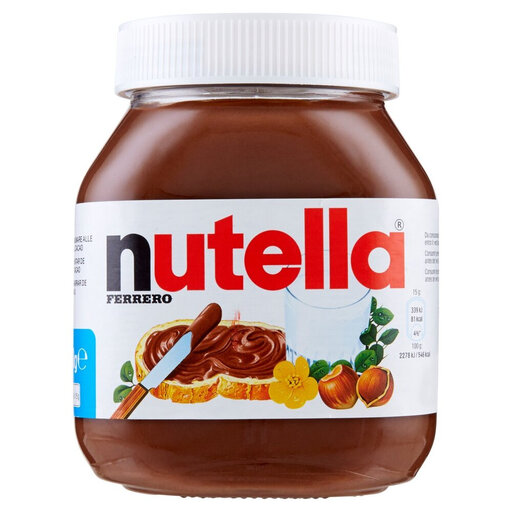 Image unavailable
Compare this 630 g jar with the other sizes based on how much you plan to serve. Check the label on the exact jar for its ingredients and nutritional information.
 Image unavailable
The 750 g size is another option to consider for your party. Before serving, check the jar for ingredients, allergens and sugars per 100 g.
No, chocolate spread isn’t a drink. The provisions of the French General Tax Code set out by Légifrance apply to drinks and liquid preparations for drinks intended for human consumption. Sugar content is still worth checking when comparing chocolate spreads.
No, displaying it is voluntary in France, as Santé publique France explains. If it appears on the jar, use it alongside the ingredients list and nutritional information, including the sugars per 100 g.
Not necessarily. Nutella France states that Nutella Plant-Based may contain milk and isn’t suitable for people with an allergy to milk proteins. Check the information on the exact product before offering it to a guest with an allergy.
Follow the storage instructions and best-before date shown on the jar. If several people are helping themselves, use clean utensils and avoid putting food back in the jar if it has already come into contact with other dishes.