Organisers looking for verifiable fibre content
You want to serve a powder that genuinely meets the threshold for the ‘high in fibre’ claim, rather than relying on the fact that it contains cocoa or cereals.


To choose a fibre-rich chocolate powder for a meeting break, first check the declared fibre content of the exact product. Under the European regulation published on EUR-Lex, the claim ‘high in fibre’ requires at least 6 g of fibre per 100 g or 3 g per 100 kcal. Abbaye de Sept-Fons declares 11 g per 100 g for Germacao, while Auchan’s product listing for Banania 1 kg states 6.7 g per 100 g. Then compare sugars on the same basis, check allergens and consider the pack size before choosing for your group.
You want to serve a powder that genuinely meets the threshold for the ‘high in fibre’ claim, rather than relying on the fact that it contains cocoa or cereals.
You want to compare fibre and sugar content per 100 g of powder for the same product. This is especially useful when you’re considering several cocoa-and-cereal recipes.
You need to choose a pack size that suits the number of breaks planned and check the allergen information before serving the powder to participants.
For a meeting break, start with your main priority, then check the ingredients and pack size of the product you’re considering.
| Factor | What to check | Who is it for? |
|---|---|---|
| Fibre | Check the fibre content per 100 g of powder. According to EUR-Lex, the European threshold for the ‘high in fibre’ claim is 6 g per 100 g or 3 g per 100 kcal. | If I’m specifically looking for a high-fibre powder, the presence of cereals isn’t enough: I want a declared value for the recipe I choose. Around 46% of consumers make this their priority. |
| Sugars | Compare the ‘of which sugars’ figure per 100 g for every option you’re considering, as well as the amount of powder you plan to use per cup. | If I want to serve a recipe with a sugar content that suits me, I need to check its own label, even if it also meets the fibre threshold. This is the top priority for around 27% of consumers. |
| Serving a group | Check the pack size, storage instructions after opening and allergen information for the product you’re buying. | If I’m planning several breaks, I want a pack that works for that purpose and a recipe whose allergens I can check before serving. This is the main consideration for around 27% of consumers. |
The ingredients alone don’t tell you how much fibre a product contains. The European regulation published on EUR-Lex sets a specific threshold for this claim.
Check the nutritional information for the exact recipe: to claim ‘high in fibre’, it must contain at least 6 g of fibre per 100 g or 3 g per 100 kcal.
Auchan’s product listing for Banania 1 kg states that it contains 6.7 g of fibre and 69 g of sugars per 100 g of powder. Fibre content therefore doesn’t tell you how much sugar it contains.
Compare both figures per 100 g for each option you’re considering.
A fibre figure or the presence of cereals doesn’t prove what effect participants will feel during the meeting.
Make your choice based on the ingredients, nutritional values and serving requirements, without promising an individual effect.
According to Santé publique France, displaying Nutri-Score is voluntary. Its presence doesn’t replace checking the nutritional information and ingredients.
If it appears on the pack, use it as an additional guide, then check the fibre, sugars and allergens.
Germacao and Gaborcao are two recipes combining cocoa with other cereal ingredients, including wheatgerm in Gaborcao.
A cocoa-and-cereal-based chocolate powder, available in a 1 kg pack, among other sizes.
The range includes a classic powder and varieties described as having less sugar.
The products reviewed include Super Poulain and an organic powder labelled as containing 34% cocoa.
Carrefour’s range includes several chocolate powders, as well as pure cocoa and organic recipes.
These chocolate powders, available in sizes from 400 g to 1 kg, are worth considering for a meeting break. Check the ingredients of each product before choosing the one that best suits your priorities.
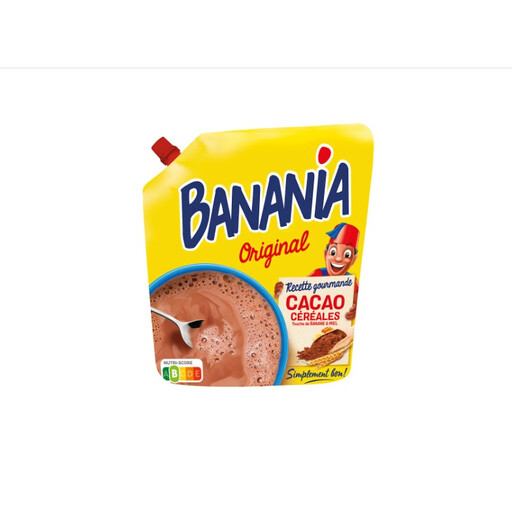 Image unavailable
The 1 kg pack may be a good option if you’re planning several breaks. However, the name Bananina alone isn’t enough to identify this as the Banania 1 kg product whose nutritional values are listed above. Check the name, fibre, sugars and allergens on the product you receive.
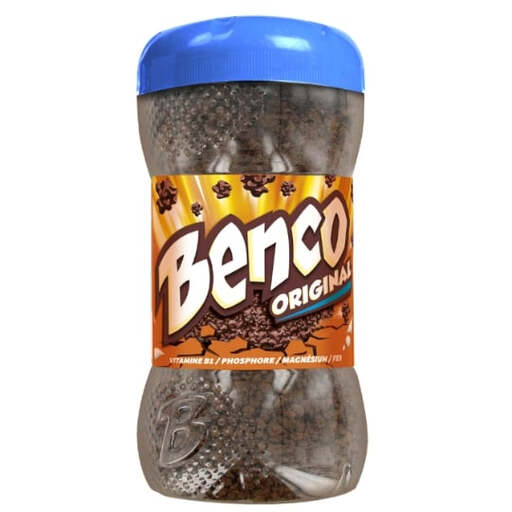 Image unavailable
This 800 g pack is worth considering if your group will be using the powder for several breaks. To compare it with other recipes, check the fibre and sugar content per 100 g, and read the allergen information on the pack.
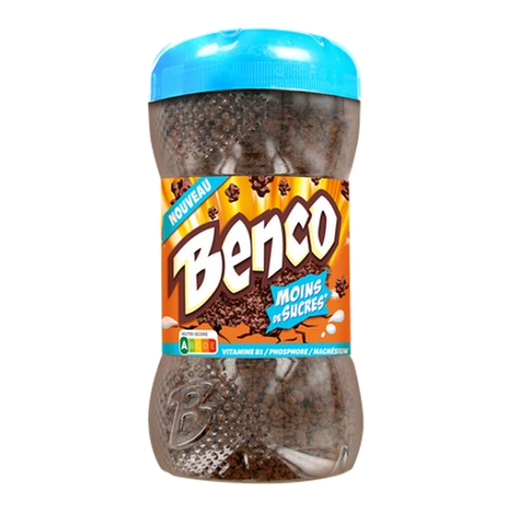 Image unavailable
The 400 g pack is worth considering if you need a smaller amount of powder. The Less Sugar name alone doesn’t tell you how this recipe compares with others: check the sugar and fibre content per 100 g, then the allergen information for the product you’re buying.
Under the European regulation published on EUR-Lex, it must contain at least 6 g of fibre per 100 g or 3 g per 100 kcal. When comparing powders before making drinks, check the figure given for the powder itself.
No. Santé publique France says that displaying it is voluntary. Whether or not it appears on the pack, check the nutritional information and ingredients list to compare products.
Article 1613 ter of the French General Tax Code, in the version in force since 1 July 2026 and published by Légifrance, covers, among other things, drinks and liquid preparations for drinks that are packaged for retail sale and contain added sugars. Dry powder does not fall within this description. For a different product or type of packaging, its specific characteristics need to be considered.
Not necessarily. Joybuy’s listing for Banania 1 kg flags gluten and possible traces of milk and soya. Before serving a product to the group, check the allergen information on its packaging; don’t assume the information for Banania applies to a product with a different name.