Households that often share
For several breakfasts, snack times or a group activity, a large pack makes sense if the number of pastries matches how many you expect to eat.


Choose the number of chocolate pastries based on how many you expect to eat before the date shown on the pack. A large pack works well for regular sharing, while individually wrapped portions make lunchboxes easier to prepare. A mid-sized pack may help a smaller household avoid leftovers. Also check the portion weight, sugars per 100 g and allergens on the packaging of the product you choose.
For several breakfasts, snack times or a group activity, a large pack makes sense if the number of pastries matches how many you expect to eat.
Individually wrapped portions make it easier to divide them up. Before putting one in a lunchbox, check the allergens on the packaging of the product you bought.
To compare two products, look at the nutritional values per 100 g, the ingredients and the allergens, rather than just the pack size.
Start by working out how many portions you need and how you’ll share them, then compare the labels of packs that suit your needs.
| What to consider | What to check | Who this matters to |
|---|---|---|
| Quantity without leftovers | Number of pastries, net weight and date shown. | For shared snacks on several occasions, I want enough pastries without leaving an opened pack unfinished. Around 42% of shoppers prioritise getting the quantity right for how they plan to use them. |
| Portions to hand out | Whether individual wrappers are actually included and how many portions there are. | If I’m preparing several lunchboxes, separate portions save me having to wrap each pastry myself. This convenience is the main priority for around 33% of shoppers. |
| Ingredients and allergens | Sugars per 100 g, ingredients and allergens in the product you choose. | Before choosing a pack, I want to read the ingredients and compare sugar levels on the same basis. For around 25% of shoppers, these checks matter more than the pack size. |
In France, the DGCCRF says that displaying it is voluntary. Nutritional information, which is generally required for prepacked foods, still lets you compare values per 100 g.
In particular, check the ‘sugars’ line. If the packaging displays a Nutri-Score, use it as additional information.
The products listed by Carrefour, Auchan and ALDI contain between 8 and 20 pastries, with different total weights. A large pack could leave you with portions you don’t use.
Check the net weight, the date shown and how many you expect to eat before choosing a pack size.
Ingredients vary between products. Auchan also notes that a product’s ingredients may differ depending on the chosen delivery service and the date of purchase.
If you’re preparing a lunchbox for someone with an allergy, check the ingredients and allergens on the packaging of the product you actually bought.
The French Ministry of the Economy describes this levy as applying to sugary drinks, not chocolate pastries.
To compare chocolate pastries, use the nutritional information, especially the sugars per 100 g.
Carrefour lists a 16-piece Classic pack and a 20-piece SIMPL pack weighing 1.2 kg.
Auchan lists a 20-piece pack weighing 900 g and an 8-piece pack weighing 360 g, with individually wrapped portions.
ALDI lists a 10-piece LES PATISSADES pack weighing 450 g.
Lidl describes a pure-butter chocolate pastry baked in store and sold individually.
Bridor offers, among other products, a 28 g SelectBlend mini chocolate pastry for professional customers.
This selection features six chocolate rolls to bake at home, giving you several portions to prepare. Check that the product name and preparation method match the chocolate pastries you’re looking for; the multipack does not confirm that the pastries are individually wrapped for lunchboxes.
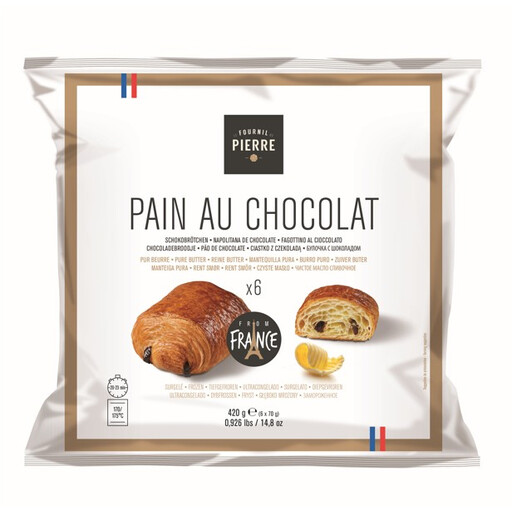 Image unavailable
This multipack is suitable for preparing several portions at home if you’re looking for a product to bake, rather than a pastry that’s ready to eat.
The title states 6 pieces weighing 420 g. The information for this product says to store it at −18 °C and advises against refreezing after defrosting. Check the packaging if you need individually wrapped portions or need to check allergens.
No. The French Ministry of the Economy describes this levy as applying to sugary drinks. To compare the sugar content of chocolate pastries, check their nutritional information instead.
No. In France, the DGCCRF says that the Nutri-Score is voluntary. Nutritional information is generally required for prepacked foods and includes sugars per 100 g, among other values.
Compare the nutritional values per 100 g, then consider the portion you expect to eat. Also check the ingredients, allergens, net weight and number of pastries.
No: check the allergens for the exact product before preparing the lunchbox. Some of the products listed by Auchan and Bridor include ingredients containing wheat, milk, soya or eggs, depending on the product. Always check the packaging of the one you bought.
Not necessarily. The 20-piece packs listed by Carrefour and Auchan have different total weights, and the quantity is only useful if the portions match how many you expect to eat. Check the net weight and the date shown before choosing.