Small household keen to avoid leftovers
You buy a few at a time and want a pack size that suits how much you eat. If you have a freezer, a small ready-to-bake pack could let you bake only as many as you need.


For a chocolate pastry you can pop into your gym bag without any preparation, choose a ready-to-eat product in an individual wrapper, provided you can get through the whole pack at your own pace. If you have a small household and a freezer, a ready-to-bake frozen pack lets you prepare as many as you need, but you’ll have to plan ahead for baking. Also compare the number of pastries, storage instructions and nutritional information for each product.
You buy a few at a time and want a pack size that suits how much you eat. If you have a freezer, a small ready-to-bake pack could let you bake only as many as you need.
You want to set off with a pastry that’s ready to eat, without baking or needing an extra container. An individually wrapped option is convenient to take with you; just check that the pack contains the right number for you.
You want to compare the sugar, fat, salt and allergen information for the products you’re considering. The DGCCRF points out that Nutri-Score is voluntary, so its absence is no substitute for checking the nutritional information on prepacked food.
For a snack to take with you, first decide whether it needs to be ready when you leave or whether you can bake it in advance. Then choose a pack size that matches how often you eat them.
| Criterion | What to check | Who it matters to |
|---|---|---|
| Pack size | Number of pastries and storage instructions. | In a small household, I want to finish the pack at my own pace rather than end up with a pile of pastries. Around 40% of consumers prioritise getting the quantity right. |
| Ready to take away | Whether it’s ready to eat and individually wrapped. | Before setting off with my gym bag, I’d rather take a pastry that’s already protected, without having to bake it first. Around 30% of consumers put convenience for taking food with them first. |
| Ingredients and nutrition | Ingredients, allergens and nutritional values per 100 g; per serving if provided. | To choose between two products, I want to be able to check the sugar, fat and allergen information on the packaging. Comparing labels is the main priority for around 20% of consumers. |
| Recipe and baking | Preparation method and the type of fat listed in the ingredients. | I’d rather bake a pastry at home and am happy to allow time for it before taking it with me. Around 10% of consumers prioritise this type of preparation or the recipe. |
For the products listed by Auchan and E.Leclerc, the size is given as a number of pastries and a total weight. The term “half pastry” doesn’t tell you how many snacks are in the pack.
Compare the number of pastries, their weight if listed, and how often you expect to eat them.
The DGCCRF says that displaying it is voluntary. Its absence alone doesn’t tell you what the product contains.
Read the ingredients, allergens and nutritional values per 100 g, and take the serving size into account if it’s provided.
This describes the recipe, not the product’s overall nutritional values. E.Leclerc’s product listing for Epi d’Or all-butter chocolate pastries shows a Nutri-Score of E.
If ingredients and nutrition guide your choice, compare the labels on the products you’re considering rather than relying on this claim alone.
E.Leclerc lists a 20-piece ECO+ pack, while the Epi d’Or product contains 6. A ready-to-bake product isn’t something you can take with you like a pastry that’s already baked.
Before buying, check you have enough freezer space, the number of pastries in the pack and the baking instructions.
Carrefour lists a ready-to-eat pack of 8 chocolate pastries in a 360 g bag.
Auchan lists an 8-piece, 360 g pack in individual wrappers, as well as a 10-piece, 450 g Pouce pack without individual wrappers.
E.Leclerc lists ready-to-bake frozen chocolate pastries under this brand, in a 20-piece pack weighing 1.2 kg.
E.Leclerc lists a ready-to-bake frozen all-butter product, with 6 pastries weighing 450 g in total.
Bridor lists an 85 g professional-use chocolate pastry dough product, ready to prove.
ALDI France lists a 10-piece chocolate pastry pack under its Les Pâtissades range.
This selection features a chocolate pastry to bake. It may suit you if you have a freezer and can prepare your snack before setting off. The product name doesn’t confirm that it’s a pain au chocolat.
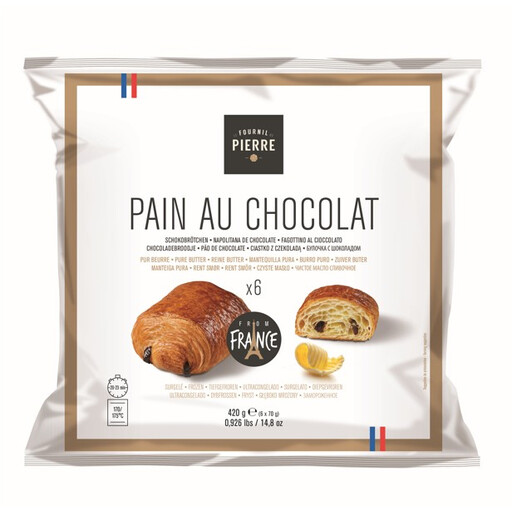 Image unavailable
Worth considering for a small household that’s happy to bake its snack in advance. The pack contains 6 pastries and weighs 420 g; it’s not ready to pop straight into your bag. Check the baking instructions, how the pastries are packed and the allergens on the packaging.
No. The legislation published by Légifrance covers drinks and liquid preparations for drinks, subject to the conditions set out for those products. A solid chocolate pastry isn’t covered. To compare two pastries, check their nutritional information instead.
No. The DGCCRF describes Nutri-Score as a voluntary label. For prepacked food, check the ingredients, allergens and nutrition declaration, whether or not Nutri-Score is shown.
Read the ingredients and the allergens highlighted on the packaging of the product you’re buying. Ingredients vary between products: those listed by Auchan, E.Leclerc and Bridor mention wheat or gluten, milk, eggs or soya, depending on the product.
Choose a pack with a number of pastries that suits how much you eat, and check that it’ll fit in your freezer. Ready-to-bake products let you prepare only as many as you need, provided you follow the storage and baking instructions for that product.