Hosts who care about ingredients
For a special meal, you want to compare a specific feature, such as a named butter designation or the stated proportions of butter and chocolate, rather than relying on the word ‘premium’ alone.


For a National Day buffet, first choose between chocolate pastries that are ready to serve and those that need baking, depending on when you plan to serve them and how much time you have. Then compare the number of pieces and the ingredients listed: an assortment of mini pastries makes it easier to offer smaller portions, but it won’t contain chocolate pastries exclusively.
For a special meal, you want to compare a specific feature, such as a named butter designation or the stated proportions of butter and chocolate, rather than relying on the word ‘premium’ alone.
You have an oven and can factor baking – and possibly defrosting beforehand – into your meal preparations.
Before serving your guests, you need to check the allergens, any possible traces and the nutritional information for the product you choose.
For this meal, first decide how you’ll serve them and how many portions you need. Then compare the recipes and the information shown on each product.
| Criteria | What to check | Who is it for? |
|---|---|---|
| Recipe | Type of butter and the proportions of butter and chocolate, where stated. | For this special meal, I want a recipe with clearly stated characteristics. Around 37% of consumers would prioritise this criterion. |
| Size and serving | Number of pieces, weight per piece, and whether they’re ready to serve or need baking. | If I’m putting together a buffet, I need to plan the portions and how they’ll be served. This would be the main priority for around 27% of consumers. |
| Allergens and nutrition | Allergens and possible traces for the product you buy; nutritional values per 100 g. | Before serving my guests, I need to check the ingredients and allergens in each product. Around 27% of consumers would make this their top priority. |
| Preparation time | Defrosting, baking and storage instructions for the product you choose. | When it’s nearly time to serve, I want to know whether preparation fits into my schedule. Ease of preparation would be a priority for around 9% of consumers. |
The European Commission distinguishes between mandatory nutritional information and additional food information provided voluntarily. So, a product without a Nutri-Score on the front of the pack shouldn’t automatically be ruled out.
If a Nutri-Score is displayed, check it for the specific product, then look at the nutritional values, ingredients and allergens too.
Article 1613 ter of the General Tax Code, published by Légifrance, applies to drinks and liquid preparations for drinks. This levy isn’t a factor when choosing chocolate pastries.
To compare their sugar content, use the nutritional values given per 100 g.
Instructions vary by product: Carrefour gives a baking time of 18 to 20 minutes for Classic’, while Auchan also recommends defrosting its product beforehand.
Check the exact instructions and plan your batches before deciding when to serve them.
Frozen products also need suitable storage space, and you must follow the instructions after defrosting.
These descriptions relate to the recipe or the origin of the butter; they don’t replace nutritional information or details about allergens.
Compare the recipe you’re looking for, the allergens and the nutritional values per 100 g separately.
A 70 g frozen product designed to be baked before serving.
Two products suit different plans: a Carrefour Traiteur assortment for eight people and Classic’ chocolate pastries that need baking.
A box of six chocolate pastries and an assortment of mini pastries let you choose between standard-size pieces and smaller portions.
A frozen pack of six pure-butter chocolate pastries, with preparation instructions provided in its product information.
This six-piece pack is suited to serving them warm after baking at home. Check the preparation instructions before planning your meal.
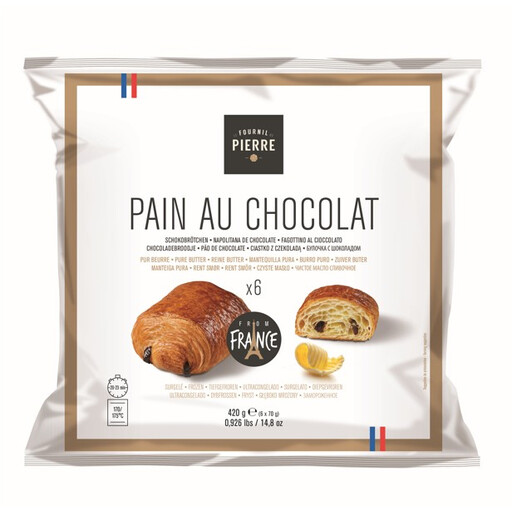 Image unavailable
This pack is a good choice if you’re planning to bake the chocolate pastries before serving. Check the packaging for the baking time and temperature, as well as the allergens in the product you buy.
No. The European Commission distinguishes between mandatory nutritional information and additional food information provided voluntarily. Check the nutritional values and allergens for the exact product, whether or not it displays a Nutri-Score.
Read the labelling on the product you choose, including any possible traces. The Bridor, Carrefour, E.Leclerc and Auchan product information mentioned here lists ingredients such as wheat, milk, eggs or soya; check the ingredients for each product.
Follow the instructions for the product you buy, and allow time to defrost it before baking if required. Carrefour gives an oven time of 18 to 20 minutes for Classic’; Auchan recommends defrosting for 15 minutes, then baking for 15 to 20 minutes at 180 °C.
No. The stated proportion tells you one thing about the recipe, but it doesn’t by itself indicate which product you’ll prefer or which is more nutritious. Also compare the size, the chocolate content where stated, the allergens and the preparation required.
No, not when it comes to chocolate pastries: Article 1613 ter of the General Tax Code, published by Légifrance, applies to drinks and liquid preparations for drinks. If sugar content matters to you, check the nutritional values per 100 g instead.