Who is this guide for?

Cyclists looking for a dessert after a ride

You’re after a chocolate cone to enjoy after cycling or with a meal, without mistaking it for a sports-fuelling product. For this choice, the portion and when you eat it matter more than any claims linking it to sport.

Fans of a rich cocoa flavour

You’d rather check the ingredients for dark chocolate, cocoa mass or cocoa than judge by the colour of the ice cream or packaging.

People who need to avoid certain ingredients

Before choosing a flavour, check the ingredients and allergen information on the exact product packaging, particularly for milk, wheat, soya or nuts.

What should you look for first?

When choosing a chocolate cone to enjoy around your cycling, first check what goes into the recipe, then compare the portion size and nutritional information. If you avoid an ingredient, check the allergens before looking at these other factors.

What to consider What to check Who is it for?
Cocoa profile Look for dark chocolate and cocoa mass, and check their proportions if these are stated in the ingredients list. I want to tell the difference between a cocoa flavour and a cone that’s mostly vanilla or caramel, without judging by its appearance alone. Around 50% of consumers may put this first.
How the dessert fits around cycling Compare the nutritional values on the same basis, per 100 g or per 100 mL, then consider the portion you’ll actually eat. After a ride, I want to enjoy a portion of dessert without treating it as a fuelling plan. This may be the top priority for around 30% of consumers.
Allergens Read the allergen information and any “may contain” warnings on the packaging of the variant you’ve chosen. If I avoid milk, wheat, soya or nuts, whether the recipe is suitable comes before the flavour. Around 20% of consumers may put this first.

Mistakes to avoid

  • Assuming that declared dark chocolate means a high cocoa content

    Carrefour Extra and TRIUM’s product information lists 0.6% and 0.5% dark chocolate in their recipes, respectively. These percentages confirm that it’s present, but on their own they don’t tell you what the cone tastes like or its overall cocoa content.

    Check the percentages and the full ingredients list. Compare the sugar and fat separately in the nutritional information.

  • Relying on a cone to fuel your ride

    The make-up and timing of your food and drink matter as part of a sports nutrition strategy, as highlighted in the American College of Sports Medicine’s position statement. An ice cream dessert alone doesn’t determine what you need to fuel a ride.

    Plan what you’ll eat during exercise separately from whether you’ll have a cone for dessert.

  • Overlooking allergens behind the chocolate flavour

    A cone may contain ice cream, a wafer and toppings. Depending on the recipe, milk, wheat, soya or nuts may be listed as ingredients or included in “may contain” warnings.

    Check the packaging of the exact product, even if you know another flavour from the same brand.

  • Assuming a product is available everywhere

    Product availability can vary from one shop to another. E.Leclerc, for example, states that its stores manage their own stock locally.

    Check availability at the shop or click-and-collect location you plan to visit before setting off.

Brands to compare

Magnum

The chocolate and hazelnut cone described by Carrefour France combines wafer, chocolate and hazelnut; it isn’t presented as a dark chocolate cone.

  • Its ingredients list separately identifies cocoa butter, fat-reduced cocoa, cocoa mass and hazelnuts.
  • If you’re specifically looking for dark chocolate, check the variant you’ve chosen rather than assuming what it contains from the brand name alone.

Cornetto

The hazelnut and caramel product described by Carrefour France contains cocoa and dark chocolate chips, but the recipe isn’t all about dark chocolate.

  • The ingredients list lets you distinguish the dark chocolate chips from the cone’s other components.
  • Check availability at your local shop, and don’t assume the chips define the flavour of the whole ice cream.

Carrefour Extra

Carrefour Extra’s chocolate cones are one option whose Carrefour France product information explicitly lists dark chocolate.

  • The product information lists 0.6% dark chocolate in the recipe, giving you a precise indication of its presence.
  • This percentage doesn’t prove that the overall cocoa content is high; check the packet for allergen information too.

TRIUM (Marque Repère, E.Leclerc)

The TRIUM chocolate cones described by E.Leclerc combine a chocolate-flavoured recipe with toppings and list dark chocolate.

  • The product information lists 0.5% dark chocolate, confirming its presence rather than merely suggesting a chocolate flavour.
  • This percentage alone doesn’t mean the cone has an intense cocoa flavour; check availability with your local store too.

Auchan

The vanilla and chocolate ice cream cones described by Auchan France are worth comparing if you’re looking at vanilla and chocolate recipes, rather than specifically seeking a product that lists dark chocolate.

  • The product information lists cocoa powder and fat-reduced cocoa as separate ingredients.
  • The product described doesn’t list dark chocolate; it includes milk, wheat, soya, almonds and hazelnuts, among other ingredients.

Chocolate cones on Joybuy

This pack of chocolate ice cream cones is for anyone looking for a dessert to enjoy as part of their cycling day, not a product to fuel a ride. Check the packaging to assess the cocoa profile and find a portion size that suits you.
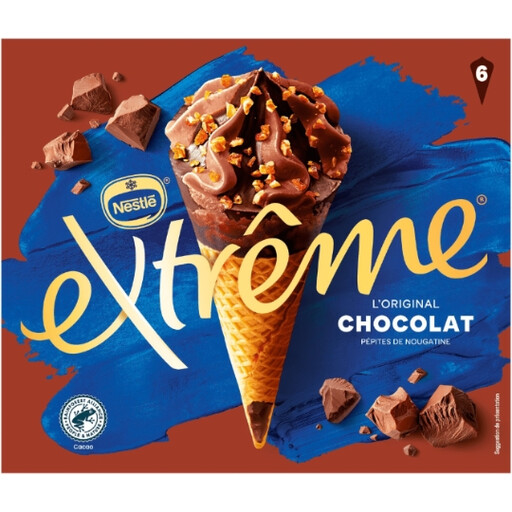
EXTRÊME chocolate ice cream cones, pack of six, 426 g

EXTRÊME chocolate ice cream cones, 6 pack, 426 g

A cone-shaped dessert to enjoy after a ride or with a meal, rather than as fuel while cycling.

The pack contains six cones, weighing 426 g in total. Check the ingredients, allergens and nutritional information on the packaging of the variant you buy.

View on Joybuy

Frequently asked questions

Does a “chocolate” cone always contain dark chocolate?

No. Check the ingredients list for the exact product: Carrefour France lists 0.6% dark chocolate in its Carrefour Extra cones, while E.Leclerc lists 0.5% in its TRIUM cones. The word “chocolate” on its own doesn’t tell you what the product contains.

Can I have a cone before a bike ride?

A cone can be a dessert, but it doesn’t replace food planned for your ride. The American College of Sports Medicine highlights the importance of what you eat and when as part of a sports nutrition strategy. Consider how long your ride will be and what you usually tolerate, rather than trying a new food just before a demanding effort.

How do I compare the nutritional values of two cones?

First compare their nutritional information on the same basis, per 100 g or per 100 mL, then check the portion listed for each cone. The DGCCRF notes that presenting information per 100 g or 100 mL makes comparisons easier. Look in particular at energy, fat and sugars, but don’t use these figures alone to decide whether a product suits your sporting activity.

Where can I check the allergens in an ice cream cone?

Read the ingredients list and any “may contain” warnings on the packaging of the variant you buy. The DGCCRF states that allergens in prepacked food must be emphasised in the ingredients list. Another flavour from the same brand may have a different recipe.

How should I store cones after buying them?

Follow the instructions on the packaging. For its vanilla and chocolate cones, Auchan France recommends storing them in the freezer at −18 °C and says not to refreeze a product once defrosted. Check the instructions for the exact product you buy.