Shoppers comparing sizes
If you buy spread regularly for breakfast or an afternoon snack, consider the jar’s weight alongside how much your household usually gets through.


When shopping locally, first choose a jar that suits how quickly you’ll use it, then compare the recipe and nutritional information per 100 g. A higher hazelnut content may suit your preferences, but it isn’t enough on its own to assess sugars, fat or allergens.
If you buy spread regularly for breakfast or an afternoon snack, consider the jar’s weight alongside how much your household usually gets through.
If the hazelnut content or type of fat matters to you, check the ingredients for each product rather than relying on the range name alone.
Hazelnuts, milk, soya and ‘may contain’ warnings vary between products. Check the label on the jar you choose before buying.
Start with how much you’ll use, then compare the recipe and nutritional values on the same per-100 g basis. Always check the exact product for allergen information.
| Criteria | What to check | Who it matters to |
|---|---|---|
| Size | Net weight of the jar and whether the quantity suits how much you use. | If I buy it regularly, I want a jar my household can use at its usual pace. Around 36% of consumers would put this choice of size first. |
| Nutritional values | Sugars and saturated fatty acids per 100 g; Nutri-Score, if shown on the product. | If I’m comparing two recipes, I need to read their values on the same basis rather than relying on how they’re presented. Nutritional information would be the top priority for around 29% of consumers. |
| Ingredients and allergens | Hazelnut content, ingredients list and any ‘may contain’ warnings on the exact jar. | If certain ingredients need to be avoided, I check the label before choosing a recipe. Around 21% of consumers would make this their first check. |
| Storage and availability | Product-specific storage instructions and whether the product is available at your chosen retailer. | I prefer to choose a jar I can find near home and store according to its label. This would be the top priority for around 14% of consumers. |
Santé publique France says that displaying the Nutri-Score is voluntary in France. Even when it appears on the jar, it doesn’t replace checking the nutritional values and ingredients.
Compare sugars and saturated fatty acids per 100 g, then check the ingredients list.
This claim tells you that one ingredient is absent, not how much sugar the recipe contains or which allergens it includes. For example, Carrefour’s product page for Jardin Bio Étic lists hazelnuts and milk.
Check the fats listed, nutritional values, allergens and any ‘may contain’ warnings separately.
A chocolate and hazelnut recipe available in several sizes, making it useful for comparing jar contents and ingredients.
An E.Leclerc product sold in a 1 kg jar.
An E.Leclerc range whose documented product comes in a 750 g jar.
The documented E.Leclerc product highlights the hazelnut content stated on its product page.
Worth considering if an organic recipe and no palm oil are among your preferences.
These four Nutella jars offer a choice of size for different needs. To compare the recipes, check the information on each jar.
 Image unavailable
A size to consider if you use it regularly and it suits how quickly your household gets through a jar.
Check the allergens and nutritional values on the jar’s label.
 Image unavailable
This size is suited to frequent or larger-scale use. Make sure it matches how much you consume.
Follow the storage instructions on the product.
 Image unavailable
This size may suit you if you’re looking for something smaller than the 1 kg and 3 kg jars featured here.
To compare the recipe, check the values per 100 g and allergens on the jar.
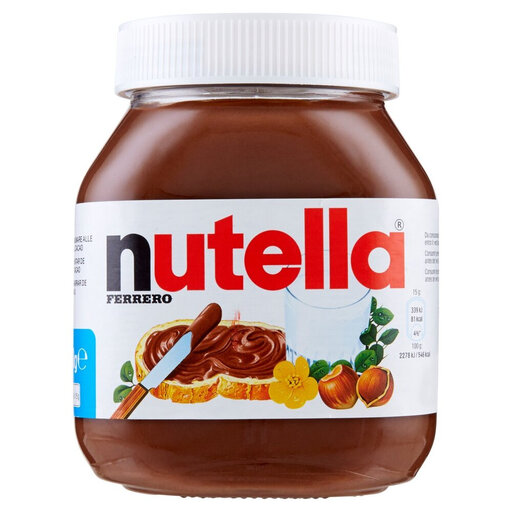 Image unavailable
This size gives you the option of a smaller jar than the other three featured here.
If sugar content is important to your comparison, check the per-100 g value on this jar’s label.
No. Santé publique France says that displaying the Nutri-Score is voluntary in France. When comparing two jars, also check their nutritional values per 100 g and their ingredients.
Check in particular for hazelnuts, milk and soya, which feature in several documented recipes. Also read any ‘may contain’ warnings on the label of the product you’re buying.
Follow the instructions for the product you’ve chosen. For its Pouce spread, Auchan advises keeping the jar away from heat and moisture and not refrigerating it; this doesn’t automatically apply to other products.
The claim ‘palm oil-free’ doesn’t tell you how much sugar the spread contains. Compare the values per 100 g and check the ingredients and allergens on each jar separately.