Groups staying in a holiday rental or campsite
If several people plan to have breakfast or snacks at your accommodation, estimate how much you’ll get through and check that you’ll have somewhere cool to store a large jar.


A large jar of chocolate and hazelnut spread is a good choice if several people will enjoy it more than once during your stay and you can follow the storage instructions. For a small group or a short stay, a 350 to 400 g jar helps limit how much you have left once opened. Either way, compare the ingredients, allergens and nutritional values per 100 g; according to Santé publique France, Nutri-Score labelling is optional.
If several people plan to have breakfast or snacks at your accommodation, estimate how much you’ll get through and check that you’ll have somewhere cool to store a large jar.
Compare the sugar and fat content per 100 g, as well as the ingredients list. Check the allergens and possible traces listed for each recipe, particularly if anyone needs to avoid hazelnuts or milk.
For a short stay or a small number of people, a 350 to 400 g jar means less to carry and less left over once opened.
For a group holiday, consider how much you’ll need, where you can store it and which ingredients everyone can have before choosing a jar size.
| Factor | What to check | Who is this for? |
|---|---|---|
| How much you’ll need | Compare the net weight with the number of people and how often you’ll open the jar. | If several people regularly have breakfast together, I want enough to go round without leaving a large jar half-used. Having the right amount in reserve is the top priority for around 40% of consumers. |
| Storage and transport | Read the instructions for your chosen jar and make sure you have a suitable place to store it during your stay. | When camping or staying somewhere warm, I need to be able to store the jar as directed on its label. This is the top priority for around 30% of consumers. |
| Recipe and allergens | Compare the sugar and fat content per 100 g, then check the ingredients, allergens and possible traces. | If other people will be sharing the jar with me, I want to check that its recipe meets their dietary requirements. Ingredients are the top priority for around 30% of consumers. |
The French Ministry of the Economy describes this levy as applying to sugary drinks, not to the spread category.
When comparing these products, look instead at the sugar content per 100 g and the ingredients list.
Auchan’s product pages for Pouce and Bonne Maman spreads give instructions on protecting them from heat, moisture or light, depending on the product. This is especially important during a summer holiday.
Check the instructions for the exact jar and choose a size that suits both how much you expect to use and the storage space available.
A “organic” or “no palm oil” claim, or a stated hazelnut percentage, tells you neither the full nutritional values nor the allergens in a recipe.
Compare the values per 100 g, ingredients lists and allergen information for the products you’re considering.
According to Santé publique France, displaying it is voluntary. If it’s not shown, you should still read the nutritional information.
If it is shown, use it to compare products in the same category; otherwise, check their nutritional values per 100 g.
The sizes and features below apply to the products mentioned, not to every recipe from each brand.
Nutella describes its recipe as a hazelnut and cocoa spread.
Carrefour lists a 750 g jar of Jardin Bio étic spread, made with organic ingredients and labelled as containing no palm oil.
Auchan lists a 750 g jar of Pouce cocoa and hazelnut spread.
E.Leclerc lists a 1 kg jar of Nustikao spread.
Auchan lists a 725 g jar of Bonne Maman hazelnut and cocoa spread.
Carrefour lists a 350 g jar of Ethiquable cocoa and hazelnut spread.
These chocolate and hazelnut spreads include 750 g to 1 kg jars for sharing repeatedly with a group, a 3 kg size for when you expect to need considerably more, and 400 g jars to keep the amount left once opened to a minimum.
 Image unavailable
Consider this for several shared breakfasts or snack times if your group expects to get through this amount.
Check the allergens and storage instructions on the jar before deciding where to keep it during your stay.
 Image unavailable
This size is for a group expecting to enjoy the spread often and in generous quantities, rather than just over a few breakfasts.
Make sure you have room for 3 kg, and check the product’s storage instructions and allergen information.
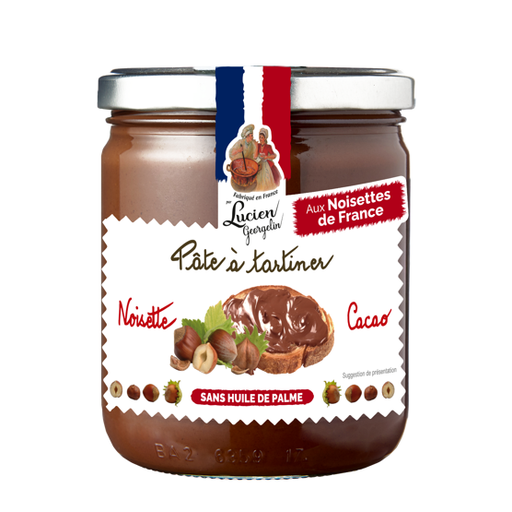 Image unavailable
Consider this if you want to carry less or limit how much is left once opened during a short stay.
Check the label for ingredients, any possible traces of allergens and storage instructions.
 Image unavailable
This size means less to carry for a small group looking for a spread labelled as organic.
The organic label doesn’t replace checking the nutritional values, allergens and instructions for after opening.
 Image unavailable
Consider this when several people will be sharing the jar on different occasions during their holiday.
Check the packaging for allergen information and storage instructions for this particular size.
No. The levy described by the French Ministry of the Economy applies to sugary drinks, not chocolate spreads. When choosing between two jars, compare their size, ingredients and nutritional values instead.
No. According to Santé publique France, displaying it is voluntary. If it appears on the jar, it can help you compare products in the same category; also check the nutrition declaration and ingredients.
Read the ingredients list and any warnings about traces on the exact jar before sharing it. The Carrefour, Auchan and E.Leclerc product pages cited for various recipes list ingredients such as hazelnuts or milk, and possible traces vary from product to product.
Follow the instructions on your chosen jar and make sure you have somewhere suitable to store it. Auchan’s product pages for some products advise protecting them from heat, moisture or light, and say not to refrigerate them.