People who regularly eat chocolate spread
If you regularly add it to a post-workout snack, the jar size matters just as much as whether you can finish it in line with the instructions on the packaging.


To accompany a post-workout snack, choose a size that suits how often you eat it, then compare the sugar, fat and ingredients per 100 g. Check the allergens on the specific jar, too: an organic or plant-based label alone doesn’t tell you whether a recipe meets your needs.
If you regularly add it to a post-workout snack, the jar size matters just as much as whether you can finish it in line with the instructions on the packaging.
You want to compare the sugar, fat and protein per 100 g, then check the ingredients and the hazelnut percentage, where listed.
Read the allergen information and warnings on the jar you choose. A recipe labelled as plant-based may still carry a warning about the possible presence of milk.
For a post-workout snack, start with how often you eat chocolate spread, then compare the recipes against your nutritional preferences and any ingredients you need to avoid.
| Criteria | What to check | Who is it for? |
|---|---|---|
| Jar size | Check the net weight and storage instructions before choosing a large jar. | If I eat it regularly, I look for a jar I can finish in line with the storage instructions. Around 42% of consumers primarily prioritise choosing a size that suits how they use the product. |
| Ingredients and nutrition | Compare the sugar and fat per 100 g, then read the ingredients list. | To choose a recipe that meets my preferences, I want to know what’s in it rather than rely on how it’s presented. Ingredients are the main priority for around 33% of consumers. |
| Allergens and snacks | Check the allergens highlighted on the jar and any ‘may contain’ warnings. | If I need to avoid an ingredient, I first check whether this spread can be part of my snack. This is the main priority for around 25% of consumers. |
Santé publique France explains that displaying the score is voluntary. If it isn’t shown, you should still check the nutrition declaration, which the DGCCRF says is compulsory for most pre-packed foods.
Compare the values per 100 g. If the jar displays a Nutri-Score, use it as additional information rather than taking it as proof that the product is right for you.
A size designed for frequent use may not be suitable if you only eat chocolate spread occasionally.
Choose a quantity that suits how often you eat it, and check the product’s storage instructions.
These labels describe different aspects of a recipe. On their own, they don’t tell you how much sugar it contains or whether it’s suitable for your dietary requirements. Nutella France, for example, states that Nutella Plant-Based may contain milk.
Check the nutrition information, ingredients and allergen warnings on the jar you choose together.
Carrefour offers its hazelnut spread in several sizes, including 400 g, 750 g and 1 kg.
The range includes cocoa and hazelnut spread in different jar sizes, as well as a Plant-Based version.
Auchan’s product listing describes an organic hazelnut and chocolate spread, advertised as containing 20% hazelnuts and no palm oil.
Auchan describes this organic cocoa and hazelnut spread as containing 18.5% hazelnuts and no palm oil.
ALDI has offered a milk and hazelnut spread in a 400 g jar.
These Nutella jars differ in size. Choose one that suits how often you eat chocolate spread, without assuming the recipe meets your nutritional preferences or dietary requirements.
 Image unavailable
This 1 kg size may suit regular use if you can finish it in line with the storage instructions on the packaging.
Before choosing it for your snack, check the nutrition information and allergens on the jar.
 Image unavailable
This 3 kg jar is suited to frequent use. If you only eat chocolate spread occasionally, check whether this quantity fits your habits.
Check the storage instructions, nutrition information and allergens on the packaging.
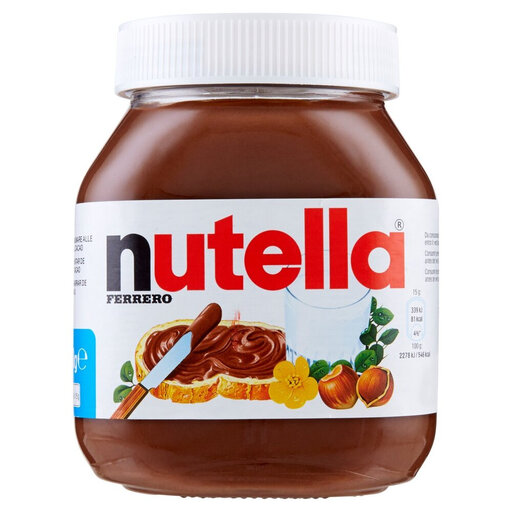 Image unavailable
This 630 g jar is smaller than the 1 kg and 3 kg sizes shown here. Compare the quantity with how often you eat chocolate spread.
Read the nutrition information and allergen details on the specific jar.
No. Santé publique France says producers can choose whether to display it. The DGCCRF states that a nutrition declaration is compulsory for most pre-packed foods, so compare the information per 100 g even if no Nutri-Score is shown.
Read the highlighted allergen ingredients and any ‘may contain’ warnings on the specific jar. The recipes mentioned here may contain hazelnuts, milk or soya. A plant-based label doesn’t mean you can skip the warnings.
Choose based on how much you actually use and the product’s storage instructions. A 3 kg jar calls for more frequent use than a 630 g jar; size alone tells you nothing about the ingredients or allergens.
Follow the instructions on the jar you’ve bought. Recommendations can vary by recipe: for example, Auchan’s listing for Jardin Bio étic says not to refrigerate the product and to consume it preferably within a month of opening.