Everyday bakers
You make chocolate fondants, brownies or simple cakes, and want a bar that’s clearly labelled for baking.


For a cake that needs melted chocolate, start with a bar labelled ‘baking’ or ‘dessert’ chocolate, and use the type specified in the recipe. Then compare the cocoa percentage, weight, ingredients and allergens. A gift box isn’t automatically a substitute for a bar made for baking.
You make chocolate fondants, brownies or simple cakes, and want a bar that’s clearly labelled for baking.
You’re after a stronger cocoa flavour and compare the percentages on baking chocolate bars with the one specified in your recipe.
You check the ingredients, allergens or nutritional information before adding a chocolate bar to your cake. If the packaging shows a Nutri-Score, it doesn’t replace this information.
Start with the type of chocolate your recipe calls for, then check the stated use and the information for the specific variety you’re buying.
| Criteria | What to check | Who is it for? |
|---|---|---|
| Suitable for baking | Look for ‘baking’ or ‘dessert’ on the label, and check that the bar weighs enough for the amount required by your recipe. | When I melt chocolate to add to a cake, I first look for a bar that’s described as suitable for baking. Around 45% of consumers put this use first. |
| Chocolate type and cocoa percentage | Check the type of chocolate your recipe calls for and the cocoa percentage shown on the bar. | To get the chocolate flavour I’m looking for, I first compare the bar with the one specified in my recipe. Around 33% of consumers prioritise this match. |
| Food labelling | Check the ingredients, allergen information and nutritional details for the exact variety. | If I need to check the ingredients, allergens or nutritional values before cooking, this information matters more to me than the taste. It’s the main criterion for around 22% of consumers. |
According to Santé publique France, this voluntary logo supplements the mandatory nutrition declaration. Its absence, on its own, doesn’t tell you what a chocolate bar contains.
Read the nutritional information, ingredients list and allergen details for the variety you’ve chosen.
The rules published by Légifrance apply to non-alcoholic drinks, not solid chocolate bars.
When choosing chocolate for a cake, focus on the type of bar, its weight and its ingredients.
A gift box may contain chocolates with different ingredients, including filled chocolates. It won’t necessarily melt well or suit the recipe you’re making.
Check each chocolate before using it. If your recipe calls for a bar to melt, look for one labelled for baking or dessert.
The product information for Carrefour Bio dark chocolate at 52% mentions possible traces of nuts, cereals containing gluten and milk. So the cocoa percentage is no substitute for checking these warnings.
Check the ingredients and any ‘may contain’ warnings on the specific variety you’ve bought.
Auchan and Carrefour list several dark chocolate bars from this range for baking, with different cocoa percentages depending on the product.
Carrefour lists a 200 g Lindt Dessert dark baking chocolate bar with 51% cocoa.
Carrefour’s listed products include an organic dark ‘dessert’ chocolate bar with 52% cocoa, and a 200 g Original dark ‘dessert’ chocolate bar.
These two Dessert bars suit recipes calling for white chocolate or dark chocolate respectively. Check which type your recipe needs before swapping one for the other.
 Image unavailable
Consider this if your recipe calls for white chocolate for baking. The bar weighs 170 g; check the amount required, as well as the ingredients and allergens on the packaging.
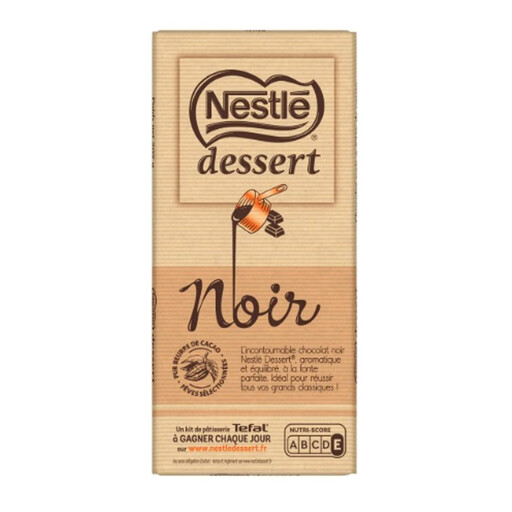 Image unavailable
Worth considering for a recipe that calls for dark chocolate. The bar weighs 205 g; check the packaging for the cocoa percentage you need, as well as the ingredients and allergen information.
Yes, if the chocolates are suitable for your recipe, but a gift box isn’t automatically a substitute for baking chocolate. Before melting them, check the type of chocolate and whether any are filled.
No. According to Santé publique France, the Nutri-Score is voluntary and supplements the mandatory nutrition declaration. Even if the logo isn’t shown, check the bar’s nutritional information and ingredients.
Check the allergens listed in the ingredients and any ‘may contain’ warnings on the variety you’ve bought. For example, the product information for Carrefour Bio dark chocolate at 52% warns of possible traces of nuts, cereals containing gluten and milk. These details don’t apply to all chocolate bars.
No. The rules published by Légifrance apply to non-alcoholic drinks, not solid chocolate bars.