Choose mini bars if you want pre-portioned pieces of chocolate for your biscuits, but be sure to weigh out the amount specified in the recipe. If it calls for baking chocolate, a bar specifically intended for desserts is a more straightforward choice. Either way, compare the sugar content per 100 g and check the ingredients and allergen information for the exact product you choose.
Who are these formats for?
You regularly bake biscuits or cakes
If your recipe calls for chocolate to be mixed into the dough or batter, the Lindt DESSERT and NESTLÉ DESSERT ranges include bars specifically marketed for baking. You then just need to choose the quantity and cocoa flavour you prefer.
You prefer to use small amounts at a time
Milka Mini Bars come individually wrapped. This makes it easy to take out a few pieces, but you’ll need to include each one in the weight of chocolate required by the recipe.
You check sugar or allergen information
Compare the nutritional values per 100 g, then read the ingredients and allergen information on the packaging of the exact product. The European Commission and Santé publique France distinguish between nutrition declarations and Nutri-Score, which is displayed voluntarily.
What should you look for?
For biscuits, start with the amount and type of chocolate specified in the recipe, then choose between individually portioned pieces and a bar marketed for baking.
| Criteria |
What to check |
Consumers concerned |
| Baking and cocoa flavour |
Whether it’s described as suitable for baking; cocoa percentage if flavour intensity matters. |
When I’m mixing chocolate into the dough, I first look for a bar marketed for baking and a flavour that suits my biscuits. Around 31% of consumers prioritise this combination of intended use and flavour. |
| Portioning and leftovers |
Weight of each piece; total weight required by the recipe. |
When I’m making a small batch, I’d rather take out a few pieces than open a large bar. Portion size is a priority for around 31% of consumers. |
| Sugar and nutritional information |
Sugar and energy values per 100 g; per-portion information if it’s also shown on the label. |
If I’m comparing two chocolates for the same recipe, I want to check their values on the same basis before choosing. Around 23% of consumers put this nutritional comparison first. |
| Allergens and ingredients |
Ingredients list and ‘may contain’ statements for the exact product. |
If there are ingredients we need to avoid at home, I check the packaging before choosing a chocolate, whatever its format. Around 15% of consumers prioritise checking the ingredients and allergen information. |
Mistakes to avoid
-
Assuming ‘mini’ means ‘baking chocolate’
Milka markets its Mini Bars as individual portions, while the Lindt DESSERT and NESTLÉ DESSERT products mentioned here are marketed for desserts. The format alone doesn’t tell you what a bar is intended for.
Choose according to your recipe and how you want to portion the chocolate, then weigh the amount you actually add.
-
Relying on Nutri-Score alone
According to Santé publique France, displaying Nutri-Score is voluntary. The European Commission says that front-of-pack nutrition information is not mandatory.
Compare the nutritional information per 100 g and the ingredients list. Use Nutri-Score as additional information when it appears on the packaging.
-
Forgetting about the sugar in the chocolate
The Milka Mini Bars 8 × 25 g product listing gives a sugar content of 58 g per 100 g; the listing for NESTLÉ DESSERT 205 g dark baking chocolate at Courses U gives 46,4 g per 100 g. These values are for the chocolate, not the finished biscuits.
If you change the chocolate or the amount, check the values per 100 g again and adjust the other ingredients to suit the flavour you’re after.
-
Guessing allergens from the colour of the chocolate
The Courses U listing for NESTLÉ DESSERT Noir 205 g mentions that it may contain milk and nuts. The Carrefour listing for Côte d'Or milk chocolate lists milk and soya, and says it may contain nuts.
If you have an allergy, check the ingredients and precautionary statements on the packaging of the product you buy.
Brands and ranges to consider
Milka
Milka’s milk chocolate Mini Bars include an 8 × 25 g format in individually wrapped portions: a handy way to take out chocolate a few pieces at a time.
- Each piece has a set weight in this format.
- Milka markets them as a snack to enjoy, not as baking chocolate; the product listing gives a sugar content of 58 g per 100 g.
NESTLÉ DESSERT
The Noir 205 g bar listed by Courses U is dark baking chocolate intended for desserts.
- The product listing clearly states that it’s for baking and provides nutritional information.
- It isn’t individually portioned; the listing says it may contain milk and nuts.
Lindt
The Lindt DESSERT range includes 200 g Noir 51% and Noir Intense 70% Cacao bars, which the brand markets for baking.
- These two products let you choose between the stated cocoa percentages.
- The 200 g bars don’t come in individually wrapped mini portions.
Côte d'Or
Carrefour lists the L'Original milk chocolate as a pack of two 200 g bars, rather than as mini portions.
- The Carrefour listing provides the ingredients and allergen information for this product.
- It lists milk and soya and says it may contain nuts; also check whether this bar is suitable for your recipe.
Carrefour
Carrefour’s range distinguishes baking chocolate bars and includes, among others, a Carrefour Original Lait Dessert bar.
- The baking category can help you identify products to consider for a recipe.
- Check the format, ingredients and allergens in the product listing and then on the packaging of the bar you choose.
E.Leclerc / Marque Repère
E.Leclerc DRIVE offers baking chocolate for desserts and includes ranges such as Marque Repère.
- The distinction between baking chocolate and eating chocolate can help you find the right product.
- Before choosing a bar for biscuits, check its format and nutritional information.
Chocolates available on Joybuy
These two formats suit different biscuit-making needs: a 205 g Dessert bar for a recipe calling for baking chocolate, and a small 35 g bar if you’d prefer a smaller amount of chocolate with 70% cocoa.
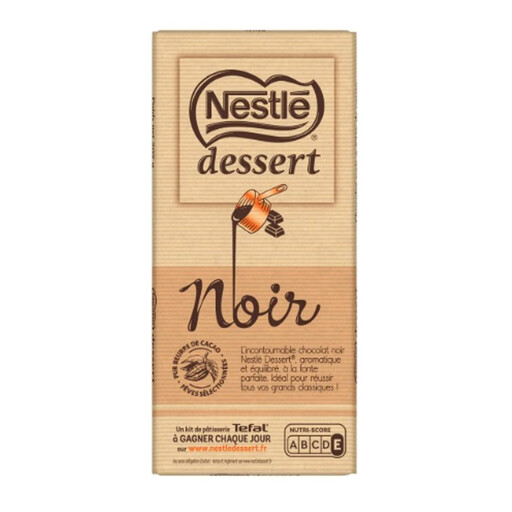 Image unavailable
Nestlé Dessert dark chocolate 205 g
Consider this when your recipe calls for chocolate marketed for baking rather than individually portioned pieces. This 205 g bar lists 46,4 g of sugar per 100 g; weigh or break off the amount you need. The product listing says it may contain milk and nuts, so check the packaging if you have an allergy.
View on Joybuy
 Image unavailable
Lindt Excellence 70% dark chocolate mini 35 g
Consider this if you want to use a small amount of chocolate with 70% cocoa. This 35 g bar isn’t marketed as baking chocolate, so check that it’s suitable for your recipe and check the sugar content on the label. The product listing says it may contain nuts, milk and soya; check the packaging if you have an allergy.
View on Joybuy
Frequently asked questions
Does the ‘sugar tax’ apply to chocolate bars?
No. The levy described by the Ministry of the Economy applies to sugary drinks, not solid chocolate bars. When choosing chocolate for your biscuits, check the sugar content on the label instead.
Does a chocolate bar have to display Nutri-Score?
No. Santé publique France says that displaying it is voluntary; the European Commission says that nutrition declarations apply to the vast majority of prepacked foods. When comparing two bars, check their sugar content per 100 g, even if one doesn’t display Nutri-Score.
Can a mini bar replace the baking chocolate in a recipe?
Not necessarily: Milka Mini Bars are marketed as individual portions, while the Lindt DESSERT and NESTLÉ DESSERT products mentioned here are intended for baking. If you choose mini bars for your biscuits, weigh the amount required and break or chop them to get the size of pieces you want.
Which allergens should you check before making chocolate biscuits?
Read the ingredients list and any ‘may contain’ statements on the exact product packaging. The Courses U listing for NESTLÉ DESSERT Noir 205 g says it may contain milk and nuts; the Carrefour listing for Côte d'Or milk chocolate lists milk and soya and says it may contain nuts. Don’t assume what’s in a product from the brand name or cocoa percentage alone.


