Hosts who want to get the quantity right
If you’re serving several friends, work out how many pastries you want before choosing between a small pack and a family-size one. A higher number of pieces doesn’t, by itself, mean better value.


For drinks with friends, start by thinking about how many people you’re catering for, then compare the number of pastries and the cost per piece. A larger pack isn’t necessarily the best fit. A ready-to-serve product saves you having to bake, while a frozen option needs an oven, time and suitable storage. Remember to check the allergens in your chosen product before sharing it.
If you’re serving several friends, work out how many pastries you want before choosing between a small pack and a family-size one. A higher number of pieces doesn’t, by itself, mean better value.
A ready-to-eat product or one packed in individual portions makes serving easier. A frozen product that needs baking, on the other hand, means getting the oven ready and allowing time for preparation before your guests arrive.
If your guests’ food preferences or dietary restrictions affect your choice, check the ingredients, allergens and any ‘may contain’ information for the exact product.
First decide how many pastries you’ll serve, then choose between something ready to serve and a product that needs baking. Always check the ingredients before you buy.
| What to consider | What to check | Who is it for? |
|---|---|---|
| Quantity and budget | How many pieces you need and the cost per piece at your chosen shop or online grocery service. | If there aren’t many of us, I want to avoid buying a pack that’s too large or having to get a second pack. For around 42 % of consumers, finding a quantity that fits their budget is the top priority. |
| Preparation and serving | Whether it says ‘ready to eat’ or ‘bake at home’, how long it takes to prepare and how it should be stored. | When drinks are a last-minute decision, I’d rather be able to serve straight away without waiting for anything to bake. Around 33 % of consumers put this convenience first. |
| Ingredients | Ingredients, allergens, possible traces and nutritional information per 100 g. | Before sharing chocolate croissants, I want to be able to check their ingredients to make sure they’re suitable for my guests. This is the top consideration for around 25 % of consumers. |
Two packs may contain different numbers of pieces. A pack that seems like the right size at first might also leave you needing to buy a second one to cater for everyone.
Work out how many portions you want, then compare the cost per piece with the quantity you’ll actually use.
Frozen products don’t all need the same preparation. For example, Carrefour says its Classic’ chocolate croissants take 18 to 20 minutes in the oven, while Bridor describes its 85 g product as ready to prove.
Read the instructions for the product you’re considering before you buy, and make sure you have an oven, enough time and suitable storage.
According to the Directorate-General for Competition Policy, Consumer Affairs and Fraud Control, nutrition information is generally required on prepacked foods, while displaying a Nutri-Score is voluntary. So, the absence of a Nutri-Score doesn’t mean a chocolate croissant is non-compliant.
To compare prepacked products, check their nutrition information per 100 g and their ingredients lists. Only take the Nutri-Score into account if it appears on the product.
Ingredients vary from one product to another. You can’t tell the recipe or whether it may contain traces of other ingredients from the name ‘chocolate croissant’ alone.
Ask any guests with dietary requirements what they need to avoid, then keep the packaging handy so you can check the allergens before serving.
Bridor offers, among other products, an 85 g chocolate croissant that’s ready to prove.
The products considered include an eight-piece Traiteur pack and Classic’ chocolate croissants that need baking.
E.Leclerc stocks a 450 g ECO+ pack containing ten chocolate croissants.
Auchan stocks, among other options, a 720 g pack of 16 individually wrapped pastries.
Lidl includes a selection of viennoiseries in its range.
ALDI stocks, among other options, a LES PATISSADES® pack of ten chocolate croissants.
This selection is a pack of six chocolate croissants to bake at home. Consider it if you can prepare them in the oven before serving.
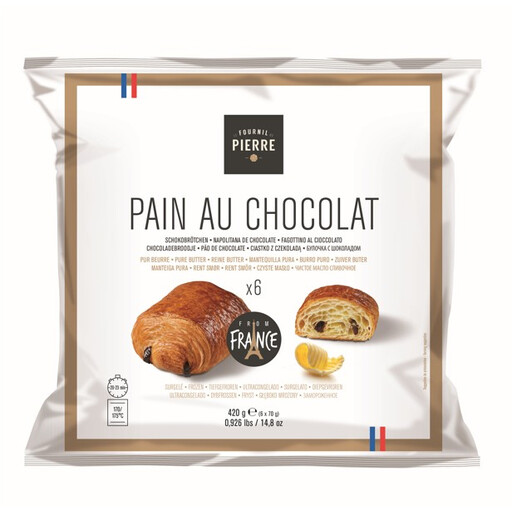 Image unavailable
This pack is a good fit if six pieces is the right quantity and you have access to an oven before serving. It’s described as a frozen product to bake at home, so store it at −18 °C and check the baking instructions and allergen information on the packaging.
No. The Directorate-General for Competition Policy, Consumer Affairs and Fraud Control says that Nutri-Score labelling is voluntary, while nutrition information is generally required for prepacked foods. Check the nutrition information per 100 g and the ingredients list for the product you choose.
Check the information for the specific product. The chocolate croissant product details considered here mention wheat or gluten, milk, eggs and soya, and sometimes nuts or possible traces. Don’t assume that another product from the same retailer has the same ingredients.
Yes, as long as the product is intended for baking and you have the oven and time you need. Carrefour says its Classic’ chocolate croissants take 18 to 20 minutes to bake; follow the baking and storage instructions on the pack you buy.
First decide how many pieces you want to serve, then compare pack sizes and their cost per piece at your chosen shop or online grocery service. Also check whether the pack needs baking or special storage: these requirements affect how you plan your drinks party.