If your cake recipe calls for dark baking chocolate, start with a bar labelled for baking or desserts: around 51–52% cocoa for a less intense flavour, or 70% for a more pronounced cocoa taste. A high-cocoa eating chocolate bar is not automatically a suitable substitute. Check the recipe, then the ingredients, allergens and nutritional information for the specific product you choose.
Who is this choice for?
Anyone following a cake recipe
If your recipe calls for dark baking chocolate, start with a bar labelled “for desserts” or “for baking”. The Lindt DESSERT and NESTLÉ DESSERT ranges include products presented for this purpose. Then choose the cocoa percentage specified in the recipe.
Fans of a pronounced cocoa flavour
If you want the chocolate to dominate the flavour of your cake, a 70% baking chocolate bar could be a good match. Lindt presents its DESSERT Noir Intense 70% as a choice for desserts with a more pronounced cocoa flavour. Check that it also suits the recipe and your guests.
Anyone keeping an eye on ingredients
If you want to compare sugar levels or check for an ingredient you need to avoid, read the label on the specific bar. In France, the DGCCRF highlights the importance of the ingredients list, emphasised allergen information and nutrition declaration on prepacked foods. Nutri-Score, meanwhile, is voluntary.
What should you check?
Start with the chocolate called for in the recipe, then compare bars by flavour, ingredients and the quantity you need.
| Criteria |
What to check |
Who is it for? |
| For baking |
Look for a “for baking” or “for desserts” label and compare it with the guidance in the recipe. |
If I’m following a recipe and don’t want to change the type of chocolate, the bar’s intended use helps guide my choice. Around 31% of consumers prioritise this match with the recipe. |
| Cocoa intensity |
Check the percentage specified in the recipe. The baking chocolate options featured here include 51–52% and 70% cocoa. |
If I want the cocoa flavour to stand out in my cake, I first choose the level of intensity I’m after. Around 31% of consumers are said to prioritise this. |
| Ingredients |
Read the ingredients and allergen information, including “may contain” statements. Compare the nutritional values per 100 g if needed. |
If I need to avoid an ingredient or compare sugar levels, I check the label on the exact product before considering its cocoa percentage. Around 23% of consumers put ingredients first. |
| Quantity |
Compare the net weight with the amount specified in the recipe and check that the available purchase options suit you. |
If the recipe calls for a specific amount, I want to know whether the bar contains what I need or if I’ll have to weigh out part of it. Format is said to be the main criterion for around 15% of consumers. |
Mistakes to avoid
-
Swapping baking chocolate for an eating chocolate bar without checking
The words “dark chocolate” and a high cocoa percentage aren’t enough to confirm that an eating chocolate bar will work as a substitute in your recipe.
If you don’t want to adapt the recipe, first look for a product labelled for baking or desserts. Otherwise, check the ingredients and the recipe’s guidance before changing bars.
-
Always choosing the highest cocoa percentage
Switching from a baking chocolate bar with around 51–52% cocoa to a 70% option changes the cocoa profile. It may not suit the cake you’re making or your guests’ tastes.
Follow the percentage specified in the recipe, if there is one. If not, choose according to the intensity you want rather than simply picking the highest number.
-
Judging allergens by the colour of the chocolate
A dark chocolate bar may contain ingredients you need to watch out for, or state that they may be present. Carrefour Original says its Noir Dessert bar may contain traces of nuts, cereals containing gluten and milk.
Check the packaging of the product you buy for the ingredients list, emphasised allergen information and “may contain” statements.
-
Assuming that no Nutri-Score means something is wrong
The DGCCRF states that displaying Nutri-Score is voluntary in France. Whether or not it appears on a product, it doesn’t replace checking the nutritional information and ingredients.
To compare bars, look in particular at the sugars and fat listed per 100 g. Don’t assume from these figures alone that a product is suitable for everyone.
Baking chocolate brands to consider
Lindt
The Lindt DESSERT range includes dark chocolate bars presented for cakes and desserts, including Noir 51% and Noir Intense 70% cocoa.
- Two clearly stated cocoa percentages let you choose according to the recipe and the intensity you want.
- The cocoa percentage doesn’t replace checking the ingredients and allergen information for each product.
Nestlé Dessert
Nestlé describes NESTLÉ DESSERT as a range of chocolates for making desserts, including a dark chocolate bar.
- The “Dessert” label makes it easy to identify a product presented for this purpose.
- Before choosing a bar for a recipe, check its cocoa percentage, ingredients and allergen information.
Carrefour Original
Carrefour Original’s Chocolat Noir Dessert bar comes in a 200 g format and contains at least 52% cocoa, according to Carrefour.
- The product listing states that it is for desserts, as well as its weight and minimum cocoa content.
- Carrefour says it may contain traces of nuts, cereals containing gluten and milk. Check the packaging of the product you buy.
E.Leclerc — Marque Repère / TABLETTE D’OR
The range includes a 200 g Chocolat Noir Dessert Pâtissier bar as well as a stronger version, according to E.Leclerc.
- The product names distinguish the dark baking chocolate bar from its stronger version.
- For the 200 g bar, E.Leclerc recommends checking availability with the relevant store.
Côte d’Or
Côte d’Or offers dark chocolate bars. For a cake, check whether the specific product is intended for baking rather than eating.
- The information on the product you choose will help you check whether it suits the recipe’s intended use.
- The L’Original bar described by Carrefour contains, among other ingredients, soya and skimmed milk powder, and may contain nuts. These details shouldn’t be assumed to apply to the whole brand.
Chocolate bars available on Joybuy
These dark chocolate bars are options to consider when looking for chocolate to make a cake: one is labelled “Dessert”, while the other is presented for baking. Check that they match the cocoa percentage specified in your recipe.
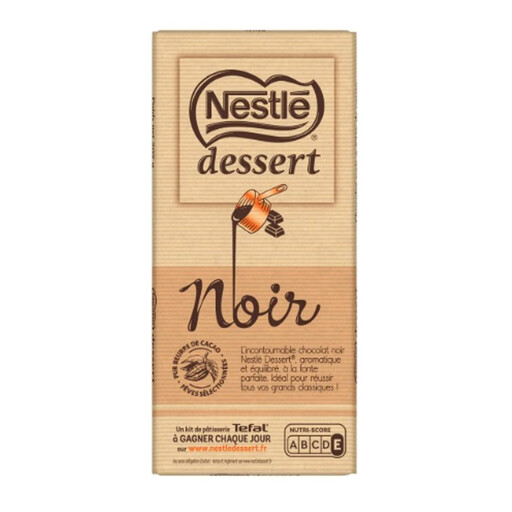 Image unavailable
Nestlé Dessert dark chocolate 205 g
A “Dessert” option to consider for a cake that calls for dark chocolate. The bar weighs 205 g. If your recipe requires a specific cocoa percentage, check the packaging, along with the ingredients and allergen information.
View on Joybuy
 Image unavailable
Poulain Extra Dark dark chocolate 200 g
A dark chocolate bar presented for baking, worth considering if its details match your recipe. It weighs 200 g. Before using it instead of a specific baking chocolate product, check the packaging for its cocoa content, ingredients and allergen information.
View on Joybuy
Frequently asked questions
Is Nutri-Score compulsory on chocolate bars in France?
No. The DGCCRF says that Nutri-Score is a voluntary labelling system in France. For a prepacked chocolate bar, check the ingredients list, emphasised allergen information and nutrition declaration instead, whether or not a score is displayed.
How do you choose between a 51–52% baking chocolate bar and a 70% bar?
First, follow the percentage specified in the recipe, if there is one. Otherwise, a baking chocolate bar with around 51–52% cocoa is a good choice if you want a less intense flavour, while Lindt presents its DESSERT Noir Intense 70% for desserts with a more pronounced cocoa taste.
Which allergens should you check on a dark chocolate bar before baking?
Read the emphasised allergen information in the ingredients list and check the “may contain” statements on the specific bar. Depending on the product, soya or milk may be listed as ingredients, while possible traces of nuts, milk or cereals containing gluten may also be mentioned.


