Households filling a biscuit tin
If several people dip into the tin over a number of evenings, check the total weight, how the biscuits are divided between packs and the storage instructions once opened.


When filling a biscuit tin for several evenings, first choose a format you can store and share in a way that suits your routine. Multipacks work well when you want to spread your supply over time, while individually wrapped portions make it easier to choose how much to have. Then compare the nutrition information per 100 g and the allergens for the exact product; if a Nutri-Score is shown, it does not replace these checks.
If several people dip into the tin over a number of evenings, check the total weight, how the biscuits are divided between packs and the storage instructions once opened.
If you’re having a biscuit on your own in the evening, an individually wrapped portion or one set aside before opening the pack may be more convenient than keeping a large pack within easy reach.
If you’re comparing two recipes or checking allergens for your household, use the nutrition information per 100 g, the ingredients list and the information on the specific pack you’ve chosen.
First decide how the biscuits will be eaten and stored, then compare the recipes available in that format.
| What matters | What to check | Who is it for? |
|---|---|---|
| How much you need to store | Total weight and number of inner packs; storage instructions after opening. | If several people are filling the same biscuit tin for a number of evenings, having a supply divided into packs matters more than having individually wrapped portions. Around 33% of consumers prioritise having a family-size supply. |
| Evening portions | Weight per item and whether the pack contains separate sachets or bars. | If I have a biscuit on my own in the evening, I prefer to choose how much I’m going to have before I start, rather than eating straight from the pack. Around 25% of consumers put portion control first. |
| Labels and allergens | Sugars and fat per 100 g, ingredients and allergens for the exact product. | In a household where ingredients need to be checked, I want to compare recipes rather than rely on the biscuit’s name alone. Around 25% of consumers mainly want to check nutrition information and allergens. |
| Type of biscuit | Filled biscuit, chocolate-coated biscuit or cookie; size of the item or stated portion. | For an occasional treat, I might look for a particular texture, such as a chocolate-coated biscuit rather than a cookie. Around 17% of consumers prioritise the type of biscuit and its chocolate texture. |
According to Légifrance, the contribution in question applies to drinks and liquid preparations for drinks, not solid biscuits. It therefore tells you nothing about the sugar content of a biscuit recipe.
To compare two packs, check the amount of sugars per 100 g in their nutrition tables.
Santé publique France describes its use as voluntary. If it appears on a pack, Nutri-Score provides a way to compare similar products, but it does not tell you about allergens or how much you’ll eat.
Also check the ingredients list, nutrition information and allergens for the product you’ve chosen.
A family-size pack can serve several people, but it also leaves more biscuits accessible once opened. Multipacks and individually wrapped portions suit different ways of eating.
If you mainly have biscuits on your own in the evening, set aside a portion. If you share the tin, check how to store the rest.
The Prince, Mikado and Petit Écolier products listed by Carrefour show the different shapes and pack formats available for chocolate biscuits.
Carrefour lists chocolate BN biscuits in a 285 g pack, as well as Mini BN in a pack of ten 35 g portions.
Products listed by Auchan include 312 g Choco Sensations cookies and milk chocolate-coated biscuits in three 150 g sachets.
Carrefour lists SIMPL chocolate-flavoured sandwich biscuits in a 500 g pack.
E.Leclerc lists round biscuits topped with milk chocolate under this brand, in a 200 g pack.
These two chocolate biscuit packs suit different ways of stocking a family biscuit tin: keep some of your Prince supply in one of the two packs, or share a pack of Mikado.
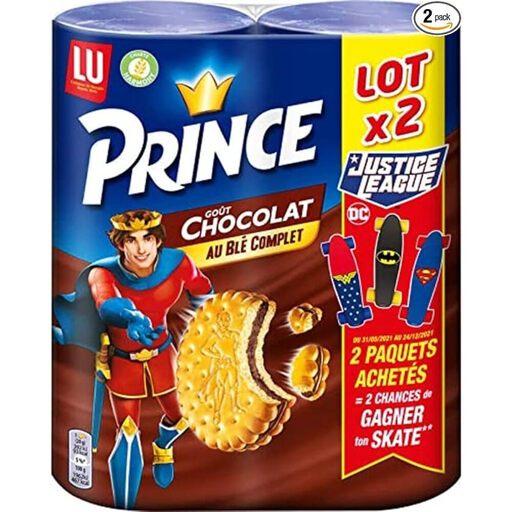 Image unavailable
The two 300 g packs let you keep one sealed while you use the other. If you’re filling a biscuit tin, check the storage instructions and allergens on the packaging for this product.
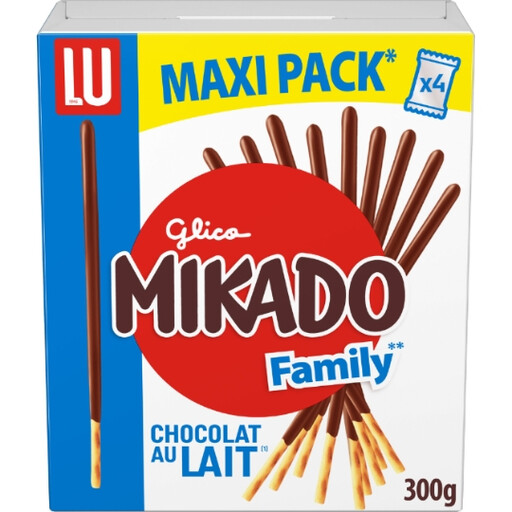 Image unavailable
This 300 g pack is a good choice if you’re looking for Mikado to share, rather than a supply split across several packs. If you’ll be enjoying them over several evenings, check the storage instructions after opening and the allergens on the pack you buy.
No. The contribution described by Légifrance applies to drinks and liquid preparations for drinks, not solid biscuits. To find out how much sugar a biscuit contains, check its nutrition information per 100 g.
No, as Santé publique France explains, displaying it is voluntary. If it’s shown, use it to compare similar products, but still check the ingredients, allergens and nutrition information.
Follow the instructions on the packaging for the product you’ve bought. For the Milka Choco Sensations cookies listed by Auchan, the instructions say to store them away from heat and moisture. Resealing the pack also helps keep the biscuits covered.
Read the ingredients list and allergen information on the specific pack you’re buying, including any ‘may contain’ warnings. Products from the same brand can differ: for example, Carrefour’s product listing for the 285 g BN biscuits mentions that they may contain traces of nuts.