For occasional baking
You’re looking for a bar labelled for baking, so you can choose a chocolate whose ingredients suit your cake, brownie or muffins.


For a small cake, choose based on the quantity required by the recipe and the chocolate’s ingredients, rather than simply looking for a “single bar”. A bar labelled for baking is suitable if its type of chocolate and ingredients match the recipe. For a more pronounced dark chocolate flavour, compare options with 51–52% and 70% cocoa, then check the weight and allergens of the product you choose.
You’re looking for a bar labelled for baking, so you can choose a chocolate whose ingredients suit your cake, brownie or muffins.
You’d like to compare the cocoa percentages of baking chocolate bars, especially options with 51–52% and 70% cocoa, to find the right flavour for your dessert.
You want to buy just one bar and check its weight, ingredients, allergens and nutritional information before adding it to your recipe.
Start with the recipe: identify the type and quantity of chocolate you need, then compare the ingredients and labelling of suitable bars.
| Criterion | What to check | Who is this for? |
|---|---|---|
| Suitability for baking and the recipe | Check how the product is described on the packaging and read the ingredients, especially if the recipe doesn’t call for a filling or added pieces. | If I’m melting chocolate into cake batter, I first want it to suit the recipe; around 42% of consumers put this first. |
| Cocoa intensity | Compare the cocoa percentage of the specific product. Lindt describes its Dessert Noir 51% and Noir Intense 70% bars as having distinct flavour profiles. | For a fondant where dark chocolate provides the main flavour, I choose the intensity I’m looking for; this is the top priority for around 25% of consumers. |
| Weight and pack size | Compare the net weight with the quantity required by the recipe, and distinguish a single bar from a multipack. The words “single bar” alone don’t tell you how much you’ll need. | When I’m making a small cake, I’d rather buy one bar in a suitable weight than have several left over; around 17% of consumers prioritise a format that suits their needs. |
| Nutritional information and allergens | Check the sugars and fat per 100 g, then read the ingredients list and allergen information for the exact product. | If the cake is for people whose allergies I need to take into account, I check the label before choosing; for around 16% of consumers, nutritional information and allergens are the main consideration. |
A filling or added pieces introduce ingredients that your recipe may not call for. Carrefour’s product details for a milk chocolate bar, for example, list milk and hazelnuts. Its ingredients shouldn’t be assumed to be the same as those of a dark baking chocolate bar.
Check the type of chocolate and the ingredients list before using it in place of the chocolate specified in the recipe.
The DGCCRF states that Nutri-Score is voluntary in France. Its absence doesn’t, by itself, tell you whether a bar’s labelling is compliant or whether it’s suitable for your cake.
Compare the nutritional information per 100 g, the quantity used in the recipe and the ingredients. Treat Nutri-Score as additional information when it appears on the packaging.
Carrefour’s Noir Dessert chocolate, for example, is sold in a pack of three 200 g bars and contains at least 52% cocoa. That pack contains a different quantity from a single bar.
Make a note of the weight required by your recipe, then check how many bars are in the pack.
For one small bake, a multipack may leave you with several bars to keep for another time.
Carrefour and Joybuy describe the 205 g Dessert dark chocolate bar as suitable for baking.
Lindt offers baking chocolate bars in Noir 51% and Noir Intense 70%, both weighing 200 g.
Carrefour’s Noir Dessert bar contains at least 52% cocoa. The product details consulted list it as a pack of three 200 g bars.
E.Leclerc offers a 200 g Noir Dessert Pâtissier bar.
These bars are labelled for baking: two dark chocolate options for a chocolate cake, and one white chocolate option for a recipe that specifically calls for white chocolate. For a small bake, compare their weights with the quantity required before choosing.
 Image unavailable
This bar is labelled for baking and may suit a recipe that calls for dark chocolate and around 200 g. The stated minimum cocoa content is 47%; the ingredients also include milk powder, vanilla and soya lecithin. Check the packaging for allergen information before use.
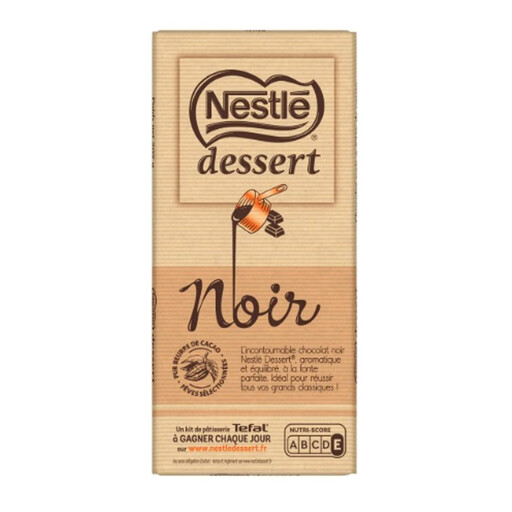 Image unavailable
This single bar is labelled for baking. Compare its 205 g size with the amount your cake recipe calls for. The listed ingredients include cocoa mass, sugar and cocoa butter. If you’re choosing based on chocolate intensity, check the cocoa percentage on the packaging. Also check for statements about possible traces of milk and nuts.
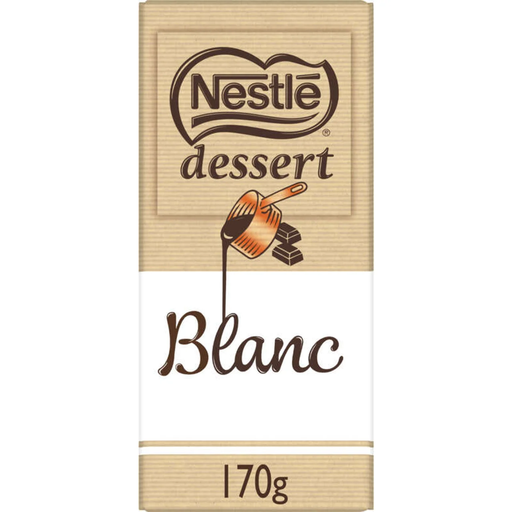 Image unavailable
Choose this for a recipe that calls for white chocolate, rather than swapping it in for dark chocolate in a cake without adapting the recipe. This baking bar weighs 170 g and contains milk. It’s also labelled as possibly containing traces of egg, gluten and nuts. Check the packaging if you need to avoid any allergens.
No. The DGCCRF describes Nutri-Score as a voluntary label in France. It states that, in principle, prepacked foods must carry a nutrition declaration, which is given per 100 g, among other formats. Check this declaration to compare chocolate bars.
Read the ingredients, the allergens listed and any “may contain” statements on the packaging of the bar you choose. For example, the product details consulted state that NESTLÉ DESSERT Noir may contain traces of milk and nuts. Don’t assume the same applies to another product.
Follow the instructions on the packaging. For the 205 g NESTLÉ DESSERT Noir bar, Joybuy’s product details recommend storing it in a cool, dry place, away from heat and moisture.
No. The scheme described by Légifrance applies to drinks and liquid preparations intended to become drinks. A solid chocolate bar falls outside its scope.
Yes. Check the date on the packaging, the condition of the bar and the storage instructions before baking. The French Ministry of the Economy distinguishes between a best-before date and a use-by date. Read the date shown on the product rather than assuming they mean the same thing.