People setting a calorie limit for their break
If you have a specific limit in mind, check the kcal for the amount you’ll actually eat, not just per 100 g. Also check whether the label gives values for a whole bar or a smaller portion.


For a break at work, first decide how much you plan to eat and check the energy for that amount. A small portion may suit an occasional craving, while a bar with clearly stated energy per unit makes it easier to stick to a specific limit. Then compare the sugars, ingredients and allergens. Claims such as ‘high protein’ or ‘organic’ don’t replace these checks.
If you have a specific limit in mind, check the kcal for the amount you’ll actually eat, not just per 100 g. Also check whether the label gives values for a whole bar or a smaller portion.
If you want to enjoy a chocolate snack while comparing sugars, check the amount per portion alongside the energy and ingredients list. A recipe containing sweeteners may also carry a consumption warning.
Individually wrapped portions are easy to store and hand out. Before leaving bars out for everyone, make sure their labels are accessible: ingredients and allergens can vary between products and varieties.
For a break at work, first decide how much you’ll eat, then compare the nutritional values and ingredients according to what matters most to you.
| What matters | What to check | Who is this for? |
|---|---|---|
| Calories in your break | Kcal for the amount you’ll eat and the number of portions in the pack. | If I set a limit for my break, the value for a small portion isn’t enough if I eat the whole bar; around 36% of consumers would make this their priority. |
| Sugars | Sugars and energy per portion; any sweeteners. | For a chocolate snack, I may want to keep an eye on sugars without losing sight of calories: around 29% of consumers would prioritise this comparison. |
| Protein | Protein and kcal per bar, along with the ingredients list. | If protein content guides my choice, I want to be able to compare it without assuming the bar is low in calories; around 21% of consumers would have this as their priority. |
| Convenient portion | Portion weight; allergens if the bars are being shared. | If I want to keep a familiar chocolate bar at work, I’d rather know how much I’m having and leave the label available for my colleagues; around 14% of consumers would put this need first. |
Carrefour’s product information for Twix gives 123 kcal per 25 g. This doesn’t necessarily cover everything you’ll eat if you have more than one portion.
Check the weight shown alongside the kcal, then compare it with the amount you plan to eat. The value per 100 g helps you compare different sizes.
The Carrefour Bio chocolate cereal bar listed by Carrefour has 405 kcal per 100 g. A small bar and a low energy value for the same weight are two different things.
Compare the energy per portion, sugars and bar weight. Check protein separately if it matters to your choice.
In France, displaying a Nutri-Score is still voluntary, according to the Ministry of the Economy. As a general rule, prepacked foods must have a nutrition declaration.
Whether or not a Nutri-Score is shown, read the nutritional information per 100 g and check the portion, ingredients and allergens.
The recipes reviewed list different ingredients or allergens, including wheat, milk, soya and peanuts, depending on the product. Some bars containing sweeteners also carry a warning about excessive consumption.
In a shared space, keep the packaging for each variety so everyone can check its own ingredients list and warnings.
The classic and Hi Protein Low Sugar varieties suit different priorities, so their nutritional values aren’t interchangeable.
A biscuit, caramel and chocolate bar to assess according to the portion you choose.
Some formats contain several bars, so the reference portion may be smaller than the full pack.
The chocolate cereal bar in a box of six is a different category from a classic chocolate bar.
The chocolate high-protein bar described by E.Leclerc is suited to comparisons based on a stated energy value per bar, but shouldn’t be treated as a classic confectionery bar.
This selection features a KitKat format with small bars for a break at work. Before choosing it to meet a specific calorie limit, check the value for one bar as you’ll actually eat it.
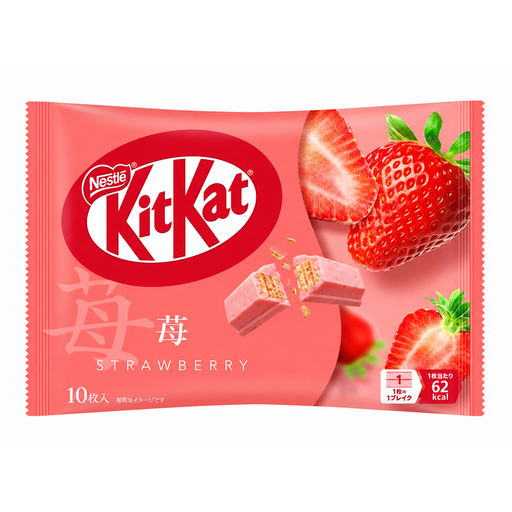 Image unavailable
The pack of ten small bars may suit you if you’d like to choose one for a break at work. The information gives a weight of 11.3 g per bar, but provides an energy value for 12.5 g. Check the weight of one bar and its corresponding kcal before counting it towards a specific limit. Also check the label for sugars and allergens, particularly if you’re sharing the pack.
No. Article 1613 ter of the General Tax Code, published on Légifrance, applies to drinks and liquid preparations for drinks, not solid chocolate bars. When choosing a bar, compare its sugar content in the nutritional information.
No. According to the Ministry of the Economy, displaying a Nutri-Score is still voluntary. As a general rule, prepacked foods must have a nutrition declaration. Whether or not there’s a logo, compare the values per 100 g with the amount you’ll eat.
Not necessarily. A small bar may mean fewer kcal on that occasion while still having a high energy value per 100 g. Check the weight of the bar, its corresponding kcal and how many bars you plan to eat.
Keep the packaging for each product accessible so your colleagues can check its ingredients, allergens and any consumption warnings. Don’t assume that another variety from the same brand has the same ingredients.