Anyone making a Christmas dessert
For a mousse, yule log, cake, ganache or icing, the bar’s stated suitability for baking and the quantity your recipe needs matter more than the pack size alone.


If you’re melting chocolate to use in a Christmas recipe, start with a bar made for baking, in the quantity specified by the recipe. If you want chocolate that’s ready to eat, a bag of bite-sized chocolates serves a different purpose. Don’t automatically use it instead of a bar, especially if it contains inclusions. In either case, compare the sugars per 100 g and check the allergens on the exact packaging.
For a mousse, yule log, cake, ganache or icing, the bar’s stated suitability for baking and the quantity your recipe needs matter more than the pack size alone.
A ready-to-eat format can be handy alongside coffee or when serving bite-sized chocolates to a group. However, being suitable for sharing doesn’t mean a bag is also suitable for melting into a recipe.
Comparing sugars per 100 g can help you tell recipes apart. If guests have mentioned allergies, be sure to read the ingredients and allergen information for each product you’re considering.
First decide whether the chocolate is mainly for a recipe or to serve as it is. Then check the quantity and label of each product.
| Criteria | What to check | Who is it for? |
|---|---|---|
| Suitable for baking | Look for « baking » or « dessert » on the label, then check the quantity required by the recipe. | For a ganache or yule log, I’d first look for chocolate intended to be mixed into a dessert; around 42% of consumers would put this suitability for baking first. |
| Format for sharing | Check the net weight and whether it comes as a bar or ready-to-serve bite-sized chocolates. | If I’m also planning to serve chocolate with coffee, I want it to be easy to serve; around 33% of consumers would make sharing their main consideration. |
| Food label | Check sugars per 100 g, ingredients and allergen information. | When comparing recipes or catering for guests who have mentioned allergies, I use the label to guide my choice; around 25% of consumers would prioritise this information. |
The DGCCRF says that the nutrition declaration lets you compare sugars per 100 g, and that allergenic ingredients must be clearly highlighted. Santé publique France notes that displaying the Nutri-Score is voluntary. If it appears on a product, you can use it alongside the nutrition information, but it doesn’t replace the ingredients list.
Lindt lists its DESSERT bars separately for baking and its bags for enjoying as they are. Inclusions or a bite-sized format may not suit the recipe you have in mind.
For a dessert that calls for melted chocolate, start with the recipe and choose a bar labelled as suitable for baking. Save a bag for serving, or check its ingredients before deliberately adding it to your dessert.
Santé publique France explains that displaying the Nutri-Score is voluntary. Its absence alone doesn’t tell you anything about the composition of a bar.
To compare pre-packed products, check their nutrition information per 100 g, particularly the sugars and fat.
A hazelnut bar may contain other allergenic ingredients. A recipe’s ingredients aren’t necessarily the same across every bar from the same brand.
Before preparing a buffet, check the highlighted ingredients and any « may contain » statements on the exact packaging of each product.
Cocoa content and sugar levels answer two different questions. The cocoa percentage also tells you nothing about allergens.
Choose the cocoa intensity you want for your recipe, then check the « of which sugars » line per 100 g and the ingredients list separately.
Lindt distinguishes its DESSERT range of bars, presented as suitable for baking, from its bags intended for enjoying as they are.
The retailer’s range includes bars of baking chocolate as well as bars intended for other uses.
The brand offers bars for enjoying as they are, including recipes with hazelnuts.
Carrefour lists a Menier Noir Dessert bar as baking chocolate.
This selection features a white chocolate bar labelled as suitable for baking. If you’re also looking for bite-sized chocolates to share, choose a separate format to suit how you plan to serve them.
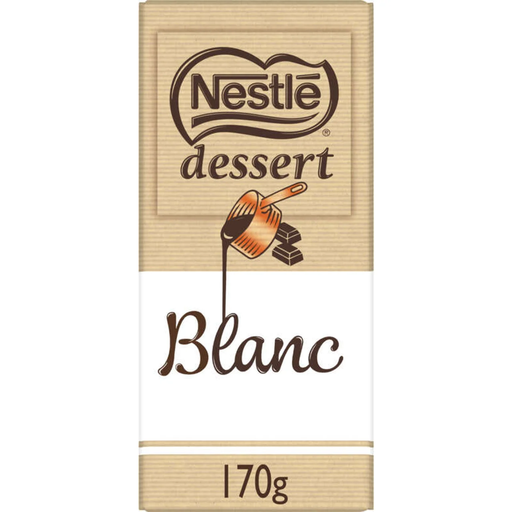 Image unavailable
Worth considering for a Christmas recipe that calls for white chocolate intended for baking. Check that the 170 g bar covers the quantity you need, and refer to the exact packaging for allergen information. Its format alone doesn’t tell you whether it’s suitable for serving directly to a group.
Not automatically: bags of chocolate for enjoying as they are and bars labelled as suitable for baking aren’t intended for the same use. If your recipe calls for melted chocolate, choose a baking bar. Check the ingredients in a bag before deciding to use it in your dessert.
No. Santé publique France says that displaying it is voluntary. To compare pre-packed bars, check the nutrition information, particularly sugars and fat per 100 g, in line with the DGCCRF’s guidance.
Read the label for the exact product before serving it or adding it to a recipe. The DGCCRF says that allergenic ingredients must be clearly highlighted; also check for any « may contain » statements.
No. The French Ministry of the Economy describes this levy as applying to sugary drinks, not chocolate bars. To compare the sugar content of two bars, check the value per 100 g in their nutrition declarations instead.