Hosts keeping an eye on fat content
You want to compare recipes for a party selection without assuming that a smaller portion means a lower-fat product.


To choose a lower-fat chocolate bar for a national day celebration, don’t mistake a mini size for a reduced-fat recipe. Check the claim on the product, then compare the fat content per 100 g of like-for-like products. If you’re putting together a selection, also check the number of portions, sugar content and allergens. A displayed Nutri-Score doesn’t replace this information.
You want to compare recipes for a party selection without assuming that a smaller portion means a lower-fat product.
You’re preparing bars for several guests and need to check the number of units as well as the allergens listed on each pack.
Whether you’re in store or using a supermarket collection service, you want to compare the nutrition information per 100 g for specific products rather than relying on the brand name alone.
Start by comparing recipes on the same 100 g basis, then check portion sizes and the information your guests may need.
| What to check | Look for | Who is it for? |
|---|---|---|
| Fat content | The exact claim on the product and the fat content per 100 g for comparable recipes. | If my main priority is finding a lower-fat recipe, a mini bar alone doesn’t meet that need. Around 45% of consumers prioritise a reduction they can verify. |
| Portions and allergens | The number and weight of the individual bars, followed by declared allergens and any ‘may contain’ warnings. | When serving several guests, I want to know how many bars I can hand out and be able to check their ingredients. Around 36% of consumers put this planning and allergen checking first. |
| Nutrition information | Fat and sugar per 100 g; Nutri-Score only if displayed. | When comparing products in store or through a supermarket collection service, I need to read their labels before choosing. Around 19% of consumers mainly want to compare the information available. |
A smaller bar changes the amount served, but not necessarily the recipe’s composition per 100 g. The Carrefour listing consulted for Mars mini bars gives a fat content of 15 g per 100 g without describing them as reduced-fat.
First compare similar recipes per 100 g, then check the weight of each bar to plan your portions.
According to the Ministry of Health, Nutri-Score is a recommended scheme that provides an overall nutritional guide. It isn’t compulsory on all chocolate bars, and it doesn’t detail allergens or serving size.
If it appears on the pack, check the nutrition information and ingredients for the exact product as well.
Two Carrefour listings give fat contents of 15 g per 100 g for Mars mini bars and 34 g per 100 g for Carrefour milk chocolate bars, respectively. These figures apply to those specific products, not to the entire ranges.
Compare the labels of the products you’re actually considering, using the same 100 g basis.
Ingredients and possible allergen traces vary by recipe. The Mars and Carrefour listings consulted flag several allergens.
Keep the wrappers where guests can access them so they can check the information for each bar.
Mars mini bars are worth considering if you’re serving individual portions at a party.
A supermarket own-brand product lets you check the pack size and nutrition information for a milk chocolate bar.
If you’re considering a Nestlé or KitKat bar, start by choosing the specific product you want to compare.
This bag of mini bars is suitable for serving individual portions at a party. Its size doesn’t prove that it has a lower fat content.
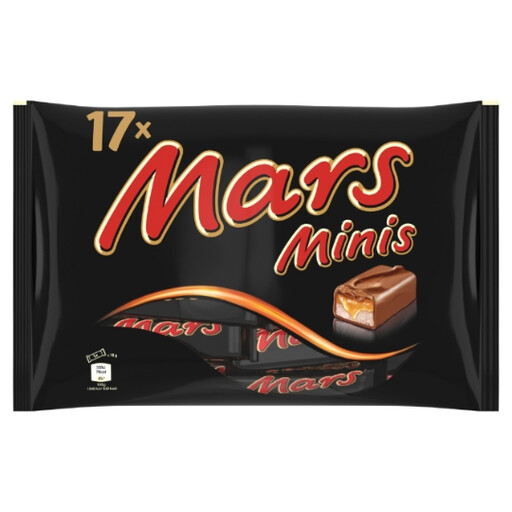 Image unavailable
The mini size is handy for serving individual bars at a party. The bag contains 333 g. If you’re choosing it because you’re looking for a lower-fat recipe, compare the fat content per 100 g and check the allergens on the exact product packaging.
No, not under the levy described by Légifrance. Under the conditions set out in the legislation, it applies to drinks and liquid preparations for drinks intended for human consumption. A solid chocolate bar doesn’t fall into this category.
No. The Ministry of Health describes Nutri-Score as a recommended scheme, so its absence alone doesn’t mean a bar is incorrectly labelled. If it is displayed, check the nutrition information and ingredients too.
Check the exact wording on the packaging or product listing, then compare its fat content per 100 g with that of a comparable product. The DGCCRF notes that nutrition claims are regulated: a bar’s small size doesn’t count as a claim.
Use the per-100 g figures to compare recipes, then check the weight of each bar to work out how much you’ll serve at the party. Always check the information for the exact product: a mini size alone doesn’t tell you about its composition.
Keep the packaging for each product accessible when serving, and follow its storage instructions. Check the declared allergens and any ‘may contain’ warnings on the product you’ve actually bought.