Shoppers keeping an eye on kcal per portion
If you plan to eat the bar as soon as you’ve bought it, its weight and kcal per bar matter more when comparing options than the figure per 100 g alone.


To keep calories in check when buying a snack on the go, compare the kcal for the amount you’ll eat, not just the figures per 100 g. Carrefour France’s product listings show that 32 g of KITKAT CHUNKY contains 165 kcal, compared with 185 kcal for a 32 g Carrefour Sensation bar. However, the KITKAT CHUNKY weighs 64 g, so these figures are not for two whole bars. Check the sugars, ingredients and allergens too: a bar marketed as high in protein is not necessarily lower in calories per bar.
If you plan to eat the bar as soon as you’ve bought it, its weight and kcal per bar matter more when comparing options than the figure per 100 g alone.
A high-protein or low-sugar bar may catch your eye. Compare its kcal and size as well: each of these criteria answers a different question.
Before making a quick purchase, check the exact recipe on the packaging, paying particular attention to information about milk, soya, peanuts, tree nuts or wheat, depending on the product.
When buying a snack on the go, start with the amount you plan to eat, then check the other details that matter to you separately.
| Criterion | What to check | Who is it for? |
|---|---|---|
| Kcal per portion | Check the kcal per bar and its weight; if necessary, calculate them from the kcal per 100 g. | If I’m eating the bar as soon as I buy it, I want to compare the whole amount I’ll have, rather than a theoretical serving. Around 33% of shoppers put kcal per portion first. |
| Sugars and protein | Check the sugars, protein and kcal for the same portion, rather than assuming one figure from a claim on the front of the pack. | The sugar or protein content can guide my choice, even though it doesn’t tell me how many kcal the bar contains. This is the top priority for around 25% of shoppers. |
| Allergens and ingredients | Check the ingredients list and any ‘may contain’ statements for the exact product. | If I need to avoid an ingredient, the brand name alone isn’t enough to help me decide quickly. Around 25% of shoppers prioritise allergens or ingredients first. |
| Quick to check | Make sure the format and nutritional information are easy to read on the product available; use the Nutri-Score if it is displayed. | When I’m picking up a snack, I look for a product whose useful information I can read before I buy it. Around 17% of shoppers put ease of checking first. |
Sugars, protein and energy are separate pieces of information. The FULFIL chocolate-peanut-caramel bar listing gives 366 kcal per 100 g, or around 201 kcal for its 55 g bar, as well as 1.5 g of sugars and 19 g of protein per bar.
Compare the kcal in the whole bar first, then look at the other figures that matter to your choice.
This figure compares equal amounts, but not necessarily the amount you’ll eat. The serving size shown on a pack may also be smaller than the whole bar.
Check the weight of the bar and the stated serving size before comparing the kcal you’ll consume.
Santé publique France says that displaying the Nutri-Score is voluntary. Its absence therefore isn’t enough on its own to judge a bar’s ingredients.
If a Nutri-Score is shown, read it alongside the nutritional information, serving size and ingredients list.
Ingredients and traces statements vary between recipes. Depending on the product, Carrefour France’s listings mention milk, soya, peanuts, almonds or wheat.
If you have an allergy or need to avoid an ingredient, check the information on the packaging of the exact product you’re buying.
The chocolate product reviewed is a 32 g protein bar, sold in a pack of four.
The CHUNKY product is a 64 g chocolate bar with a stated serving size of 32 g.
Carrefour France’s peanut-caramel product is sold in 36.5 g bars.
The chocolate-peanut-caramel product is a 55 g protein bar.
These smaller KITKAT products are worth considering when you’re buying a snack on the go. Before comparing kcal per bar, check that the stated serving size matches the amount you plan to eat.
 Image unavailable
This pack of nine pieces gives you the option of having a small portion when buying a snack on the go. To compare the energy you’ll consume, check the kcal per piece on the packaging; also check the allergen information, particularly for gluten, soya and milk.
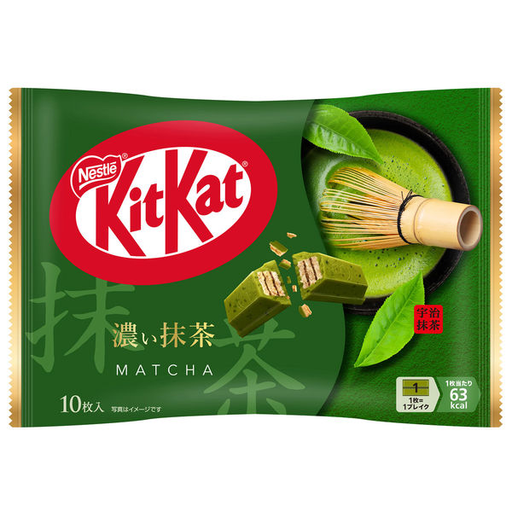 Image unavailable
This mini format may suit you if you want to choose how much you eat, piece by piece. Check the number of pieces in the pack before calculating the kcal in your portion, as the available information doesn’t agree on this point. Also check the sugars and allergen information on the packaging.
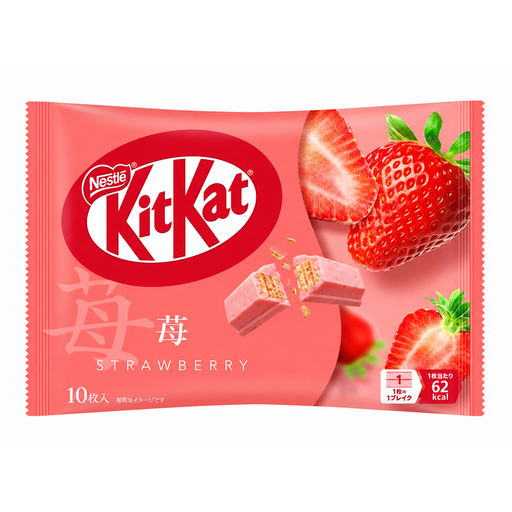 Image unavailable
The pack of ten small bars can make it easier to choose a portion. However, don’t assume that the serving in the nutrition table is one whole bar without checking their respective weights on the packaging: the available information isn’t clear. Also check the sugars and allergens for this variant.
Multiply the kcal per 100 g by the weight in grams you’ll eat, then divide by 100. If the packaging gives a serving size smaller than the whole bar, use the bar’s weight to calculate the kcal for the entire piece.
No: the protein content alone doesn’t tell you how many kcal are in a bar. The FULFIL chocolate-peanut-caramel listing gives 19 g of protein in a 55 g bar, which contains around 201 kcal based on its figure of 366 kcal per 100 g.
No. Santé publique France says that producers can choose whether to display the Nutri-Score. If it appears on a product, consider it alongside the nutritional information and serving size rather than treating it as a guide to the kcal per bar.
Check the weight of the piece, the kcal for the amount you’ll eat, the sugars, then the ingredients list and allergens for the exact product. For the products described by Carrefour France, these vary by recipe and include milk, soya, peanuts, almonds or wheat, depending on the bar.