People who prefer a set portion
You’d like to enjoy a chocolate snack at your picnic while knowing what one bar contains. Individually wrapped bars make it easy to compare your planned portion with a whole bar.


To keep the calories down when enjoying chocolate at a picnic, first choose a portion you genuinely plan to eat and compare its energy content. Then check the figures per 100 g: a small bar may contain fewer calories per bar while still being energy-dense. Sugars, ingredients and allergens also matter when choosing a bar. If the pack displays a Nutri-Score, remember that it doesn’t replace this information.
You’d like to enjoy a chocolate snack at your picnic while knowing what one bar contains. Individually wrapped bars make it easy to compare your planned portion with a whole bar.
You check the nutritional information per 100 g and per portion, rather than focusing only on the calories highlighted on the pack. If a Nutri-Score is shown, you use it alongside these figures.
You pay close attention to the allergens in the exact recipe. Peanuts, milk or wheat are among the ingredients in some of the products mentioned here, but ingredient lists and any ‘may contain’ warnings vary between bars.
When choosing a bar to take on a picnic, start with the amount you plan to eat, then check the nutritional information and ingredients list for that specific product.
| What to check | What to look at | Who is this for? |
|---|---|---|
| Calories per portion | Compare the kcal per bar with the weight of the bar you plan to eat. | If I’m planning just one chocolate break, I want to know what’s in the whole bar I’ll take with me; around 42% of consumers would prioritise calories per portion. |
| Sugars and nutritional values | Check the energy and sugars per 100 g, then per portion. Only refer to the Nutri-Score if one is displayed. | When comparing two recipes, I want to look beyond bar size and compare their sugars and energy; around 33% of consumers would put this nutritional profile first. |
| Ingredients and allergens | Check the ingredients list, highlighted allergens and any ‘may contain’ warnings on the pack you’ve chosen. | If an ingredient needs to be avoided, the exact recipe matters more than the snack format; ingredient suitability would be the main consideration for around 25% of consumers. |
A smaller format may reduce the calories you eat at one time without changing the recipe’s energy density. Regulation (EC) No 1924/2006 reserves the claim ‘low energy’, or wording with the same meaning, for solid foods containing no more than 40 kcal per 100 g.
Check the kcal per portion and per 100 g. Present a mini format as a way to choose how much you eat, not as a nutritional property of the recipe.
According to Santé publique France, displaying the Nutri-Score is voluntary. On its own, this guide doesn’t tell you the calories and sugars in the portion you’ll eat.
If it appears on the pack, check it alongside the nutrition table, the bar’s weight and the ingredients list.
Two bars with similar packaging may have different ingredients or trace warnings. The 50 g Snickers bar shown by the brand contains peanuts; the KitKat Milk Chocolate product information lists wheat and milk, among other ingredients.
Read the information on the exact pack, rather than relying on the brand name alone or on a different variety.
Mars France describes Mars as a bar combining chocolate and caramel.
Snickers France describes a 50 g bar made with chocolate, caramel and peanuts.
KitKat also makes a wafer bar coated in milk chocolate.
Carrefour sells its Milk Chocolate Bars in a pack of 10, with each bar weighing 21 g.
If you’re happy to try a nut and chocolate bar instead of a classic chocolate bar, this selection offers a format sold in 30 g portions. To compare its calories and sugars with those of a chocolate bar, check the nutritional information for the variety you choose.
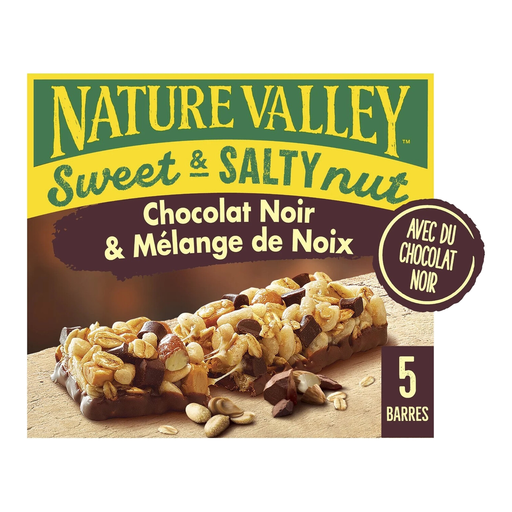 Image unavailable
This nut and chocolate bar is worth considering if you’d like to try a different type of picnic snack. It comes in a pack of 5 bars, each weighing 30 g. Check the nutritional information, ingredients and allergens for the variety you buy.
Not simply because it’s small. For solid foods, Regulation (EC) No 1924/2006 limits the claim ‘low energy’, or any claim with the same meaning, to products containing no more than 40 kcal per 100 g. A smaller portion may simply contain fewer calories per bar.
No. Santé publique France says that producers display the Nutri-Score on a voluntary basis. However, nutrition labelling is compulsory for most pre-packed foods. The DGCCRF explains that showing the information per 100 g makes it easier to compare products.
Read the ingredients list and any trace warnings on the exact pack. The recipes mentioned here show why: Snickers France describes a bar containing peanuts, while the KitKat Milk Chocolate bar contains wheat and milk. The DGCCRF reminds consumers that allergenic ingredients must be highlighted on the label.
Article 1613 ter of the General Tax Code covers drinks and liquid preparations for drinks, not solid chocolate bars. When choosing your snack, check the sugars, energy and portion size shown on the pack instead.
Follow the storage instructions on the pack of the bar you’ve chosen. Anses guidance on the cold chain applies to foods that need to be kept at a low temperature; it doesn’t mean that every chocolate bar needs to go in a cool bag. When transporting it, also follow the manufacturer’s guidance on heat and light.