
Livraison le jour même ou le lendemain

Qualité garantie

Débloquez vos offres de bienvenue: Livraison GRATUITE | Jusqu'à -80 % | 30 jours d'essai gratuits à JoyPlus
Téléchargez l'application
Giving a child their first bike is an unforgettable moment. But faced with a crowded market, choosing a child's tricycle can quickly become a headache. Between marketing promises and technical specs, it's easy to get lost. As a product expert at Joybuy, I'm here to break down the market for you and help you avoid the common pitfalls to make the right choice, with confidence.
Before you start, watch out for these three frequent issues that can turn a promising purchase into a real disappointment:
To avoid falling into these traps, it's essential to focus on a few objective criteria that make all the difference.
Analyzing a tricycle is about more than just its color. Here are the three technical points to inspect to ensure the product's safety, comfort, and longevity.
The foundation of a good tricycle is its chassis. A metal frame is a guarantee of sturdiness and durability compared to an all-plastic frame. But beyond the material, it's the geometry that matters most. Look for a triangular structure with a wide wheelbase at the rear for rock-solid stability.
Another fundamental safety feature is the steering limiter. This mechanism, often built into the handlebars, prevents the child from turning too sharply and causing a tip-over. It's a detail that prevents many falls, especially during their first rides.
A true convertible bike should grow with your child, hassle-free. Here are the modes you should be able to find:
Never underestimate the power of the wheels! They determine the ride comfort and the parents' peace of mind. Steer clear of hollow plastic wheels. Opt for EVA (ethylene-vinyl acetate) foam wheels. They offer several major advantages:
Rather than an impersonal list, here are options that meet specific needs, based on the safety and practicality criteria we've just discussed.
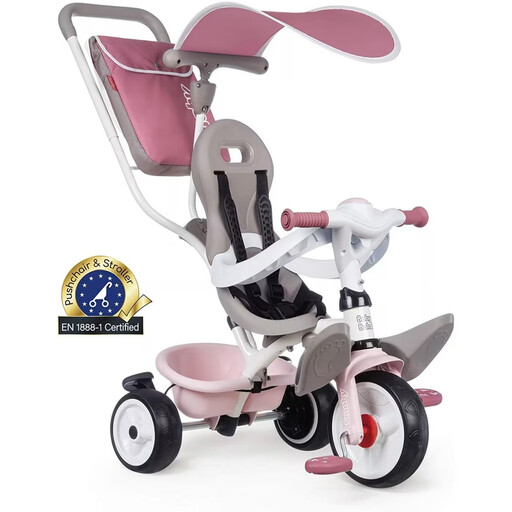
Why we love it: It's designed to accompany a child from their first outings in stroller mode to their first pedal strokes, with a strong focus on parental control and safety.
This model offers a true convertible system. Its metal frame and directional parent handle are robust. The transitions between modes are designed to be simple, avoiding the trap of flimsy gadgets.
The comprehensive parental control system (handle, steering lock, freewheel) and silent EVA wheels make it a reassuring and comfortable option for both parents and child.
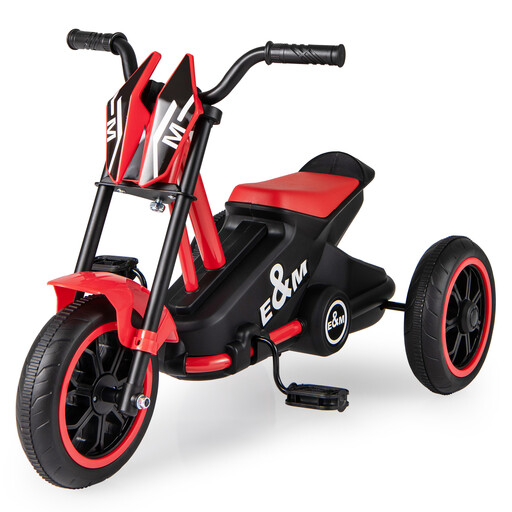
Why we love it: This is a classic, simple, and sturdy tricycle that focuses on the essentials: allowing an older child to learn to pedal safely, without any superfluous features.
It bypasses the instability trap with its stable triangular structure and wide wheelbase. The 30° steering limiter prevents overly sharp turns and the falls that result from them.
Its streamlined design with a solid metal frame makes it a reliable and durable choice for learning to pedal, offering excellent value for money.
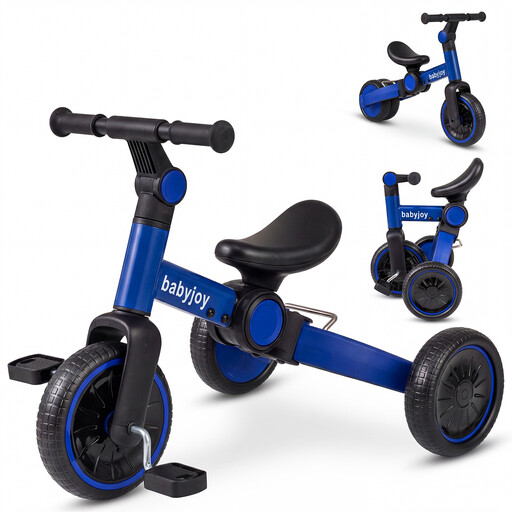
Why we love it: It's the ultimate all-in-one solution for parents looking for a single product to cover all stages, from tricycle to balance bike, making it a long-term investment that pays off.
It avoids the "fake convertible" trap by offering genuine, well-designed modularity. The pedals are removable and the wheels can be reconfigured, ensuring prolonged use and a true transition to learning balance.
Its ability to transform into a balance bike is a major asset for preparing a child to master balance, which is essential for a future two-wheeled bike, all with a single product.
We have compiled a complete list of products that meet our strict selection criteria and safety standards.
The age depends on the type of tricycle. Convertible models with a parent handle, harness, and footrests can be used as a stroller for walks from as early as 10 to 12 months. For independent pedaling, children are generally ready between 2 and 3 years old, when they have the necessary coordination and leg strength.
The two do not serve the same purpose. The tricycle is ideal for stability and for introducing a child to the motion of pedaling. The balance bike, with no pedals, is entirely focused on learning balance. A convertible tricycle that transforms into a balance bike can offer the best of both worlds.
The first rule is constant adult supervision. Next, wearing a helmet should become a reflex from the very first use. Finally, choose a model that is appropriate for the child's size, stable, and equipped with a steering limiter if possible. Regularly check that all screws are tight and inspect the general condition of the tricycle.