
Livraison le jour même ou le lendemain

Qualité garantie

Débloquez vos offres de bienvenue: Livraison GRATUITE | Jusqu'à -80 % | 30 jours d'essai gratuits à JoyPlus
Téléchargez l'application
A children’s trampoline with a safety net can turn a corner of your home into a real play area. But between compact models, those fitted with a support bar and multifunctional frames, the differences are not always obvious from the photos.
For parents of children aged 3 to 6, three common pitfalls regularly come up:
Before comparing models, it is therefore best to check the weight limit, dimensions, materials and usage instructions, rather than relying solely on the number of accessories.
The maximum weight limit should correspond to your child’s current weight, with a reasonable margin. A model rated for 25 kg is more suitable for lighter children and individual use. It must not be used by several children at the same time, even if the surface appears wide enough.
For a trampoline intended for children aged 3 to 6, also check:
A higher capacity, such as that advertised for a 6-in-1 trampoline with a 250 kg weight limit, does not remove the need to check the specific limits for each accessory or the manufacturer’s instructions.
A safety net reduces the risk of leaving the jumping surface, but it never replaces adult supervision. On a children’s mini trampoline with a bar, protecting the springs or elastic bands is just as important.
Look for a product listing that specifies:
The first SPORTSOUL model has 24 steel springs and a safety cover that completely encloses them. The second uses 24 elastic bands, with integrated padding and an adjustable T-bar. These two systems do not provide exactly the same feel: springs offer a more direct bounce, while elastic bands may be better suited to households looking to keep noise to a minimum.
A trampoline suitable for both indoor and outdoor use should be chosen according to the space you actually have available, not just the size of the mat. Leave a clear area around the frame, keep it away from furniture, walls and windows, and check the ceiling height.
A 36-inch model measures approximately 91,6 cm in diameter. This size may be suitable for a spacious bedroom, playroom or clear patio, but it does not mean that your child can jump freely in every direction.
In a smaller home, a folding children’s trampoline can make storage easier. However, you should check that the mechanism is properly locked before every session. Storing the trampoline indoors after use also helps limit its exposure to moisture and temperature changes.
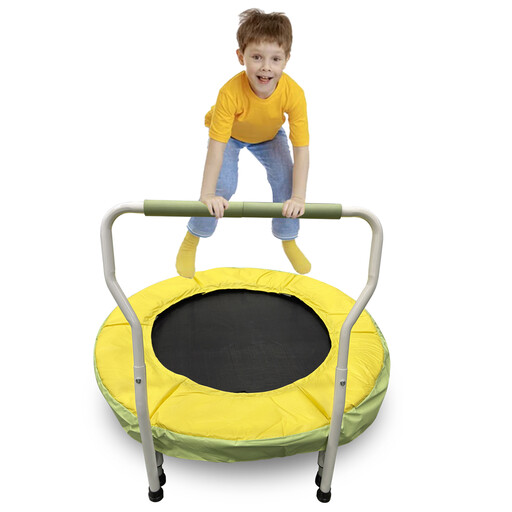
Why this choice suits this profile : With its 36-inch diameter, padded bar and 25 kg weight limit, this model is suitable for a first introduction, under supervision, indoors or in a clear outdoor space.
The cover encloses all 24 springs, limiting direct access to this area. The maximum capacity of 25 kg is clearly stated to prevent use beyond the specified limit.
Steel frame with anti-corrosion finish, polypropylene mat and adjustable support bar.
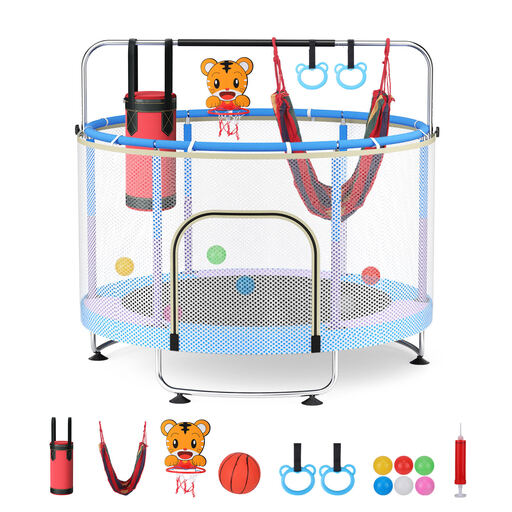
Why this choice suits this profile : This 59-inch frame is designed for families looking for an adaptable setup with a net, swing and basketball hoop, for indoor or outdoor use depending on the available space.
The net is integrated into the advertised design, while the accessories are listed separately. It is still essential to check the age, weight and installation limits for each type of use.
Advertised 6-in-1 design with safety net, bar, swing and basketball hoop. Maximum capacity stated in the product name : 250 kg.
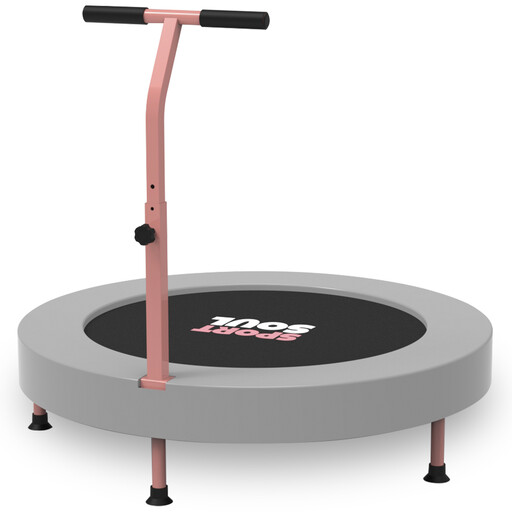
Why this choice suits this profile : Its design without metal springs, foldable format and adjustable T-bar may suit households that regularly store their trampoline or want to keep noise to a minimum.
The elastic bands replace the steel springs and the padding is integrated. Even so, the model must be inspected before every use, particularly around the bands.
Foldable frame, 24 elastic bands, adjustable bar and net weight of 4,77 kg. Advertised maximum capacity : 25 kg.
We have put together a complete, real-time updated selection of products that meet these demanding criteria, as well as European safety regulations.
To use a children’s trampoline with a safety net safely and comfortably, follow a simple routine:
Its lifespan depends on how often it is used, exposure to the elements and the condition of the springs, bands, stitching and protective covers. Any worn or damaged part should mean stopping use immediately.
Leave a clear area around the trampoline and check the ceiling height. The space required depends on the model and the instructions in its manual. No furniture, wall or hard object should be immediately next to the play area.
Some models are advertised as suitable for indoor and outdoor use, but this does not mean they can be left exposed permanently. Moisture, sunlight and temperature changes accelerate wear. It is best to store them indoors after every use.
The cost depends on which parts need replacing and how often the trampoline is used. The main components to monitor are the mat, springs or elastic bands, protective covers and, where fitted, the net. Regular inspections make it possible to spot signs of wear quickly and avoid continuing to use damaged equipment.