
Livraison le jour même ou le lendemain

Qualité garantie

Débloquez vos offres de bienvenue: Livraison GRATUITE | Jusqu'à -80 % | 30 jours d'essai gratuits à JoyPlus
Téléchargez l'application
A children’s train set can be much more than a simple toy: it can be an evolving construction game, a family activity or a motorised train with sounds and lights. Yet the differences between models can be considerable. Some come with just a few tracks, while others require batteries, plenty of floor space or compatible accessories.
Before getting your bank card out for a birthday, Christmas or an activity at home, take the time to check three points that are often overlooked: the actual suitable age, track compatibility and the day-to-day cost.
A toy labelled “from 2 years” may contain parts that require close supervision. Small pieces, removable bricks and certain accessories may not be suitable for children who still put objects in their mouths.
Always check:
The EN 71 and REACH standards provide a useful European framework, but they do not replace reading the product-specific instructions.
Not all children’s train tracks fit together. Even within the same manufacturer’s range, pre-school products and more advanced construction models may use different formats.
An extension should therefore be chosen according to:
For example, the LEGO DUPLO track extension 10425 is designed for the LEGO DUPLO interactive trains 10427 and 10428, sold separately. On its own, it does not make a complete motorised layout.
A children’s electric train may run on batteries or require regular recharging. You also need to consider the space it needs, storage and, in some cases, the purchase of additional carriages or tracks.
Light, sound and steam effects are appealing, but they add a few practical considerations: access to the battery compartment, battery life, cleaning and the risk of leakage if batteries are left in the toy for too long.
For a train set toy from age 2, choose pieces that are easy to grip, simple connectors and an assembly process that does not require force. Large bricks are generally better suited to first construction projects.
From the age of 5 or 6, children may start to enjoy switches, alternative routes and more technical layouts. LEGO City railway tracks, for example, are aimed at more independent builders than pre-school tracks.
Measure the available area before ordering. A layout installed on the floor in a small living room is not chosen in the same way as a set intended for a playroom.
Compare:
A model packed with tracks is only worthwhile if your child can actually set it up and put it away without turning playtime into a chore.
A manual train set works without batteries and is very easy to get started with. A motorised model adds movement, light and sound, but it also needs a little more maintenance.
To help the toy last longer:
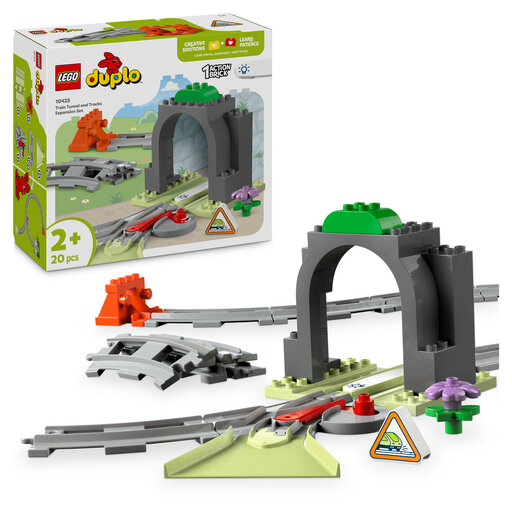
Why this choice suits this profile : With 20 pieces and manual assembly, this extension is ideal for families who already own a compatible LEGO DUPLO interactive train and want to expand their layout gradually.
Compatibility with sets 10427 and 10428 is clearly stated. However, you will need to buy the train separately if you do not already own it.
A tunnel over 20 cm high, a two-way switch and a light-up action brick activated by the compatible train.

Why this choice suits this profile : This motorised set is aimed at children aged 3 to 5 who enjoy ready-to-assemble toys, with several carriages and a large layout.
The contents are clearly detailed: locomotive, passenger carriages, 8 curved tracks and 4 straight tracks. The rechargeable battery is included, so you do not need to buy batteries straight away.
A stated layout measuring 178 × 104 cm, with lights, sounds and a steam function created by adding water to the designated tank.
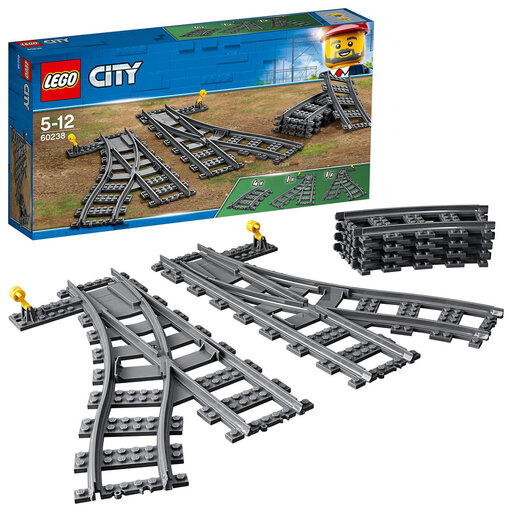
Why this choice suits this profile : This extension is aimed at children aged 5 and over who already own a LEGO City train and want to create several routes.
This is an extension, not a complete set. The product details specify the compatible ranges and models.
8 pieces including 4 curved tracks, a right-hand switch and a left-hand switch — no batteries required.

Why this choice suits this profile : For a child aged 6 or over who prefers racing against another player, this car track features a 2.22 m figure-of-eight layout.
The set includes two cars and clearly states the recommended age. However, allow for 8 AA batteries per car — these are not included.
Two Formula 1 cars, a 2.22 m figure-of-eight layout and stated compliance with EN 71 and REACH standards.
We have brought together a complete, real-time updated selection of products that meet these demanding criteria and European safety regulations.
A railway layout is ideal for children who enjoy building a world, changing routes and making up stories. Manual models are often the easiest place to start.
A children’s race track is better suited to fans of speed and head-to-head challenges. It generally requires more space, batteries and a little supervision during assembly. Between the ages of 3 and 8, a flexible track can also be used to create ramps, bends and different courses with cars, lorries or certain miniature trains.
A layout made from connecting tracks usually takes just a few minutes to assemble. Models with switches, tunnels or electrical functions may take a little longer, particularly the first time they are set up. With younger children, an adult can check that each connection is properly secured.
Choose a model made from large pieces that are easy to handle and contain few detachable parts. Read the warnings carefully: some product details state a minimum age of 2 while also recommending adult supervision and warning that small parts are present.
It depends on the type of power supply. A rechargeable model avoids the regular cost of batteries, while a train set powered by AA batteries requires them to be replaced when the speed or light effects begin to decrease. Removing the batteries before storing the toy for a long period also helps reduce the risk of leakage.