
Livraison le jour même ou le lendemain

Qualité garantie

Débloquez vos offres de bienvenue: Livraison GRATUITE | Jusqu'à -80 % | 30 jours d'essai gratuits à JoyPlus
Téléchargez l'application
Giving your child a play space that is both safe and stimulating is every parent's goal. Yet, faced with a saturated market, it's difficult to know where to start. The gap between tempting marketing promises and the reality of daily use can be immense. To help you avoid turning a great purchase into a bulky headache, we've broken down the 3 most common pitfalls.
An appealing design can hide materials that are difficult, or even impossible, to clean on a daily basis. A simple juice or marker stain on a poorly chosen fabric can become permanent. Likewise, some low-quality foams absorb liquids and eventually develop stubborn odours. Worse still, non-certified plastics may contain substances harmful to your child's health.
"Evolutive," "foldable," "compact"... there's no shortage of selling points. But in reality, daily use is often a different story: folding proves to be complex, requiring the disassembly of several parts, and in the end, the whole set remains far too bulky once stored. The play area ends up hogging precious space permanently, becoming more of a constraint than an asset.
An avalanche of bright colours, sounds, and textures doesn't necessarily equate to better development. On the contrary, an overloaded environment can scatter a child's attention and tire them out, instead of fostering concentration and free play. A good early-years toy should know how to stimulate without ever overwhelming.
To avoid falling into these traps, it's best to stick to objective criteria. Here are the non-negotiable checkpoints before you head to the checkout.
This is the non-negotiable criterion. Your first instinct should be to check for the NF EN 71 standard. This European certification guarantees several crucial points:
This standard is a guarantee of peace of mind for you and safety for your child.
The choice of material has a direct impact on the use and longevity of your play area.
Before you buy, take out your tape measure and measure the space you have available. Compare these measurements to the product's dimensions when unfolded. For outdoor play equipment for kids, also anticipate the storage space needed in the off-season. A truly practical product should be able to be assembled, disassembled, or stored by one person in just a few minutes.
To move from theory to practice, here are a few products that tick all the right boxes, adapted for different needs.
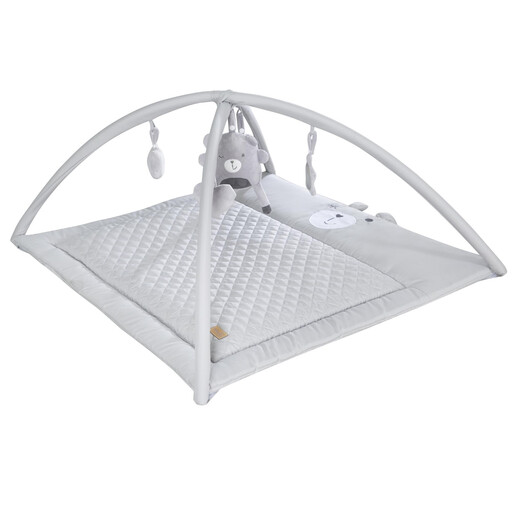
Why we chose it: Ideal for baby's first months, this set provides a soft, padded surface for tummy time and early explorations. The hanging toys offer just the right amount of targeted sensory stimulation.
It prevents overstimulation with 5 distinct toys and removable arches. Its water-repellent, easy-to-clean surface counters the difficult maintenance pitfall.
Its versatility: the arches detach to transform it into a simple play mat or a backup changing mat. The materials are certified free of harmful substances.
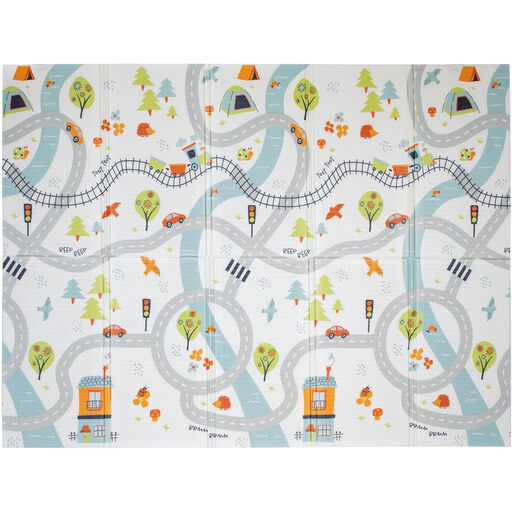
Why we chose it: Perfect for apartments where every square foot counts. This mat offers a large, comfortable play surface (200x150 cm) that folds up ultra-compactly to slip into a closet or behind furniture.
It directly tackles the "false modularity" trap. Its accordion-style folding is incredibly simple. The foam surface is waterproof and cleans up instantly.
Its reversible design (one side with a road track, one more understated side) allows it to blend in with living room decor. The 1 cm thickness effectively cushions falls.
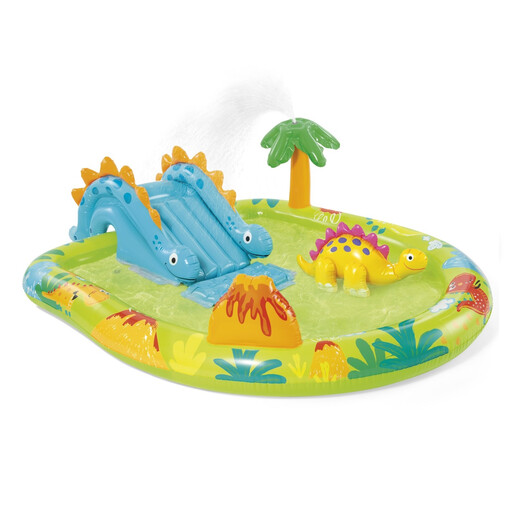
Why we chose it: The ideal solution for hot summer days. This water play center is compact, quick to set up in the garden, and promises hours of fun with its small slide and water sprayer.
It doesn't pretend to be a year-round product, which allows it to avoid the false versatility trap. Its drain plug makes cleanup easy, and the vinyl can be hosed down.
Connecting it to a simple garden hose is all it takes to create a fun sprinkler. Its size is designed for toddlers (ages 2+), with a shallow water depth for added safety (under constant supervision).
Discover our full selection of products that meet our strict criteria for safety, practicality, and durability.
It all depends on the type of product. A fabric activity gym can be used from birth. A foam baby play mat is recommended from the time a child starts to sit up and move around (around 6 months). Inflatable play areas or water centers are generally advised for ages 2 and up, and their use must always be under the constant supervision of an adult.
For a foam mat, a damp cloth with a little mild soap is sufficient for most stains. Avoid harsh cleaning products that could damage the surface or leave residue. For an inflatable structure, rinse it with clean water after use, spot clean if necessary, and most importantly, let it dry completely in the open air before folding it. This is essential to prevent mould growth.
While not "essential" in the strictest sense, a dedicated play area offers real advantages. It creates a safe perimeter that protects the child from hard, cold floors while defining a space of their own. It's a controlled environment where they can develop their motor skills, explore textures, and play freely without the potential dangers of the rest of the house. It's a wise investment to provide a play setting that is both safe and suitable.