
Livraison le jour même ou le lendemain

Qualité garantie

Débloquez vos offres de bienvenue: Livraison GRATUITE | Jusqu'à -80 % | 30 jours d'essai gratuits à JoyPlus
Téléchargez l'application
A children’s lunch box needs to survive the journey in a school bag, repeated openings and frequent washing. Yet some models focus primarily on a bright colour or a popular character, without really considering the demands of a school day. To avoid disappointment, it’s best to look beyond the design.
A small box is perfectly fine for a few pieces of fruit, biscuits or sandwiches. However, it won’t necessarily be enough to carry a full meal. Conversely, a large lunch box can quickly become cumbersome for a young child.
Start by identifying the usual contents:
A leakproof lunch box shouldn’t be judged on that claim alone. You also need to examine the type of closure, the presence of seals and the conditions of use. A compartmentalised box can prevent foods from mixing without actually being designed to carry sauce or liquid.
For moist foods, check for clips, inner lids or a mechanism explicitly described as airtight or leakproof. Avoid liquid preparations in a box whose product description doesn’t guarantee this function.
A closure that’s too stiff can discourage a child aged 3 to 6. Conversely, a lid that’s too flimsy or poorly secured risks opening at the bottom of the school bag. Maintenance also deserves your attention: deep grooves and fixed compartments tend to trap crumbs.
Check the manufacturer’s recommendations regarding the dishwasher, hand washing and removable parts. For a young child, consider the recommended age and regularly inspect the condition of the clips and the lid.
The dimensions need to suit both the school bag and your child’s appetite. A rectangular shape generally slides more easily into a bag. A capacity of 900 ml, as found on some Maped models, is suitable for a meal or a generous snack, but may be excessive for a simple snack.
For a compact snack box, measure the actual space available in the school bag. Formats around 16 × 13 × 5 cm allow you to carry a sandwich, some fruit or biscuits without taking up all the room.
A compartmentalised bento box lets you separate textures and organise portions more effectively. Models with five or six sections are suitable for varied meals, while a box without dividers is quicker to fill and clean.
However, be aware: separating foods doesn’t necessarily mean preventing leaks. Internal dividers don’t guarantee that a liquid will stay in its compartment.
Stainless steel generally withstands daily use well and retains few odours. Some models, such as Maped’s stainless steel food containers, are advertised as dishwasher-safe, but remain unsuitable for microwave ovens.
Plastic or polypropylene boxes have the advantage of being lightweight and often very colourful. However, follow the cleaning instructions and avoid abrasive products if you want to preserve the printed designs.
For each model, also check:
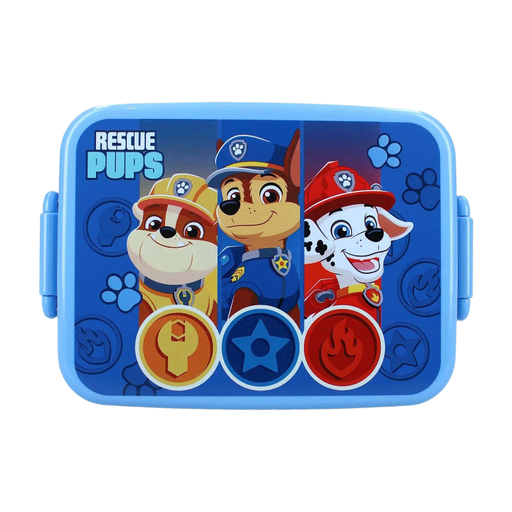
Why this choice suits this profile: With its dimensions of 16 × 13 × 5 cm and its contained weight, this box is suitable for a first school use from age 3, for carrying a simple snack without weighing down the school bag.
The press-stud closure is simple to operate and doesn’t require a complicated mechanism. However, washing is by hand only and microwave use is not permitted.
Plastic construction, press-stud closure, compact format and PAW Patrol licensed design.

Why this choice suits this profile: This model combines a 316L stainless steel structure, five compartments and four closure loops. It’s suitable for both home-prepared meals and picnics.
Foods stay well separated and the four loops reduce the risk of accidental opening. Hand washing is recommended and microwave use is not allowed.
316L stainless steel, five compartments, polypropylene lid and astronaut design.
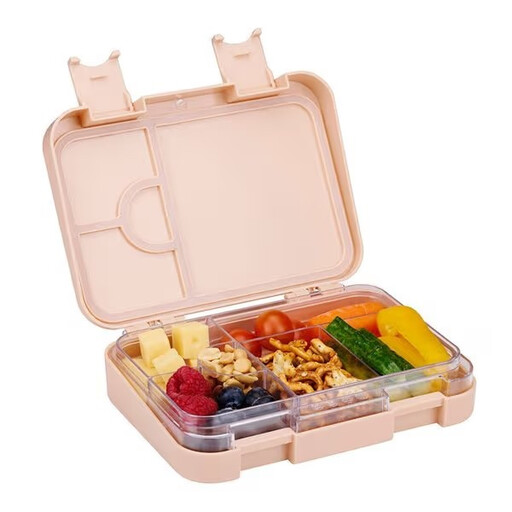
Why this choice suits this profile: Its six removable compartments make it easy to prepare varied meals and control portions. The box lends itself to repeated use, at school, work or during sports activities.
The removable parts make cleaning easier and limit hard-to-reach corners. However, very liquid foods are still not recommended.
Six sections, dimensions of 21 × 15 × 4.5 cm, removable parts and advertised dishwasher compatibility.
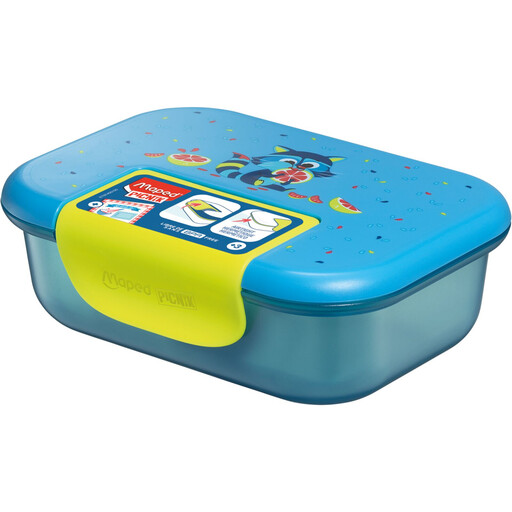
Why this choice suits this profile: Its fluorescent clip is designed to be easily operated by small hands. With its 900 ml capacity, this box is suitable for school meals, generous snacks and outings.
The attached lid reduces the risk of losing a part. The box is advertised as airtight and dishwasher-safe, but it should not be used in the microwave.
Stainless steel, 900 ml capacity, fluorescent clip, attached lid and rectangular shape.
We’ve put together a comprehensive, up-to-date selection of products that meet these demanding criteria, while complying with European safety regulations.
For a simple snack, a small format is usually sufficient. For a full meal, a capacity of around 900 ml offers more flexibility. However, remember to compare the external dimensions with those of the school bag.
It depends on the model. Some stainless steel boxes and certain compartmentalised options are dishwasher-safe. Others need to be washed by hand to preserve printed designs, seals or the closure mechanism.
There’s no universal lifespan. Replace the box as soon as a crack, broken clip, deformation or loose closure appears. Regular washing, thorough drying and avoiding overloading will help keep it in good condition for longer.