If your child needs a smooth texture, start with a product clearly labelled ‘no pieces’ or ‘blended fruit’, rather than relying on the words ‘fruit yoghurt’ alone. A drinkable format or a straw can make serving easier, but it doesn’t confirm that there are no pieces. Check the recipe, allergens and storage instructions for the product you choose, too.
Who is this choice for?
Parents looking for a smooth texture
You’re looking for a fruity dairy dessert with no noticeable pieces. For this, ‘no pieces’ and ‘blended fruit’ are more useful labels than a picture of fruit on the packaging. For young children starting to wean, Santé publique France describes a progression from smooth textures to mashed foods, then soft, small pieces.
Parents comparing recipes
You want to tell the difference between a fruit yoghurt and a fromage frais with fruit, and compare the ingredients and sugars per 100 g and per portion. Pot size matters when the pack sizes differ.
Families choosing an easy-to-serve format
A small pot, pouch or straw may suit different ways of serving a dessert or snack. The way a product is eaten doesn’t remove the need to check its texture and storage instructions.
What should you look for first?
For an easy-to-eat meal, start with the stated texture, then compare the recipe and format. A fromage frais with blended fruit may meet the same need for a smooth texture as a yoghurt with no pieces, but it isn’t the same type of product.
| Criterion |
What to check |
Who is it for? |
| Texture |
Look for ‘no pieces’ or ‘blended fruit’ on the specific recipe; ‘with fruit’ isn’t enough. |
When pieces bother my child at mealtimes, a smooth texture is my top priority. Around 33% of consumers put this need first. |
| Sugars and ingredients |
Compare the ‘of which sugars’ figure per 100 g, then check the amount in the portion served. Read the product name and ingredients, too. |
If I’m choosing between several fruity recipes, I want to know what each one contains and how much will be eaten. This is the top priority for around 27% of consumers. |
| Format |
Check the quantity per unit, how it’s eaten and the storage instructions. |
For an easy-to-serve snack or dessert, I choose a portion and container my child can manage. Around 20% of consumers prioritise this first. |
| Label and allergens |
Check the ingredients, highlighted allergens and storage instructions on the packaging you buy. |
When the flavour or format changes, I want to check the label before serving the product. This is the top priority for around 20% of consumers. |
Common mix-ups to avoid
-
Assuming ‘with fruit’ means ‘no pieces’
This description alone doesn’t tell you about the texture: depending on the recipe, the fruit may be blended or left in pieces.
If having no pieces is essential, look for an explicit claim on the specific product and flavour you choose.
-
Assuming you know the recipe because it comes with a straw
The straw tells you how to consume the product, not how much sugar it contains or whether it has pieces. Auchan says its Danonino with a straw can also be eaten with a spoon.
Check the texture, nutritional information and storage instructions separately.
-
Assuming the same details apply when the flavour changes
Two products in the same range may have different ingredients or nutritional information.
Check the packaging of the product you actually buy, especially the ingredients and allergens.
Brands and ranges to know
These examples can help you spot product descriptions and formats. Always choose based on the exact recipe, rather than assuming a feature applies to an entire brand.
Danone / Danonino
Danonino offers, among other products, a fruit yoghurt with a straw.
- According to its listing on Auchan, this product can be eaten with a spoon or its straw.
- This way of eating it doesn’t confirm that all Danonino recipes are free from pieces.
Yoplait / Petits Filous et Grands Filous
These ranges include products with blended fruit in pots of different sizes.
- The Petits Filous listing on Auchan shows 50 g pots; Yoplait lists Grands Filous pots at 100 g.
- Petits-suisses and fromage frais shouldn’t be confused with yoghurts: check the product name for each item.
E.Leclerc / Delisse
The Delisse range includes stirred fruit yoghurts explicitly labelled ‘no pieces’.
- This wording directly meets the need for a recipe with no noticeable pieces.
- On its own, it doesn’t tell you about the ingredients or sugars in each flavour.
Carrefour
The children’s range includes flavoured yoghurts and fromage frais with fruit.
- The different containers give you options for finding a way to serve it that suits the meal.
- The format doesn’t tell you the texture, so check the product listing and packaging for the item you choose.
Auchan
Its range includes flavoured yoghurts, fromage frais with fruit and drinkable formats.
- These categories offer several options for choosing between a spoon and a drinkable format.
- They include different recipes, so look for ‘blended’ or ‘no pieces’ if texture is your priority.
A drinkable option on Joybuy
This product is a fruity drinkable option for children. If a completely smooth texture is essential, check this on the specific product before choosing it.
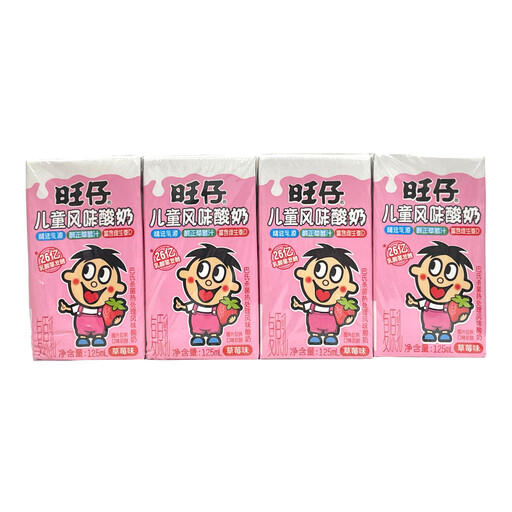 Image unavailable
WANT WANT Wantzai strawberry-flavoured yoghurt, 4 × 125 ml
A format to consider if your child prefers drinking to eating with a spoon. The pack contains four 125 ml units. Check the texture, sugars and allergens on the packaging of the product you choose.
View on Joybuy
Frequently asked questions
What should I look for to avoid pieces of fruit?
Look for ‘no pieces’ or ‘blended fruit’ on the product you choose: ‘with fruit’ doesn’t guarantee a smooth texture. For a young child starting to wean, Santé publique France describes a gradual introduction of different textures, adapted to the child.
Does a fruit yoghurt with a straw need to be kept chilled?
Follow the storage instructions on the packaging. For the Danonino with a straw described by Auchan, the stated storage temperature is between +1 °C and +6 °C; don’t assume the same applies to another product.
How can I check allergens before buying?
Read the ingredients list for each flavour and look for highlighted allergens. The DGCCRF sets out this labelling rule for prepacked foods in France; the name of a range is no substitute for checking the pack you buy.
Is the Nutri-Score enough to choose an easy-to-eat texture?
No: it doesn’t tell you whether the fruit is blended or in pieces. For this, read the texture description, then check the ingredients and nutritional information for the recipe.


