
Livraison le jour même ou le lendemain

Qualité garantie

Débloquez vos offres de bienvenue: Livraison GRATUITE | Jusqu'à -80 % | 30 jours d'essai gratuits à JoyPlus
Téléchargez l'application
A children’s climbing toy can quickly become part of the daily routine at home, in a nursery or in the garden. Between promises of a “complete play course,” photos taken in large playrooms and dimensions sometimes buried at the bottom of a product page, some purchases can disappoint within just a few weeks.
Before choosing a children’s climbing structure, a Montessori climbing triangle or gross-motor play blocks, three common pitfalls deserve particular attention.
A 7-in-1 climbing frame may combine a slide, ladder, climbing net and basketball hoop. But its dimensions are what will make the real difference in everyday use. Measure the room or outdoor area, then allow enough clearance around the structure for movement. An indoor playset for children that is too large can quickly become cumbersome and difficult to use.
The minimum age is only one factor. A toy suitable for children from 2 or 3 years old must also match their height, motor skills and ability to follow instructions. A course with a rope and climbing net presents a different level of challenge from soft blocks or a small children’s slide.
Large toys are often used less when they remain permanently in the middle of the living room. For indoor use, a foldable model or stackable blocks may prove far more practical. Outdoors, check UV resistance, how easy the surfaces are to clean and the recommended storage conditions.
Check the maximum load specified for each individual component, not just for the set as a whole. The play equipment should be installed on a flat, stable surface. Outdoors, grass or impact-absorbing matting is generally preferable to hard flooring, although the manufacturer’s instructions remain the definitive reference.
For a metal structure, inspect the joints, visible welds, handles and any anti-corrosion coating. For wooden equipment, look for smooth surfaces, rounded edges and handles with no looseness or play.
Foam gross-motor blocks should retain their shape, feature a non-slip base and have protected fastenings. BanaSuper product pages state compliance with EN71-1, EN71-2 and EN71-3, as well as with Directive 2009/48/EC on toy safety. This information reflects the details provided on the product page and should be verified in the documentation supplied with the product.
For plastic equipment, UV treatment can help limit visible material ageing. However, it does not eliminate the need to cover or store the product when it is not in use.
A foldable Montessori climbing triangle addresses different needs from an outdoor climbing playset. In particular, check:
Adult supervision remains necessary, especially with young children, during their first uses and for activities involving height or ropes.
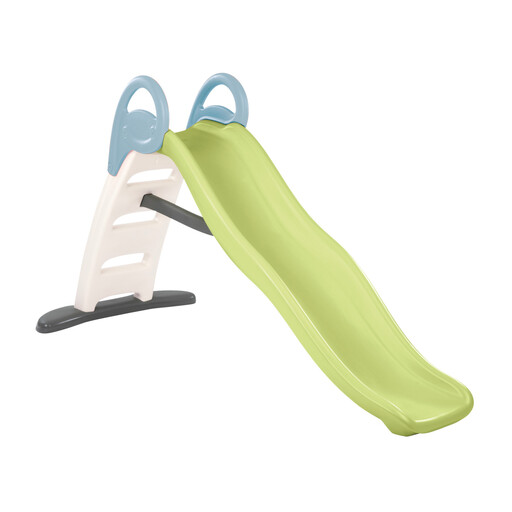
Why this model is a good fit: A straightforward option for families looking to start with a children’s slide suitable from age 2, whether in the garden or a sufficiently spacious room.
The product page specifies a minimum age of 2 years, a maximum load of 50 kg, as well as non-slip steps and handles. It is not a multi-activity play course whose footprint could be underestimated.
A 2 m double-wave sliding surface, UV-treated recycled plastic and the option to connect a garden hose, which is not included.
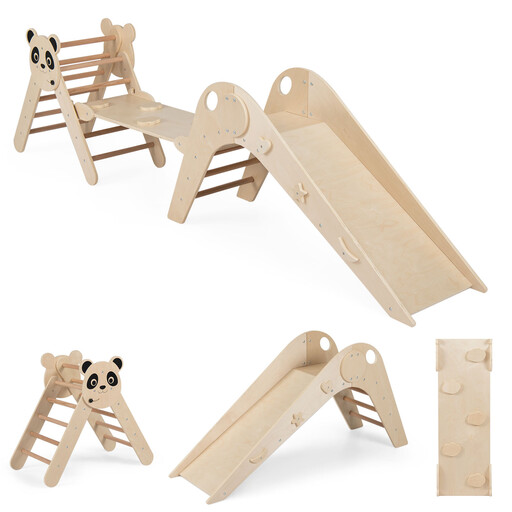
Why this model is a good fit: It suits parents looking for an adaptable wooden play set for indoor use, with multiple configurations for a bedroom or playroom.
The triangle folds up against a wall for easier storage. The product page mentions beech wood and plywood, smooth edges and handles designed to minimise movement.
The set includes a triangle, a balance board and a reversible element that can be used as a slide or tunnel. Stated age: 3 years and over, with a stated load capacity of 50 kg per component.
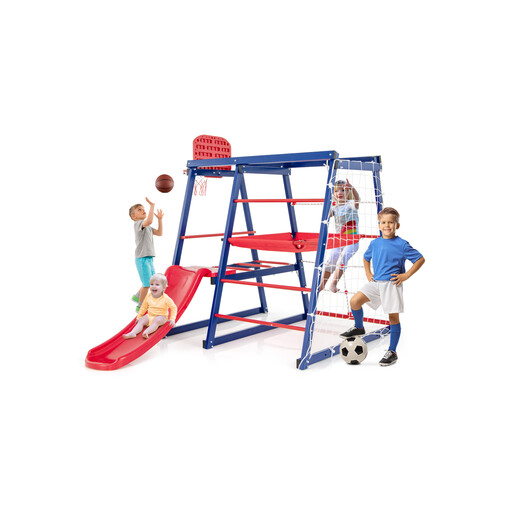
Why this model is a good fit: It is designed for nurseries, childminders and families with a dedicated space who want to offer a wider range of motor-skill activities.
The stated dimensions are 150 × 142 × 146 cm, with a maximum load of 100 kg. These figures make it possible to check whether the equipment will fit the intended room before purchase.
Seven functions are advertised : slide, climbing net, ladder, rope, basketball hoop and two platforms. The metal frame is described as rust-resistant.
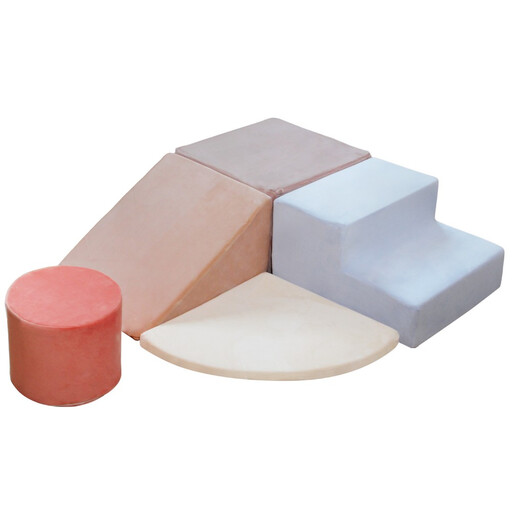
Why this model is a good fit: A modular solution for creating a gross-motor play course in a living room, nursery classroom, childcare centre or recreation room.
Removable, washable covers make maintenance easier. The product page also mentions non-slip bases, hook-and-loop fasteners and concealed zips.
No assembly is required, and multiple configurations allow children to climb, crawl, slide or build. The blocks are vacuum-packed and may take up to 48 hours to fully regain their volume.
We have brought together an up-to-date selection of products meeting practical criteria for choosing suitable gross-motor equipment for young children in France.
Before first use, assemble each component according to the instructions and check all fastenings. For an outdoor climbing playset, position the structure away from walls, fences, stairs and particularly hard surfaces. When specified in the instructions, only one child should use the slide at a time.
Clean plastic or wooden surfaces with a soft, slightly damp cloth. Foam blocks are generally easier to keep clean thanks to their washable covers. After outdoor use, dry the product before covering or storing it. Regularly inspect the ropes, screws, handles, fasteners and connection points.
Choose equipment that is low to the ground, with easy-to-grip holds and a stable base. The Smoby Life Funny Slide is advertised as suitable from age 2, while the wooden triangle and 7-in-1 metal model are recommended from age 3. Adult supervision remains essential.
They can be suitable for group use if the space is clear, the covers are cleaned regularly and the children are supervised. Check the documentation, stated compliance and condition of the fasteners before every session. Their modular design makes it possible to create a different course without installing a fixed structure.
Service life depends on frequency of use, supported weight, assembly quality and storage conditions. Outdoor equipment should be protected from the elements and direct sunlight when not in use. To extend its lifespan, follow the recommended age range and maximum load, and carry out the checks advised by the manufacturer.