Groups planning a meal together
If you’re planning to make a salad, couscous, curry or hummus for several people, you could use a large tin in one go. Carrefour, E.Leclerc and Auchan, for example, stock 530 g formats.


For a holiday rental, a multipack of small tins lets you open chickpeas as you need them, when meal plans are still uncertain. A large tin is a better fit if you’re planning a dish for several people and will use its contents quickly. Individual tins, meanwhile, let you stock up without opening a large tin. In every case, compare the drained net weight and check the ingredients, allergens and storage instructions for the specific product you choose.
If you’re planning to make a salad, couscous, curry or hummus for several people, you could use a large tin in one go. Carrefour, E.Leclerc and Auchan, for example, stock 530 g formats.
If meal plans or the number of guests might change, a multipack of small tins means you only need to open the amount you need. Available formats include packs of 3 × 125 g at Auchan, 3 × 130 g at E.Leclerc and 3 × 200 g at Carrefour.
If origin, ingredients, salt or allergens matter to you, check the exact product rather than relying on the details for another tin size from the same brand. Drained net weight also helps you compare how much chickpea you’ll actually have to use.
Start by choosing a format based on the meals you’re planning and how much you’ll be able to use once it’s open. Then compare the drained net weight and label information for the formats that suit your needs.
Choose this: when meal plans aren’t set yet or several people are sharing a small fridge.
Bear in mind: each tin stays sealed until you need it, but you may need to open several for a meal shared by a group.
Choose this: when you’re planning a dish for several people and will use the contents all at once or soon after opening.
Bear in mind: if your meal plans change, you’ll need to store any leftovers according to the product instructions.
Choose this: if you want a few tins for different dishes.
Bear in mind: you may need several tins for one dish if you’re cooking for a group.
| Criterion | What to check | Who is it for? |
|---|---|---|
| Quantity for a group meal | Compare the drained net weight of the formats you’re considering with the amount you need for your planned dish. | If I’m cooking for the whole group, I want the amount I’ve planned without having to open several tins; around 40% of consumers prioritise meals shared by a group. |
| Leftovers after opening | Check the size of each tin in the multipack and the storage instructions for after opening. | With changing meal plans and limited fridge space, I’d rather open just a small tin; limiting leftovers is the main concern for around 30% of consumers. |
| Ingredients and origin | Read the ingredients, allergen information and origin shown on the exact product. | If an allergen warning or a specific origin determines what I buy, I need to check the tin I’ve chosen; around 20% of consumers prioritise checking the label. |
| Stock for spontaneous meals | Choose the number and size of individual tins to suit the dishes you might make during your stay. | If we haven’t settled on a meal for the group, I want to keep a few tins sealed so I can cook as needed; this flexibility comes first for around 10% of consumers. |
If your plans change, leftovers take up fridge space and need to be stored according to the product instructions.
Save the large format for a dish where you know how much you’ll need. Otherwise, consider a multipack of small tins that you can open separately.
The weight of a tin including its liquid isn’t the same as the amount of chickpeas on their own once drained. The DGCCRF states that drained net weight must be shown for products sold in a covering liquid.
To compare a multipack with a large tin, check the drained net weight of each format.
For Notre Jardin, E.Leclerc lists the origin of the 3 × 130 g multipack as France, while the product details for the 530 g tin mention several possible origins. Monoprix’s product details for its 265 g tin warn that it may contain traces of gluten and soya.
If origin or allergens affect your choice, check the label on the exact format before you buy.
Once opened, follow the storage instructions for that specific product. For its 3 × 125 g multipack, Auchan advises transferring the contents to a suitable airtight container, refrigerating them and using them within two days.
Make sure you have a suitable container in your holiday rental, or choose a tin whose contents you can use in full.
Carrefour stocks Carrefour Classic' tinned chickpeas in different sizes, including a 530 g tin and a 3 × 200 g multipack.
This E.Leclerc brand offers, among other formats, a 530 g tin and a 3 × 130 g multipack.
Auchan stocks 265 g and 530 g formats, as well as a 3 × 125 g multipack.
The 265 g Monoprix tin is an individual portion for a small dish.
ALDI France stocks ALL SEASONS® chickpeas in a 265 g tin.
This 820 g tin is a good choice if you’re planning a meal for a group, rather than looking for a multipack of small tins to open as needed during your stay.
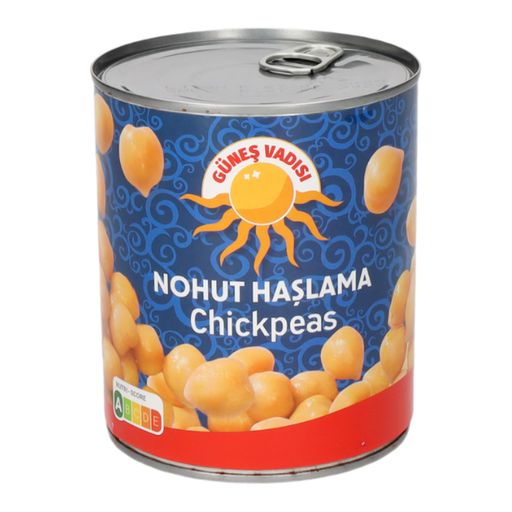 Image unavailable
The 820 gr format suits a dish for several people if you plan to use the contents of this single tin soon after opening.
To find out how much chickpea you’ll have after draining, check the drained net weight on the packaging. The product details list lupin as an allergen, so check the label if this affects you. They also advise refrigerating the product after opening and using it within three days.
Compare their drained net weight, then choose based on how much you plan to open for each meal. In France, the DGCCRF states that this weight must be shown when a product is sold in a covering liquid; net weight alone doesn’t tell you how much you’ll have after draining.
Follow the instructions for the product you’ve bought rather than leaving an opened tin in the cupboard. For its 3 × 125 g multipack, Auchan advises transferring the contents to a suitable airtight container, refrigerating them and using them within two days.
No. A best-before date passing doesn’t, by itself, mean you have to throw a tin away. The DGCCRF distinguishes this from a use-by date and notes that the packaging must be intact; however, the product’s taste or physical qualities may change.
Check the ingredients, allergens, nutritional information, net quantity, drained net weight when the chickpeas are in a covering liquid, as well as the date and storage instructions. The DGCCRF includes these details in its labelling rules for prepacked foods in France. If origin matters to you, check what’s stated on the specific product you’re considering.