Who is this choice for?

Parents of children who can manage chewing gum independently

You’re considering giving chewing gum to a child you know can chew it and then dispose of it, rather than leaving a bag within their reach. The French Union for Oral Health (UFSBD) discusses sugar-free chewing gum on a page aimed at children aged 7–11, but this does not mean it is suitable for every child in that age group.

Parents who care about oral health

You want to distinguish sugar-free products from sugary sweets without treating chewing gum as a substitute for brushing. The UFSBD points out that sugar-free chewing gum does not replace brushing your teeth.

Anyone organising a supervised snack

You need to choose between small packs of pellets to hand out and a sharing bag to portion yourself. The number of pieces, net weight and ingredients matter more than the apparent size of the pack alone.

What should you look for?

Before comparing pack formats, make sure each child can chew and then dispose of chewing gum under supervision. Then choose between handing out individual sugar-free pieces and sharing a bag of sweets as an occasional treat, and check the label of the product you’ve chosen.

Criterion What to check Relevant shoppers
Child’s ability to manage it Whether they can chew and then dispose of the gum, and whether an adult can supervise how it is handed out. If I don’t know whether a child can manage this, I’d rather not offer them chewing gum; around 36% of shoppers put this need first.
Sugar-free option The claim on the specific product, followed by its ingredients, sweeteners and warnings. If brushing isn’t possible straight after a meal, I look for a sugar-free option without treating it as a replacement for a toothbrush; this is the top priority for around 29% of shoppers.
Handing it out at snack time The stated number of packs or pellets and the net weight, and how easy it is to hand out one piece at a time. When serving a group, I want to hand out individual pieces without passing round an open bag; around 21% of shoppers put this ahead of other criteria.
Occasional fruity bag The first ingredients listed, any allergens stated and the net weight of the bag. If I’m planning to share a fruity sweet as an occasional treat, I’m happy to portion out a sugary bag myself; around 14% of shoppers prefer this type of option.

The formats offer different options: Carrefour France, for example, lists Freedent multipacks of 5 × 10 pellets, while its product pages for Fini Fruits Bubble Guum and Malabar Bubble Mix describe 165 g and 214 g bags containing sugar. Net weight helps you work out how much you’ll need to portion out, but it doesn’t define how much to give a child.

Mistakes to avoid

  • Assuming a large bag means the product is sugar-free

    The ingredient lists published by Carrefour France for Fini Fruits Bubble Guum and Malabar Bubble Mix bags include sugar. So a fruity flavour or large pack doesn’t tell you how much sugar the product contains.

    Check the product name and ingredients on the specific pack you plan to hand out.

  • Letting children help themselves from a sharing bag

    With an open bag, an adult can’t choose who gets a piece of chewing gum or keep track of how it is handed out.

    Keep the bag with you and hand out one piece at a time, only to children you know can chew and then dispose of it.

  • Treating sugar-free chewing gum as a substitute for brushing

    On its page for children aged 7–11, the UFSBD discusses chewing sugar-free gum for 20 minutes when brushing isn’t possible. It also makes clear that chewing gum does not replace brushing.

    Keep up your child’s brushing routine; Assurance Maladie recommends brushing twice a day for two minutes.

  • Assuming all sugar-free recipes are the same

    A Stimorol product page published by Carrefour France includes warnings about the laxative effects of excessive consumption and the presence of a source of phenylalanine. These warnings don’t automatically apply to other products.

    Read the ingredients, allergens and warnings on the pack you’ve chosen, especially if the child has specific dietary requirements.

Brands to know when comparing pack formats

Hollywood

Products listed by Carrefour France include sugar-free spearmint chewing gum in 5 packs of 8 pellets, and a product labelled ‘100% xylitol’ in 5 boxes of 10 pellets.

  • The smaller packs make it easier for an adult to hand out individual pieces without opening a shared bag.
  • Check the ingredients and warnings on the specific product: these two formats don’t represent the whole range.

Freedent

The range listed by Carrefour France includes sugar-free products in 14 g packs, 70 g or 84 g formats, and multipacks of 5 × 10 pellets.

  • The 5 × 10 multipack states the number of pieces, making it easier to plan how you’ll hand them out.
  • Pack formats and flavours vary by product, so check the one you’re buying.

Airwaves

Carrefour France lists sugar-free Airwaves chewing gum in 14 g and 70 g formats, including minty flavours.

  • These products give you a choice of formats if you’re looking for a minty flavour.
  • A flavour or the fact that a product is stocked doesn’t tell you whether its ingredients are suitable for every child.

Fini

Carrefour France’s product page for Fini Fruits Bubble Guum describes a 165 g fruity bag.

  • The bag suits anyone looking for sweets that an adult can portion out as an occasional treat.
  • The product page lists sugar, glucose syrup and soya lecithin in the gum base, so it’s not the same option as a sugar-free product.

Malabar

Carrefour France’s product page for Malabar Bubble Mix describes a 214 g bag of chewing gum sweets.

  • The stated net weight helps you plan how to hand out sweets at a group event.
  • The ingredients for this product include sugar, glucose syrup and dextrose; an adult should still portion out the bag.

Chewing gum multipacks on Joybuy

This sugar-free chewing gum multipack is a handy option if you want to hand out individual pieces at a supervised snack. Before offering it to a child, consider whether they can chew and then dispose of it, and check the information on the packaging.
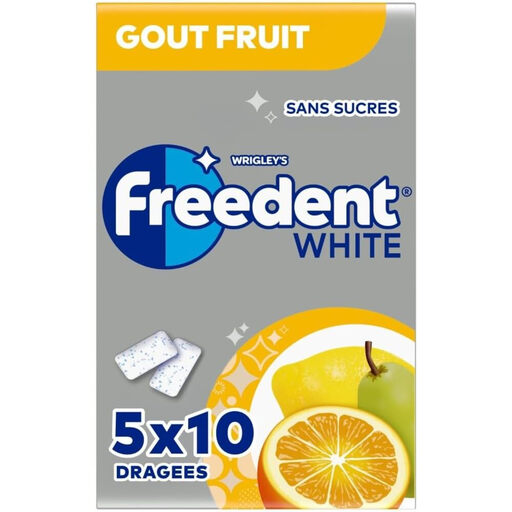
Freedent Whitening sugar-free fruit chewing gum multipack, 5 packs of 10 pellets, 70 g

Freedent Whitening fruit flavour, sugar-free, 5 × 10 pellets, 70 g

The five-pack format makes it easier for an adult to hand out individual pieces rather than leaving a shared bag open.

The product name states that it’s fruit-flavoured and contains 5 packs of 10 pellets, with a net weight of 70 g. Read the ingredients and warnings on the exact pack before offering it to a child.

View on Joybuy

Frequently asked questions

Does sugar-free chewing gum replace brushing a child’s teeth?

No. Sugar-free chewing gum does not replace brushing. On a page aimed at children aged 7–11, the UFSBD discusses chewing gum for 20 minutes when brushing after a meal isn’t possible. Assurance Maladie recommends brushing twice a day for two minutes.

How can you tell a large bag of sugared sweets from sugar-free chewing gum?

Check the product name and ingredients for the specific product. Carrefour France’s product pages for Fini Fruits Bubble Guum and Malabar Bubble Mix bags list sugar, while some Hollywood and Freedent products are described as sugar-free. Don’t assume that the ingredients of one product apply to the whole brand.

What should you check on the label before a group snack?

Check the ingredients, allergens, net quantity and nutritional information for the product you’ve chosen. The EU’s Your Europe portal includes these among the details required on food labels; also check any usage instructions and warnings specific to the pack.

Why should you read the warnings on sugar-free chewing gum?

Because sweeteners and related warnings vary by recipe. A Stimorol product page published by Carrefour France warns that excessive consumption may have laxative effects and that the product contains a source of phenylalanine. Check the information on the product you’re buying rather than assuming it applies to all sugar-free chewing gum.