Who are these formats for?

Households that shop or cook in bulk

If you need to store more groceries, ready meals or frozen food, a standalone appliance can add extra capacity to your fridge-freezer. A chest freezer has room for bulky packs, while an upright lets you separate food into drawers.

People with limited space

A compact freezer can provide extra capacity where there isn’t room for a large upright or chest freezer. Measure its height, width and depth, and remember to allow enough space to open the door or lid.

Households considering a garage, cellar or conservatory

The temperature in the room may matter more than the format when choosing a freezer. Compare the room’s minimum and maximum temperatures with the climate class specified for the model, as recommended in Whirlpool and Liebherr’s installation information.

How do you choose the right format?

Upright freezer

Consider this if: you often take out meals or bags of food and want to organise them in drawers.

Bear in mind: the drawers limit the space available for bulky packs.

Chest freezer

Consider this if: you need to store large packs and have enough room for the freezer and its lid.

Bear in mind: items stored underneath other food may be harder to find, even with baskets.

Compact freezer

Consider this if: you need some extra capacity and are guided by the available height or an under-counter space.

Bear in mind: check that its freezer capacity is genuinely enough for your groceries and meals.

Fridge-freezer

Consider this if: you also need to replace or upgrade the fridge section.

Check: its freezer capacity separately from the total capacity: replacing your fridge-freezer won’t necessarily give you the extra freezer space you’re looking for.

Priority What to check My needs
Capacity and space Compare the freezer capacity in litres, then check the external dimensions. Make sure the appliance will fit through the access route and allow enough clearance for the door or lid to open. I want to store more groceries without blocking the way or finding out that my large packs won’t fit.
Access to food Check the number and layout of drawers or baskets on the specific model. Make sure you can reach items at the bottom of a chest freezer. If I often take out a ready meal or a bag of food, I want to find it without moving everything else.
Energy consumption Compare the kWh/year figures on the labels of models with similar formats and capacities. Check the energy label and, where applicable, the European Commission’s EPREL database. An appliance that runs continuously makes me want to check its annual energy consumption, not just its energy efficiency class.
Defrosting Check the technology listed and the model’s care instructions. Don’t confuse No Frost with LowFrost or StopFrost, which are described as systems that reduce frost build-up. I’d rather know what maintenance to expect before choosing an appliance I’ll open regularly.
Installation room Measure the room’s minimum and maximum temperatures. Check they fall within the range for the climate class shown on the product information or rating plate. For a garage, cellar or conservatory, I want a model suited to the room’s temperatures, not just one that fits the available space.
Power cut Check the stated storage time in hours for the exact model and the conditions under which it was measured. Don’t assume this figure based on whether it’s a chest or upright freezer. If I’m concerned about power cuts, I want to compare how long each model I’m considering is said to keep food frozen.

What should you avoid before buying?

  • Putting a freezer outside the kitchen without checking its climate class

    A chest or upright freezer isn’t automatically suitable for all the temperatures you might get in a garage or conservatory.

    Note the likely temperatures in the room, then compare them with the range specified for the exact model on its product information or rating plate.

  • Choosing based on litre capacity alone

    The stated capacity doesn’t show how easy it will be to access meals, bags of food and large packs once the appliance is full.

    Check the drawers or baskets, their dimensions and the available opening space, based on the food you store most often.

  • Comparing energy efficiency classes alone

    Appliances with different capacities won’t necessarily meet the same needs. UFC-Que Choisir also measures freezer energy consumption at 25 °C and 32 °C in its test protocol, highlighting the importance of ambient conditions.

    For comparable models, consider both the capacity and the stated annual consumption in kWh/year. Check their energy labels and, where applicable, the EPREL data.

  • Assuming LowFrost or StopFrost means you’ll never need to defrost

    Manufacturers describe these systems as ways to reduce frost build-up or make defrosting less frequent, but they aren’t the same as No Frost.

    Check the technology listed and the care instructions in the manual for the model you’re considering.

Which brands should you compare?

Whirlpool

Whirlpool offers chest and upright freezers, among other appliances. Their product information lets you compare the layout and listed features.

  • Whirlpool France lists a 32-hour storage time and 247 kWh/year for the WHM4612 chest freezer, and six drawers for the WHFF 6403 W4E upright.
  • These figures apply to these specific models. Compare the product information for models that suit your space.

Liebherr

The Liebherr models mentioned here illustrate two different options: a small table-top appliance and a chest freezer.

  • Liebherr lists a capacity of 107 l for the Fd 1404 Pure table-top model.
  • For the CFe 1870 Pure chest freezer, Liebherr says StopFrost reduces frost build-up. However, check the model’s defrosting instructions.

Electrolux

Electrolux integrated freezers let you compare installation requirements and different cooling technologies.

  • Electrolux France lists a 10-hour storage time and climate class SN-N-ST-T for the KUN7NE18S.
  • Check the installation dimensions for each model. The LowFrost feature listed for the LUB3AE88S shouldn’t be confused with No Frost.

Bosch

Bosch is worth considering if access to spare parts is important to you in the long term.

  • Bosch Home Appliances says it offers genuine spare parts for its freezers on its official website.
  • Check which parts are available for the model you’re considering. This alone isn’t enough to compare appliance reliability.

Which Joybuy models should you consider?

These options include chest freezers for extra storage, a small upright freezer for occasional use and an upright for organising food. Compare them based on the space you have, how easily you can access your meals and the capacity you need.
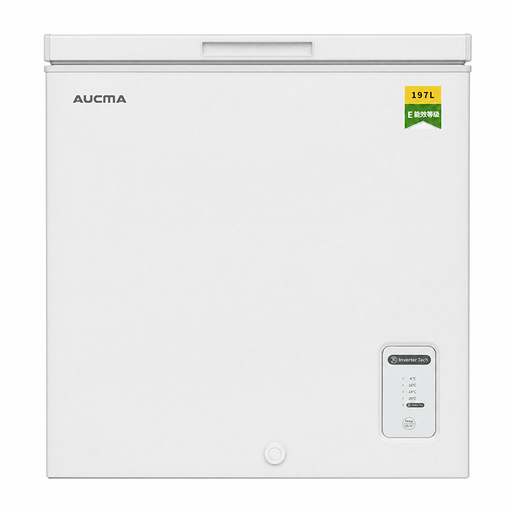
AUCMA convertible chest freezer, 197 L

AUCMA convertible chest freezer, 197 L

This chest freezer is suited to households looking for extra room for bulky packs. The product title lists a capacity of 197 L, a removable basket, an energy efficiency class of E and a choice of fridge or freezer modes. Check the climate class for the room you plan to use it in, the clearance needed to open the lid and the stated storage time in the event of a power cut, if that matters to you.

View on Joybuy

CHiQ JR99DWE chest freezer, 99 L

CHiQ JR99DWE chest freezer, 99 L

This 99 L chest freezer is suited to providing extra storage rather than storing large quantities of meals. The product title lists a removable basket, a sliding lid, 4-star freezing and an energy efficiency class of E. Allow enough room to open the lid, and check the model’s climate class and annual energy consumption.

View on Joybuy

TCL CF182EWE0FR chest freezer, 140 L

TCL CF182EWE0FR chest freezer, 140 L

This 140 L chest freezer provides extra capacity and includes a basket to keep some items within easy reach. The product title lists a counterbalanced lid, adjustable feet and an energy efficiency class of E. Measure the space and allow clearance for the lid to open. Also check the climate class and the energy consumption and defrosting information for this model.

View on Joybuy

COMFEE' RCU60WH2(E) compact upright freezer, 60 L

COMFEE' RCU60WH2(E) upright freezer, 60 L

This 60 L upright model may suit you if you’re mainly looking for a compact freezer to provide extra capacity. The product title lists a reversible door and an energy efficiency class of E. Check the internal layout before counting on three drawers: the title and descriptions show different configurations. Also check the dimensions of the space, the climate class and the annual energy consumption.

View on Joybuy

Heinrich´s upright freezer, 161 L, No Frost

Heinrich´s upright freezer, 161 L, No Frost

This upright freezer is for those who prefer to organise food in drawers rather than a chest freezer. The product title lists a capacity of 161 L, No Frost technology, three freezer drawers and an energy efficiency class of C. Check its dimensions against your available space, as well as its climate class, annual energy consumption and stated storage time in the event of a power cut.

View on Joybuy

Frequently asked questions

Can I put a freezer in a garage, cellar or conservatory?

Yes, as long as the room’s temperature stays within the range specified for the model’s climate class. For example, Liebherr lists a range of +10 °C to +32 °C for climate class SN and +16 °C to +32 °C for class N. Check the class shown on the product information or rating plate for the appliance you’re considering, then compare it with the actual temperatures in your room.

How do I compare storage times in the event of a power cut?

Compare the stated number of hours for each model, rather than assuming that all appliances in a particular format have the same storage time. Whirlpool France lists 32 hours for the WHM4612 chest freezer, while Electrolux France lists 10 hours for the KUN7NE18S integrated freezer. Take into account the conditions associated with each figure and, where available, independent test results.

Do No Frost, LowFrost and StopFrost mean the same thing?

No. Manufacturers’ product information distinguishes No Frost from LowFrost and StopFrost systems, which are described as reducing frost build-up or making defrosting less frequent. Check the model’s manual to find out what maintenance it needs; the technology name alone isn’t enough to compare energy consumption.

Which energy details should I check before choosing?

Look at the stated annual energy consumption in kWh/year alongside the freezer capacity, then compare appliances that meet similar needs. The energy label helps you find these figures. For models covered by energy labelling, you can also look up their registered information in the European Commission’s EPREL database.