A separate freezer is worth considering if your fridge freezer’s compartment isn’t big enough for your storage needs. A chest freezer is well suited to bulky items, while an upright model makes it easier to organise food and access it frequently. If space is limited, or you’re also looking to replace your fridge, compare a compact freezer with a fridge freezer instead. Check each model’s freezer capacity, dimensions, energy consumption and installation requirements.
Who are these formats suitable for?
The amount of food you need to store isn’t the only factor when choosing a format. Think about the space available and how often you need to find something, too.
Households that stock up in bulk
If you buy in bulk, cook ahead or store bulky items, compare the usable capacity of a chest freezer with that of a large upright model. How easy it is to access your food, and the stated power-cut storage time, could help you choose between two models with the right capacity.
Households that regularly use frozen food
To find food quickly, look at how the drawers, shelves or baskets are arranged. An upright freezer makes it easier to keep foods separate, but check that its capacity meets your storage needs.
Households with limited space
Whether it’s going under a worktop, in an alcove, cellar or garage, measure the available space and check how much room you have to open the door before choosing. The ambient temperature must also be within the conditions specified for the model. You can’t assume that an appliance is suitable for an unheated room just because of its format.
What should you compare before choosing?
First decide whether you need an additional appliance or a fridge freezer, then compare the capacity and installation requirements of the models you’re considering.
| Priority |
What to check |
Your needs |
| Format and capacity |
Compare the usable freezer capacity in litres, not just the total capacity of a fridge freezer. Consider the space available for bulky items as well as the room the appliance itself will take up. |
I want to increase my storage capacity. If my fridge freezer’s compartment is too small, I should compare a separate chest or upright freezer. A compact model may be enough if I only need a little extra space. |
| Access and maintenance |
Look at how the drawers, shelves or baskets are arranged, and how easy it is to reach food at the bottom of a chest freezer. Check whether the freezer compartment in the model you’re considering is No Frost or needs to be defrosted manually. |
I often take food out of the freezer and want to find it by category, without having to move items stored on top. |
| Installation |
Measure the appliance, the delivery route and the space needed to open the door or lid. For a built-in model, check the niche dimensions, hinges and ventilation requirements in the installation instructions. |
My kitchen or niche has a specific space for the appliance. The stated capacity is no use to me if the door can’t open properly. |
| Temperature and power cuts |
Compare the room temperature with the model’s climate class and specified operating conditions. Check its stated power-cut storage time in hours, and don’t assume this figure applies to every model in that format. |
If I’m putting it in a cellar or garage, I need to confirm the appliance is suitable for the actual temperatures in that space. If power cuts are a concern, I should compare the stated storage times for the models I’m considering. |
| Energy consumption |
Compare the energy label, kWh/year and usable capacity of the appliances you’re considering. ADEME recommends using the energy label as a guide; the European EPREL database provides declared information for the appliances it covers. |
As the appliance runs continuously, I’d rather compare its stated annual energy consumption than rely on a general promise of savings. |
What mistakes should you avoid?
-
Assuming any freezer will work in a garage
A climate class indicates the ambient temperature range an appliance is designed for, as Bosch explains. A feature designed for cold rooms only applies to the models for which the manufacturer specifies it.
Check the minimum and maximum temperatures in the room, then look at the appliance’s rating plate and manual. Confirm that the model is suitable for the location before installing it there.
-
Choosing a chest freezer based on capacity alone
A chest freezer can hold bulky items, but you need enough room to open the lid and reach food at the bottom. An upright model with drawers may be more convenient if you often take out small amounts.
Measure the floor space and the clearance needed to open the lid. Check whether baskets are included, and compare access with an upright model based on how you’ll use it day to day.
-
Assuming a built-in model will fit a niche based on its height alone
The niche, hinges and airflow matter just as much as the appliance’s front-facing dimensions. For example, Electrolux specifies an 880 mm niche for its LUB3AE88S freezer. This measurement doesn’t apply to other models.
Compare all the niche dimensions with the installation diagram for the product you’ve chosen. Also check the fixings, door opening direction and ventilation requirements in the manual.
-
Comparing energy consumption based on a general promise of savings
Two appliances with different capacities won’t necessarily meet the same storage needs. The energy label rating on its own doesn’t replace the annual consumption figure for each model.
Check the energy rating, kWh/year and usable capacity of your shortlisted appliances. If the model number or QR code allows, you can also look up the product information in EPREL, the European product database.
What can you learn from the brands?
These examples show features to compare on specific models; they don’t mean that every model in a brand’s range offers the same options.
Whirlpool
Whirlpool offers chest and upright freezers in a range of capacities in France.
- Whirlpool states that its W3RHS19DW chest freezer has a capacity of 198 L and a 41 h power-cut storage time. This model also features Freezer Guard, allowing it to operate down to −15 °C.
- According to Whirlpool, the WHFF6403W4E upright freezer has a capacity of 404 L, six drawers and an 11 h power-cut storage time. Compare the dimensions and specifications of your chosen model: those for the chest freezer don’t apply to the upright model.
Bosch
Bosch offers upright freezers as well as fridge freezers with freezer capacities suited to different needs.
- Bosch states that its GSN58AWCV upright freezer has a capacity of 366 L, a noise level of 38 dB(A) and a 13 h power-cut storage time.
- The KGN36NWEA fridge freezer is listed with 216 L of fridge capacity and 89 L of freezer capacity. To choose between the two, compare the space available for frozen food and check the installation requirements for each model separately.
Electrolux
Electrolux offers compact built-in freezers for kitchens where the available space is determined by a niche.
- Electrolux’s product information for the LUB3AE88S specifies a capacity of 98 L, a niche height of 880 mm and a stated power-cut storage time of 12,7 h.
- For this model, as with any other built-in freezer, meeting the niche dimensions doesn’t remove the need to follow the installation diagram and ventilation instructions.
Beko
Some Beko chest freezers have a feature designed for use in unheated rooms.
- According to Beko, Freezer Guard allows the relevant models to operate down to −15 °C in an unheated room.
- This doesn’t automatically apply to every Beko chest freezer. Check the product information for the exact model and follow its installation instructions.
Which appliances should you look at on Joybuy?
This selection includes two fridge freezers for households that also need a fridge, as well as a chest freezer, a compact upright freezer and an upright model for separate freezer storage. Compare the capacity available for frozen food and the space required for each option.
 Image unavailable
CHiQ JR263LGE, 262 L Low Frost fridge freezer
Worth considering if you want a single appliance for both refrigeration and freezing, measuring 54 cm wide, rather than adding a separate freezer.
The model name indicates a 70/30 split and a height of 176 cm. Before choosing it for your storage needs, check the capacity of the freezer compartment, the clearance required and the defrosting arrangements.
View on Joybuy
 Image unavailable
Haier HTW5618ENMG, 360 L three-door fridge freezer
This fridge freezer is suited to households looking to update both their fridge and freezer space without adding a second appliance.
The model name indicates Total No Frost and an E energy rating. The 360 L refers to the fridge freezer’s total capacity: check the freezer capacity separately, along with the dimensions and clearance required.
View on Joybuy
 Image unavailable
CHiQ JR99DWE, 99 L chest freezer
This chest freezer is worth considering if you want extra freezer space without immediately opting for a large upright model.
The product name indicates an adjustable thermostat, removable basket, sliding lid and E energy rating. Check how much room you’ll need to open the lid, as well as the exact model’s climate class, power-cut storage time and kWh/year.
View on Joybuy
 Image unavailable
COMFEE' RCU60WH2(E), 60 L upright freezer
Its compact upright design could provide extra storage in a kitchen where space is limited.
The product name indicates a reversible door and an E energy rating. Before buying, check the internal layout, dimensions and door clearance, as well as the climate class and annual energy consumption.
View on Joybuy
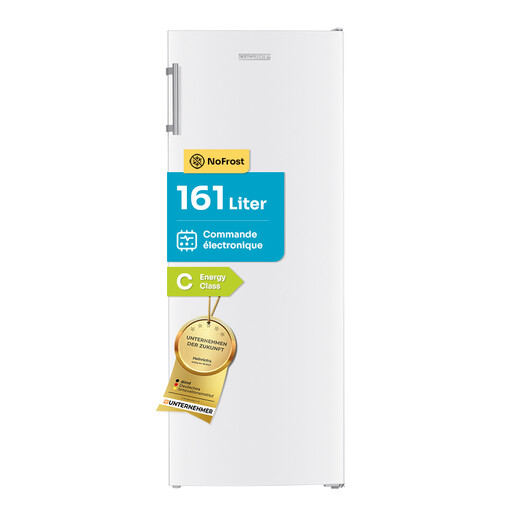 Image unavailable
Heinrich´s, 161 L No Frost upright freezer
This upright freezer is worth considering if you want separate freezer storage that’s easy to access through a front-opening door.
The product name indicates No Frost, an LED display and a C energy rating. Measure the space and check the model’s dimensions and clearance, kWh/year, climate class and stated power-cut storage time.
View on Joybuy
Frequently asked questions
Can you install a freezer in a garage or cellar?
Yes, provided the actual temperature in the room is within the operating conditions specified for the model you’ve chosen. Check its climate class on the rating plate and in the manual. A feature designed for cold rooms on some models doesn’t mean that every freezer is suitable for a garage.
Is the energy rating letter enough to compare two appliances?
No. Also compare the kWh/year and usable capacity of the exact model, distinguishing the freezer capacity from the total capacity of a fridge freezer. The European EPREL database may provide declared product information if you have the relevant model number or QR code.
Do all freezers need the same amount of ventilation space?
No. Electrolux says that the ventilation requirements are set out in the appliance’s manual or installation guide. Check the instructions for the model you’re considering, and make sure there’s enough room to open the door or lid. For a built-in model, check the niche diagram too.
Will a No Frost upright freezer always be a suitable replacement for a chest freezer?
No. An upright freezer with drawers can make it easier to organise food and access it frequently, while a chest freezer may be better suited to bulky items. Compare the usable capacity, opening space, maintenance and stated power-cut storage time of specific models rather than deciding on format alone.


