Families stocking up in bulk
If you want to store food in bulk, meals prepared in advance or larger items, compare the space offered by a chest freezer with the more direct access to food in an upright model.


If your fridge’s freezer compartment no longer has enough room for the food you want to store, choose a separate freezer based on how much you need to store and how often you’ll access it. A chest freezer is ideal for larger quantities, while an upright model makes it easier to sort food into drawers. A small model is better suited to providing extra capacity. If you also need to replace your fridge, compare the freezer capacity of a large fridge freezer before planning for two appliances. Whatever you choose, measure the space and check the permitted ambient temperature range for the room.
If you want to store food in bulk, meals prepared in advance or larger items, compare the space offered by a chest freezer with the more direct access to food in an upright model.
If you regularly sort and find food by category, the drawers in an upright freezer may matter more than having a large chest.
Whether you’re placing it in a kitchen, under a worktop, in a cellar or in a garage, check the dimensions, door or lid clearance, and permitted ambient temperatures for the model you’re considering.
Start by working out how much freezer space you need, then check that your chosen format will be easy to access and can operate in the room where you plan to put it.
| What to consider | What to check | What I need |
|---|---|---|
| Freezer capacity | Compare the freezer’s net capacity, not the total capacity of a fridge freezer. If you regularly freeze fresh food in bulk, also check the stated freezing capacity in kg/24 h. | I want to know whether an additional freezer will be enough or whether I need a separate appliance for my supplies. According to Que Choisir, large chest freezers can hold up to 600 L and large upright freezers up to 400 L. These are upper limits for each format, not the capacity of every model. |
| Access to food | Look at the drawers, removable compartments or baskets, and consider how easy it is to reach food at the bottom. Check there’s enough room to open the appliance in front of it or above the chest. | If I use my frozen supplies often, I’d rather be able to organise them and quickly find what I need. |
| Space and room temperature | Measure the height, width and depth, the delivery route and the clearance needed to open the appliance. Check that the room’s minimum and maximum temperatures fall within the range permitted for the exact model. | I need to be able to open the appliance fully without obstructing the way, including if it’s installed in an unheated cellar or garage. |
| Energy use and maintenance | Compare the energy rating and kWh/year for appliances with a similar capacity and format. If defrosting is a concern, check the cooling system for each model rather than assuming its energy use based on the No Frost label alone. | I’m looking for an appliance whose annual energy use and maintenance requirements I can compare before choosing. |
| Power cuts | Check the stated storage time in hours for the exact model, and consider how much food you’ll be storing. | If I store a lot of food, I want to know how long the freezer is stated to keep it frozen during a power cut. |
Food at the bottom of a deep chest can be harder to reach, while drawers aren’t practical if there isn’t enough room to open them.
Measure the space, delivery route and clearance needed for the lid or drawers before comparing capacities.
Permitted temperatures vary by model. The EPREL information for one Whirlpool model, for example, gives a minimum ambient temperature of 10 °C, while Beko says the RFNE290L41WN can operate down to -15 °C. This doesn’t apply to all its appliances.
Check the room’s winter and summer temperatures, then make sure they fall within the range specified for the model you’re considering.
The letter alone doesn’t tell you the annual energy use or the available freezer capacity.
Compare the kWh/year, net capacity and other useful features across models with a similar format.
The stated storage time varies by model. In a large chest freezer, food piled up without any organisation can also be difficult to find.
Check the stated storage time in the event of a power cut. Use baskets or containers and date labels to keep your supplies organised.
These examples highlight features to compare on specific models; they aren’t necessarily available across an entire range.
Worth considering if you’re looking for a No Frost upright freezer or a model designed for an unheated room.
Worth considering if you’re looking for an upright freezer with well-organised storage and, depending on the model, door alarms.
Worth considering if you’re looking for a high-capacity chest freezer or a freestanding upright model.
This selection includes chest freezers, an upright freezer and fridge freezers. To decide between a separate appliance and a fridge freezer, first compare the space available for frozen food, then consider the requirements of your chosen location.
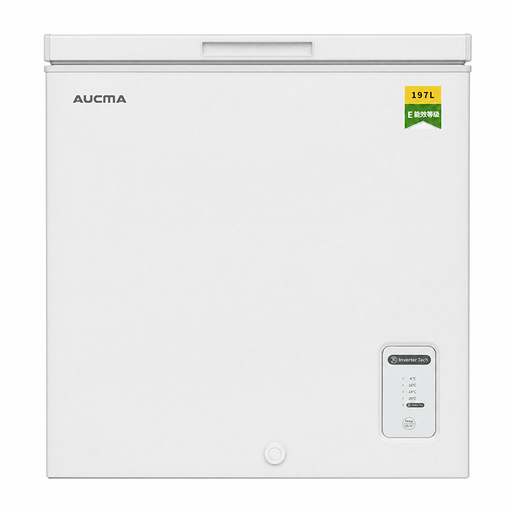 Image unavailable
Consider this separate chest freezer if you’re looking for more room for your frozen supplies. The product name lists a capacity of 197 L, a switch between refrigeration and freezing, five temperature settings, a removable basket, a defrost drain and an E energy rating. If you’re planning to put it in a cellar or garage, check the permitted ambient temperature range. Also compare the storage time during a power cut and the capacity in kg/24 h if these matter for your needs.
 Image unavailable
This three-door fridge freezer is an option if you’re replacing your fridge as well. The product name lists a total capacity of 360 L, Total No Frost, an E energy rating, Wi-Fi and My Zone. Before choosing it to increase your freezer space, compare the capacity of the freezer compartment alone with your needs, and check the room’s ambient temperature range.
 Image unavailable
This four-door model gives you the option of one appliance for both fresh and frozen food. The product name lists a total capacity of 467 L, Total No Frost and an E energy rating. This total capacity doesn’t represent the freezer space alone, so check that as well as the door clearance and permitted ambient temperature range before making your decision.
 Image unavailable
Consider this upright freezer if you’d rather organise food in drawers than in a chest. The product name lists a capacity of 161 L, No Frost, three drawers, a reversible door and a C energy rating. The stated temperature range of -14 °C to -22 °C refers to the appliance, not the permitted ambient temperature. Check the latter, along with the dimensions, kWh/year and storage time during a power cut.
 Image unavailable
With a capacity of 99 L listed in its name, this chest freezer is better suited to providing extra space than storing large quantities of food for a family. It has a removable basket, a sliding lid, an adjustable thermostat and an E energy rating. Check the dimensions and permitted ambient temperature range for the space you have in mind, as well as the kWh/year and storage time if you’re comparing several models.
A fridge freezer may be enough if its freezer compartment can hold everything you need to store. For larger quantities, compare it with a separate appliance. Que Choisir says that large chest freezers can hold up to 600 L and large upright freezers up to 400 L. Check the net capacity of the model you’re considering, not just its total capacity.
Choose a model whose permitted ambient temperature range covers the room’s minimum and maximum temperatures. The EPREL information for one Whirlpool model gives a minimum of 10 °C, while Beko says the RFNE290L41WN can operate down to -15 °C. Neither specification applies to all freezers.
Compare the energy rating and, above all, the kWh/year for freezers with a similar capacity and format. Check the net capacity too: the annual energy use on its own won’t tell you how much food the appliance can hold.
It tells you how long the manufacturer states a model will keep food frozen during a power cut. Bosch and Hisense list storage times of 14 hours for the GSN36AICM and 47 hours for the HCF500D4AWLYE respectively. Compare this figure for the models you’re interested in, especially if you store a lot of food.
No. It may be worth considering if you want to reduce frost build-up, as Beko says it can on some models, but it doesn’t replace comparing capacity, kWh/year and storage time. Check the technology and these specifications for each model.