Households that freeze prepared portions
If you often take out meals or bags of food, an upright freezer with drawers makes it easy to separate different items and access them from the front. Check the drawer dimensions if you store bulky portions.


For bulky items you access less often, compare chest freezers; if you regularly take out portions, an upright freezer with drawers is more convenient. A compact model is better suited to extra freezer space, while a larger fridge freezer is worth considering if your fridge is also short on space or needs replacing. Before choosing, measure the space and check that the model’s climate class is suitable for the room’s temperatures.
If you often take out meals or bags of food, an upright freezer with drawers makes it easy to separate different items and access them from the front. Check the drawer dimensions if you store bulky portions.
A chest freezer can store food that would be difficult to fit into drawers. Plan to use baskets or organise the contents: Darty points out that items at the bottom of a chest freezer can become harder to reach.
Check the room’s minimum and maximum temperatures before choosing a model. The climate class shows the ambient temperature range the appliance is designed to operate in; a ‘garage’ label in a product name is no substitute for checking this.
Start by considering the type of storage you need and how often you’ll access it, then compare the stated capacity with the practicalities of installation.
Consider if: you store bulky items or larger quantities that you access less often.
Bear in mind: food at the bottom of a deep freezer needs more organisation to keep it accessible, as Darty points out.
Consider if: you want to organise portions and take them out regularly from the front.
Bear in mind: drawer sizes may limit how you store very bulky food.
Consider if: you need extra freezer space and have limited room.
Check: freezer capacity and the dimensions of the space may limit how much extra food you can store.
Consider if: your fridge is also too small or needs replacing.
Check: the freezer capacity, which is separate from the fridge freezer’s total capacity.
| Feature | What to check | What I need |
|---|---|---|
| Freezing capacity | Compare freezer capacity in litres, not just the total capacity of a fridge freezer. If you regularly add a lot of food to freeze, also check the freezing capacity in kg/24 h. | I want to know whether the extra space will fit the quantities I usually store, rather than choosing based on external dimensions alone. |
| Access and storage | Check the size of the drawers in an upright freezer, or the baskets in a chest freezer. Only consider a flexible storage area if it’s included with the model you’re looking at. | If I take out portions often, I want to find them without moving the whole stock; for bulky items, I’d prefer a space that fits their shape. |
| Location | Measure the appliance, the route to its location and the clearance required in the manual. Compare the room’s temperature extremes with the model’s climate class. | My freezer needs to fit in its space and be suitable for the room’s temperature, especially in a garage or cellar. |
| Energy use and noise | On the EU energy label described by the European Commission, check the A to G rating, annual energy consumption in kWh, capacity and noise level together. Ideally, compare appliances with similar capacities and intended uses. | If the appliance is near a living space, its noise level also matters to me. |
| Maintenance | Check the cooling system and defrosting instructions for the model. According to Electrolux, No Frost helps limit ice build-up; you should still follow the manual. | I want to know what maintenance the appliance I’m going to use requires, without assuming that all cooling systems work in the same way. |
According to Darty, food at the bottom of a chest freezer becomes harder to reach as the freezer fills up.
Use baskets for smaller items and organise your food so you can find older stock. If you take out portions very often, compare an upright freezer with drawers too.
A climate class indicates a range of ambient temperatures; it doesn’t guarantee that an appliance will be suitable for every unheated space.
Check the room’s seasonal temperatures and the climate class of the exact model. Beko states that its Freezer Guard range is suitable for low temperatures, but this does not apply to all its freezers.
The rating on its own doesn’t tell you how much freezer space the appliance offers. The European Commission says the label also shows energy consumption, capacity and noise level.
Check the kWh/year alongside freezer capacity in litres, and compare appliances that meet similar storage needs.
These range and model examples can help you compare features; the features mentioned aren’t available on every appliance from each brand.
Its upright freezers include models designed for storage in drawers and flexible compartments.
The brand offers both upright freezers and fridge freezers.
Its built-in freezers offer a useful comparison if you’re limited by the dimensions of a cabinet space.
Its information about climate classes is useful if the temperature in your chosen location varies considerably.
This selection includes chest freezers in different capacities and sizes, as well as an upright model for organising portions that are easy to reach from the front. Compare their stated capacity, storage options and suitability for your chosen location.
 Image unavailable
A chest freezer to consider for bulky items, with a removable basket for separating certain foods. The model is advertised as convertible between fridge and freezer modes, with five temperature settings and an E energy rating; check its capacity in freezer mode and its climate class for your room.
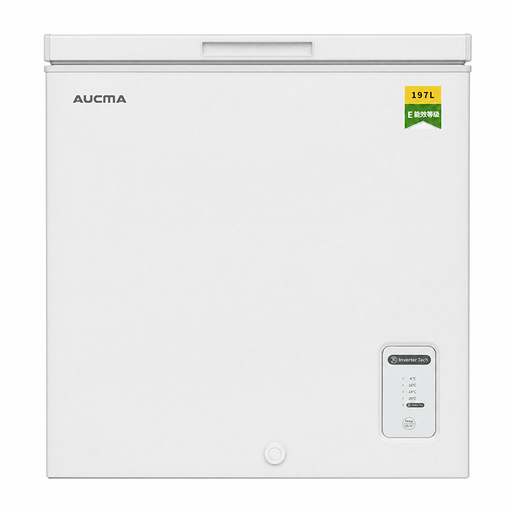 Image unavailable
This chest freezer has a removable basket to keep smaller items separate from the rest of your food. The product title lists a capacity of 197 L, a switch between fridge and freezer modes, five temperature settings and an E energy rating; check its capacity in freezer mode and its climate class before choosing where to put it.
 Image unavailable
An upright design with drawers suits households that want to store portions separately and take them out regularly. The product title lists a capacity of 161 L, No Frost, an alarm and a C energy rating; check the interior layout, dimensions and climate class of this version.
 Image unavailable
Worth comparing if you want extra chest freezer space without opting for one of the largest models featured here. The product title lists a basket, counterbalanced lid, temperature control and an E energy rating; check the climate class for the room you have in mind.
 Image unavailable
This 99 L chest freezer is better suited to adding extra storage than keeping large quantities of family food. The product title mentions a removable basket, adjustable thermostat and an E energy rating; also check the defrosting instructions and the model’s climate class.
Compare the A to G rating, annual energy consumption in kWh, storage capacity and noise level. The European Commission says these details appear on the energy label for household fridges and freezers; when comparing two freezers, also consider how much capacity you need.
Yes, provided the model’s specified ambient temperature range covers the temperatures in that space. Beko and Bosch state that an SN-T climate class corresponds to a range of 10 to 43 °C; if the room gets colder, look for a model that is explicitly suitable for the conditions.
No. According to Electrolux, No Frost helps limit ice build-up, but you should still follow the maintenance instructions in the model’s manual. If your appliance needs manual defrosting, follow the procedure specified by the manufacturer.