Households that freeze food in bulk
If you buy in bulk, cook ahead or store bulky food, first work out the usable capacity you need and how much room you have for the appliance.


If your fridge-freezer compartment is no longer big enough, choose a chest freezer if you have lots of bulky food and enough room to install it. An upright freezer is a better fit if you often need to access a varied selection and want to organise it in drawers. A table-top or under-counter model is best for limited extra storage. Whatever the format, check the usable capacity, how it opens, the permitted ambient temperature range and the model’s power-cut storage time.
If you buy in bulk, cook ahead or store bulky food, first work out the usable capacity you need and how much room you have for the appliance.
If you need to find a variety of portions every day, look at how easy it is to access the drawers or baskets and check what’s inside.
If you plan to keep the freezer in a cellar, utility room or garage, compare the room’s temperatures with the operating range stated for the exact model.
If your fridge-freezer is too small, start by checking the available capacity and space. Then choose a format based on how you prefer to access your food.
Consider it if: you need room for large packs and prioritise capacity, with enough floor space and clearance above the lid.
The trade-off: finding food stored at the bottom takes more organisation than it does in a freezer with drawers.
Consider it if: you often open the appliance to choose from different portions or categories of food.
The trade-off: the drawers need room to pull out and must be large enough for your bulkiest packs.
Consider it if: space is limited, so you need a small appliance and only a little extra storage.
The trade-off: check that the usable capacity will genuinely be enough if you want to store large quantities.
| What matters | What to check | Who it’s for |
|---|---|---|
| Capacity and space | Compare the usable capacity in litres, then measure the appliance, access routes and clearance needed to open it. | When my fridge-freezer overflows after a bulk shop, I want more room without blocking the way through my utility room; around 27% of consumers prioritise capacity and space. |
| Access and storage | Check the layout of the drawers or baskets and how easy it is to reach food stored at the bottom. | If I often take out small portions, I want to find them without moving the whole stock; access and organisation come first for around 33% of consumers. |
| Room temperature | Compare the room’s minimum and maximum temperatures with the range permitted in the model’s manual. | If I’m installing the appliance in an unheated cellar or garage, I need to know whether it will work at that room’s temperatures; around 20% of consumers prioritise this compatibility. |
| Power cuts and large batches | Compare the power-cut storage time in hours and the freezing capacity in kg/24 h. | After preparing a large batch of meals, I want to know how much food the appliance can freeze and how long it will keep going without power; around 20% of consumers prioritise these features. |
A large chest freezer takes up floor space and needs room for its lid to open. An upright freezer needs space for the door to open and the drawers to slide out.
Also measure the access routes to the intended spot and check you’ll be able to reach everything once the appliance is in place.
A feature designed for use in a cold room applies to specific models, not every freezer from the same brand or in the same format.
Track the room temperature throughout the year and compare it with the product details and manual for the model you’ve chosen.
The open space in a chest freezer can take bulky packs, while the drawers in an upright model make it easier to sort different foods.
Before choosing the interior layout, picture where your large bags and everyday portions will go.
The energy rating tells you nothing about access to the contents, storage time during a power cut or the permitted ambient temperature.
Check the technical details and manual for the exact model to compare these features too.
The range includes upright freezers worth considering if you want drawers and dedicated storage capacity.
The range includes chest and upright freezers, with frost-related features or suitability for cold rooms depending on the model.
The brand’s chest freezers are worth considering for horizontal storage. Check the features of each model individually.
These models include an upright freezer for organising food in drawers and three chest freezers for extra storage. If you need to store very large quantities, check that the capacity of your chosen model matches how much food you need to keep.
 Image unavailable
Consider this model if you’d rather organise portions in an upright freezer than stack them in a chest freezer. The model name specifies 161 L, three drawers, a reversible hinged door and an energy rating of C. Check that the capacity is enough for your stock, as well as the dimensions, ambient temperature range and storage time before installation.
 Image unavailable
This chest freezer is suited to extra storage rather than very large quantities. The model name specifies 99 L, a removable basket, an adjustable thermostat and an energy rating of E. Before placing it in a cellar or garage, check the permitted ambient temperature range and the storage time for this model.
 Image unavailable
This model gives you a separate space for frozen food, so check that it suits the size of your stock. The model name specifies 140 L, a counterbalanced lid and an energy rating of E. If the basket matters to you, confirm what’s included in the box, then check the clearance needed to open the lid, the ambient temperature range and the storage time.
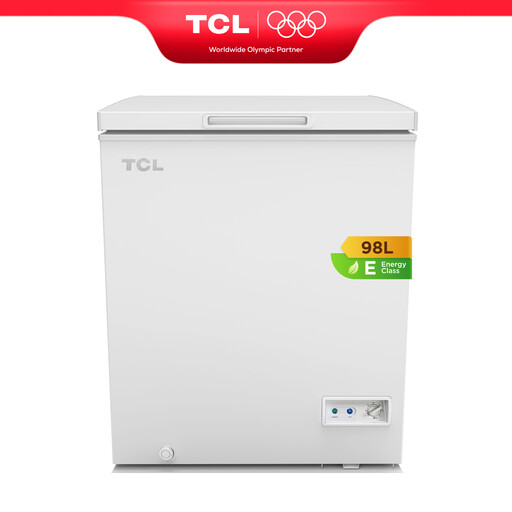 Image unavailable
This chest freezer is worth considering for a little extra storage, but not if your priority is a very large capacity. The model name specifies 98 L, a storage basket, a counterbalanced lid and an energy rating of E. Measure the space and clearance needed for the lid, and check the ambient temperature range and storage time for this model too.
No. A chest freezer is best when you need space for bulky food, while an upright model makes it easier to access food organised in drawers. Que Choisir says some chest freezers have a capacity of up to 600 L. However, compare the usable capacity of models that will actually fit in your home.
No. Compare the garage’s minimum and maximum temperatures with the range specified in the manual for your chosen model. Manufacturers such as Beko state that certain models can operate down to -15 °C, but this limit doesn’t apply to all their freezers.
Compare their ratings on the same scale, then look separately at the features that matter for your installation and the amount of food you need to store. The European Commission states that the A to G scale has applied to the refrigerators and freezers concerned since 1 March 2021. The rating alone doesn’t tell you how long food will stay frozen during a power cut.
Compare each model’s stated storage time during a power cut, in hours, and check whether it has a temperature alarm. Que Choisir’s testing protocol measures how long it takes for the temperature to rise from -17 °C to -9 °C without power. So don’t assume the storage time based on capacity or energy rating alone.
No. No Frost refers to frost management on models with this feature. You’ll still need to follow the manual’s cleaning instructions, check the condition of the door seals and store food without stopping the door from closing properly.