Priorities before buying
Start by estimating the volume you genuinely need to store, then check everyday access, the installation space and the operating specifications of the exact model.
| Priority |
What to check |
Your needs |
| Usable capacity |
Compare the net volume in litres with the portions and bulk purchases you actually store. Also check the freezing capacity if you often add a large amount of fresh food at once. |
I want to handle busy periods without having a permanently oversized appliance that is almost empty. A chest freezer can offer a generous volume, while an upright freezer is often more compact. |
| Access and storage |
Look at the drawers, shelves, baskets and the door or lid opening arc. Measure the space, including the room needed to open it. |
I need to be able to identify and remove prepared dishes without moving the entire stock. Drawers make it easier to separate portions; a chest freezer often requires baskets, storage boxes or labels. |
| Energy use and noise |
Compare kWh/year, dB(A), the noise class, storage time during a power cut and freezing capacity between appliances of a similar volume and format. |
I am looking for extra storage that will not disturb a living area and whose energy use remains suitable for the way I use it. UFC-Que Choisir measures energy consumption, noise and cold retention as part of its testing protocol. |
| Installation space |
Check the climate class, the room’s actual temperatures and the specified ventilation clearances. Keep the appliance away from heat sources. |
My appliance needs to work in an alcove, pantry, cellar or garage. Compatibility depends on the model and ambient temperature, not simply on the type of room. |
Joybuy options
These Joybuy options include upright and chest freezers, giving you dedicated extra storage for prepared portions or bulk purchases.
 Image unavailable
Heinrich’s 161 L No Frost upright freezer
A vertical option for keeping frequently accessed portions separate.
161 L, three drawers, two shelves, No Frost system, Fast Freeze function, alarm and reversible door; stated temperature range from -14 °C to -22 °C. Check the dimensions, noise level, kWh/year, storage time and clearances before installation.
Joybuy
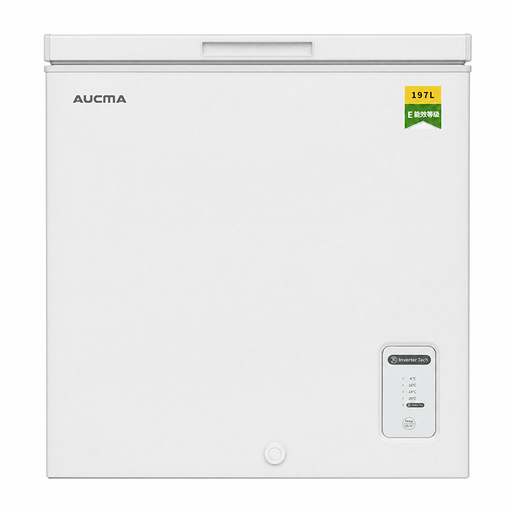 Image unavailable
AUCMA 197 L convertible chest freezer
Dedicated storage for bulk purchases and large quantities of prepared portions.
197 L, class E, 197 kWh/year, stated 38 dB, five-level digital control, removable basket and defrost drain. Allow at least 10 cm of clearance around the appliance and check its suitability for a cold room before installation.
Joybuy
 Image unavailable
AUCMA 95 L convertible chest freezer
Compact extra storage when your lack of capacity is moderate or occasional.
95 L, class E, 165 kWh/year, stated 38 dB, seven-level thermostat, removable basket and defrost drain. Measure your usual portion volume and check the climate class, ventilation and storage time before buying.
Joybuy
 Image unavailable
AUCMA 291 L convertible chest freezer
A format designed for households with a regular need for substantial extra storage.
291 L, class E, 226 kWh/year, stated 38 dB, LED lighting, five-level digital control, removable basket and defrost drain. Its dimensions of 1100 × 597 × 872 mm require a permanent floor space and at least 10 cm of ventilation around the appliance.
Joybuy
 Image unavailable
TCL CF182EWE0FR 140 L chest freezer
Mid-range capacity for supplementing an existing freezer without choosing a large chest model.
140 L, class E, storage basket, lid held between 40 and 75 degrees, castors, adjustable feet and mechanical thermostat. The stated dimensions are 637 × 556 × 846 mm; check kWh/year, noise, climate class and the required clearances.
Joybuy
Frequently asked questions
What temperature should you set a freezer to for home-cooked dishes?
For domestic freezing, Anses states that at -18 °C bacterial growth is halted, but most micro-organisms survive. Freeze food soon after buying or preparing it, thaw it in the fridge, in the microwave using the defrost setting or quickly during cooking, then eat it without refreezing it.
Is a chest freezer always suitable for bulk purchases?
No. A chest freezer offers flexible space for large packs and substantial volumes, but it takes up more floor space and food at the bottom is harder to reach. If you take out portions several times a week, an upright freezer with drawers may be more convenient, despite often having a lower maximum capacity.
Can any freezer be installed in a garage or cellar?
No. Compare the model’s climate class and ambient-temperature range with the temperatures actually recorded in the room. Some Beko chest freezers explicitly featuring Freezer Guard are advertised as operating down to -15 °C, but this feature does not apply to every freezer.
How much clearance should you leave around a spare freezer?
Always follow the model’s manual as your first point of reference. For its freestanding appliances, Whirlpool recommends 5 cm above and 10 cm behind to help heat escape, while also advising you to keep the appliance away from heat sources; other models may require different distances.


