Key buying criteria
Start by measuring the available space and deciding how you will store your food, then compare the specifications of the exact model rather than looking at the format alone.
| Priority |
What to check |
Your needs |
| Capacity and storage |
Compare the net capacity with the external dimensions, opening space and route into the room. Check the drawers, baskets and compartments; a chest freezer also requires practical access to the bottom of the compartment. |
I want to store provisions without having to move the entire stock to find a bag or portion. Drawers make organisation easier, while boxes can help structure a chest freezer. |
| Room temperature |
Measure the minimum and maximum temperatures in the cellar, garage or utility room. Check the climate class and, below 10 °C, the lowest temperature limit explicitly stated for the model. |
My appliance must work in the room where I can actually install it, including when it is very cold in winter or hot in summer. |
| Energy consumption, noise and power cuts |
Compare kWh/year, noise level in dB(A) and storage time during a power cut between appliances of a similar capacity and type. Check the energy label and, where available, the model data in EPREL. |
I am looking for an appliance that runs continuously without disturbing a living space and protects a large stock during a power cut. |
| Prepared portions |
For meals that you freeze regularly, check the drawers or boxes, fast-freeze function and usable capacity. Organise portions by type and date to make stock rotation easier. |
I want homemade meals ready to use on busy days. According to Observatoire Cetelem, 45% of working people surveyed by Harris Interactive in 2023 said they took their meal to their place of work; this indicator concerns homemade meals, not the purchase of freezers. |
Joybuy options
Joybuy options for comparing an upright freezer, several chest freezers with different capacities and a high-capacity fridge freezer, depending on the space available and the organisation you need.
 Image unavailable
Heinrich's 161 L upright freezer
An option worth considering for organising portions and food categories in a vertical format.
161 L, No Frost protection, three drawers, two shelves, LED display, alarm, reversible door, Fast Freeze function and energy-efficiency class C.
Check the storage time during a power cut, noise level, annual energy consumption and climate range before choosing where to install it.
Joybuy
 Image unavailable
AUCMA 291 L convertible chest freezer
This chest freezer is worth comparing if your household prioritises a substantial reserve of provisions or large cuts.
291 L, fridge or freezer operation, 226 kWh/year, 38 dB, LED lighting, five-level digital control, removable basket and defrost drain.
Frozen storage requires the appliance to be kept in freezer mode; plan to use boxes or labels to organise the compartment.
Joybuy
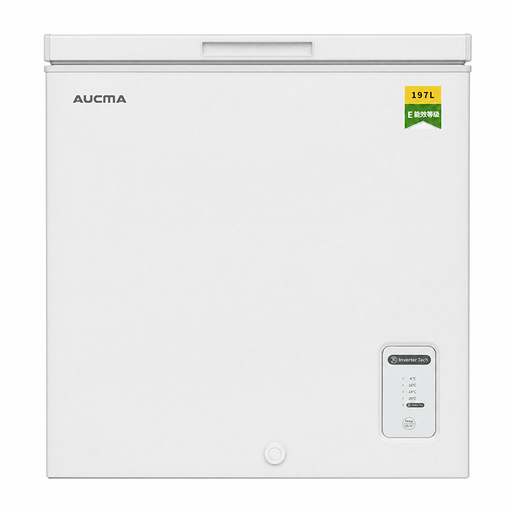 Image unavailable
AUCMA 197 L convertible chest freezer
An intermediate capacity for expanding your family’s reserves without moving up to a very large chest freezer.
197 L, fridge or freezer operation, 197 kWh/year, 38 dB, five-level digital control, removable basket, defrost drain and adjustable feet.
A single basket cannot replace drawers for precise organisation; also check the storage time during a power cut and climate range before installing it outside a temperature-controlled room.
Joybuy
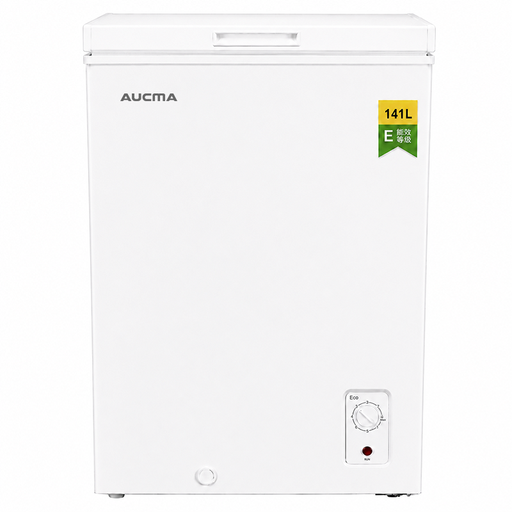 Image unavailable
AUCMA 141 L convertible chest freezer
A reserve format to consider when you need to keep the floor space it occupies to a minimum.
141 L, fridge or freezer operation, 179 kWh/year, 38 dB, 4-star freezing, seven-level thermostat, removable basket and defrost drain.
This capacity may be limited for very large quantities; check the storage time during a power cut and the room's climate compatibility.
Joybuy
 Image unavailable
Sonlu CC-520WE 444 L fridge freezer
Worth considering when replacing your main appliance if your additional frozen-food storage needs are moderate.
444 L total, Total No Frost, 289 kWh/year, 40 dB, LED lighting and SN-T climate class from 10 to 43 °C.
Check the freezer compartment capacity separately and do not install it in a room where the temperature falls below 10 °C.
Joybuy
Frequently asked questions
Which climate class do you need for a freezer installed in a garage or cellar?
First measure the actual minimum and maximum temperatures in the room. Beko states, in particular, that the SN-T range covers 10 to 43 °C: if the room falls below 10 °C, choose only a model whose manufacturer explicitly confirms that it can operate at this temperature. Some specialist models advertise a lower limit of -15 °C, but this is not a universal feature.
Does a chest freezer always keep food frozen for longer during a power cut?
No. Storage time depends on the model, load and measurement protocol, not simply on the format. UFC-Que Choisir defines it as the length of time food remains frozen during a power cut; therefore compare the stated storage time for the exact model.
How should you compare the energy consumption of two freezers?
Compare annual consumption in kWh/year and the energy-efficiency class between appliances with similar capacities, types and installation conditions. ADEME points out that freezers run continuously; the energy label and EPREL database can be used to check the model information.
Must the energy label be available when buying online in France?
Yes. The French Ministry of the Economy states that the energy label is compulsory for the relevant appliances sold in shops or online. Check that the manufacturer, reference, energy-efficiency class and annual consumption correspond to the model and its variant.
What precautions should you take with meals prepared for freezing?
The appliance format does not replace good hygiene or maintaining the cold chain. Anses points out that poor storage, a break in the cold chain or cross-contamination can increase microbiological risks; label portions and follow the food storage instructions.


